
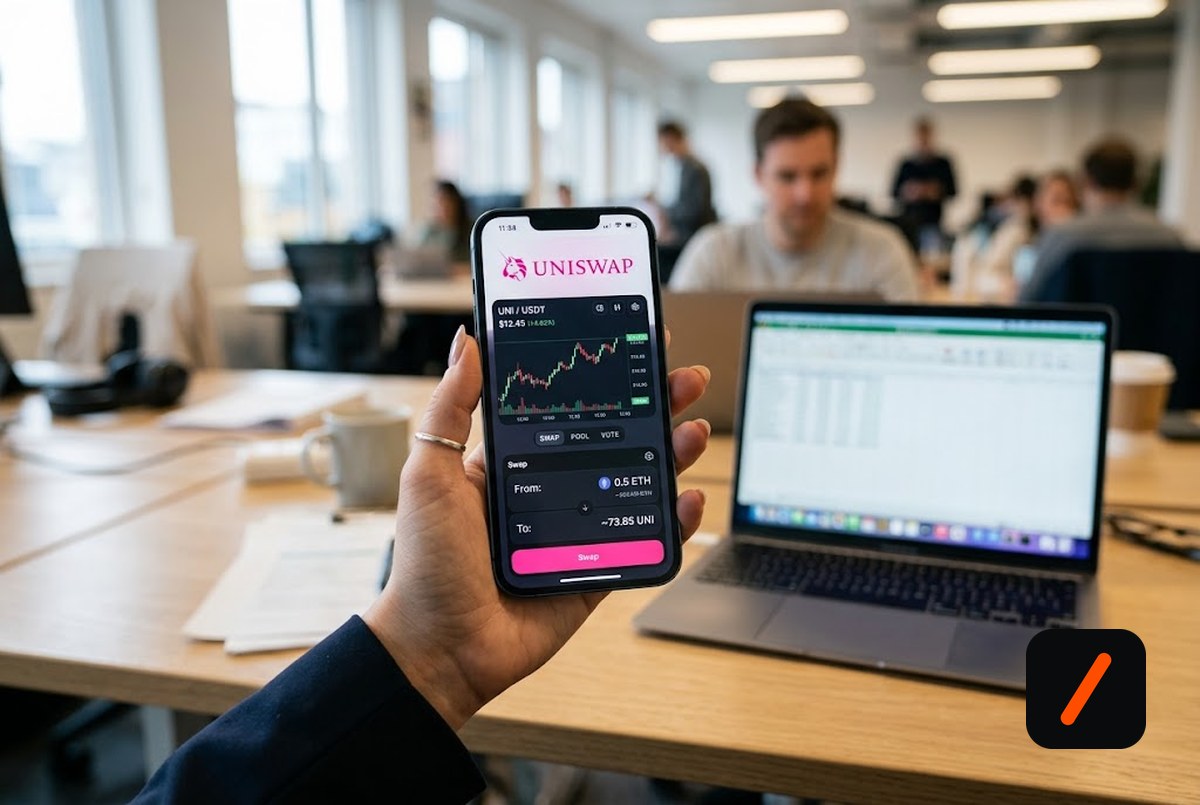
Robinhood, the app that brought commission-free stock trading to millions, has launched its own blockchain, and Uniswap is built into its core. Robinhood Chain, an Arbitrum-based Ethereum layer-2 network, went live with its public mainnet on July 1, 2026, focused on tokenized real-world assets and DeFi. Uniswap serves as the native automated market maker, providing the swap and liquidity infrastructure at the heart of the chain. It is one of the most direct bridges yet between a mainstream consumer broker and decentralized finance.
- Robinhood Chain, an Arbitrum-based Ethereum L2, launched its public mainnet on July 1, 2026.
- Uniswap is the native AMM, supplying the core swap and liquidity engine for the chain.
- The chain targets tokenized real-world assets and DeFi, not just crypto trading.
- It wires a mainstream broker directly into DeFi rails, a major step toward blurring the two worlds.
Why would a broker build its own blockchain?
Control and margin. When Robinhood routes trades through someone else's exchange or chain, it depends on that infrastructure and shares the economics. By running its own layer-2, Robinhood owns the rails its assets move on, sets the rules, captures the fees, and can offer products, like tokenized stocks and real-world assets that settle on-chain, that a traditional brokerage cannot. Building on Arbitrum rather than from scratch is the pragmatic choice: it inherits Ethereum's security and a proven scaling stack instead of bootstrapping a network and its validators alone. The result is a broker that is also a chain operator, vertically integrated from the consumer app all the way down to settlement.
RelatedAave in Talks to Sell Kraken 15% Stake at $385M
What does Uniswap get out of it?
Distribution to an audience DeFi has struggled to reach. Uniswap is the dominant decentralized exchange, but its users are overwhelmingly crypto-native people who already navigate wallets and gas fees. Being the native AMM on Robinhood Chain puts Uniswap's liquidity engine underneath a mainstream app used by people who may never have touched DeFi directly. Every swap on the chain can flow through Uniswap's infrastructure, extending its reach far beyond the usual crypto crowd. For a protocol whose value depends on volume and liquidity, becoming the default exchange layer for a major broker's chain is a powerful position, one that trades some of DeFi's permissionless ethos for enormous new reach.
| Layer | Robinhood Chain stack | Traditional brokerage |
|---|---|---|
| Front end | Robinhood app | Broker app |
| Settlement | On-chain, Arbitrum L2 | Clearinghouses, days |
| Exchange engine | Uniswap AMM | Market makers, exchanges |
| Assets | Tokenized RWAs, crypto | Stocks, ETFs, options |
| Hours | Always on | Market hours |
What are tokenized real-world assets, and why here?
They are on-chain representations of off-chain value: a token that tracks a stock, a fund, a treasury bill, or another traditional asset, tradable on a blockchain around the clock. Robinhood has been expanding access to tokenized securities tracking well-known companies through its interfaces, and a purpose-built chain is the natural home for them. The appeal is real: near-instant settlement instead of the multi-day wait in traditional markets, twenty-four-hour trading, and programmability that lets these assets plug into DeFi. The catch is regulatory. Tokenized securities sit in contested legal territory, and how regulators treat a broker issuing and trading them on its own chain is the single biggest question hanging over the whole project.
Is this DeFi or something else?
It is a hybrid, and the tension is the interesting part. Purists will note that a broker-owned, permissioned-feeling layer-2 with a corporate operator is a long way from DeFi's original vision of trustless, permissionless finance with no gatekeepers. Robinhood Chain is decentralized in its plumbing but centralized in its control, and that is precisely what makes it palatable to mainstream users and regulators. The optimistic read is that this is how DeFi actually reaches the masses: not by converting everyone into wallet-managing crypto natives, but by hiding the machinery inside apps people already trust. The pessimistic read is that it strips out the properties that made DeFi worth building. Both readings are correct, which is why this launch matters.
RelatedEthereum L2s Hit a 2-Year Low. ZK Rollups Are Empty.
- Regulatory response. How the SEC treats tokenized securities on a broker-run chain decides the ceiling for the whole model.
- Real volume. Watch whether mainstream users actually trade on-chain assets or stick to familiar stocks.
- Uniswap's cut. The economics of being the native AMM will show up in Uniswap's on-chain fee data.
- Copycats. If Robinhood Chain works, expect other brokers and fintechs to launch their own L2s.
Our take
Robinhood Chain is a landmark not because the technology is novel but because of who is deploying it. A mainstream broker with millions of ordinary users building its own Ethereum layer-2, with the leading decentralized exchange wired in as the settlement engine, is exactly the kind of bridge people have predicted for years and rarely seen at this scale. It also forces an honest reckoning with what DeFi becomes when it goes mainstream: more accessible, more regulated, and less pure, all at once. Uniswap gets reach it could never win on its own, and Robinhood gets a product traditional brokers cannot match. The decisive factor is regulation, and tokenized securities remain legally unsettled. But the direction is now unmistakable. The wall between DeFi and the apps normal people use is coming down, and this is one of the biggest bricks to fall.
Original analysis by GenZTech. Source: Robinhood. Figures current as of July 2026.