
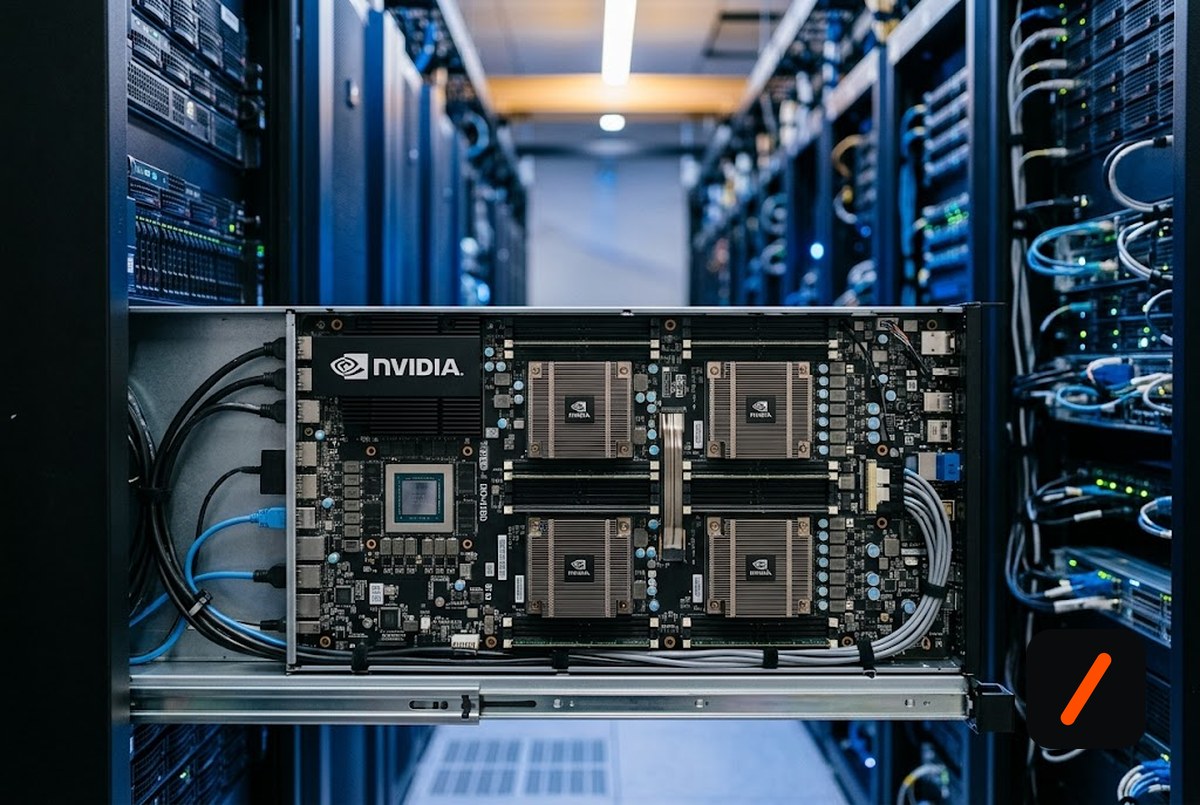
Nvidia used ISC High Performance 2026 to answer a complaint the scientific-computing world has voiced for two years: that the AI boom was hollowing out the double-precision math real science depends on. The new Vera Rubin platform, the successor to Blackwell, brings native FP64 performance back to the front of the roadmap while keeping the CUDA-X software stack and full-system design that made Nvidia unavoidable in AI. With 35 AI-HPC supercomputers already in development across Europe alone, Vera Rubin is Nvidia's bid to make one architecture serve both the AI cluster and the national lab.
- Vera Rubin is Nvidia's next platform after Blackwell, pairing a new Rubin GPU generation with the Arm-based Vera CPU.
- It restores native double-precision (FP64), the 64-bit math that climate, physics and engineering simulations require and that AI-tuned chips had de-emphasized.
- 35 Nvidia AI-HPC supercomputers are in development across Europe, a record pipeline that spans research and sovereign-AI projects.
- Nvidia also unveiled Halos for Robotics, a full-stack safety system for robots and physical AI, extending the platform beyond the data center.
Why does double-precision matter so much?
Because a lot of real science breaks without it. FP64, or 64-bit floating point, is the high-accuracy number format that climate models, computational fluid dynamics, structural engineering, molecular dynamics and astrophysics rely on to keep tiny rounding errors from compounding into garbage over billions of steps. AI, by contrast, thrives on low-precision math: 16-bit, 8-bit, even 4-bit formats that trade accuracy for speed and power. As Nvidia optimized its recent chips for AI, FP64 throughput stopped growing as fast, and the HPC community worried the world's dominant accelerator maker was drifting away from the workloads that built scientific computing. Vera Rubin's headline promise, restoring world-class native FP64, is Nvidia telling the national labs it is not abandoning them for the AI gold rush.
RelatedNvidia's Vera Rubin Brings Native FP64 Back to Science
What is actually new in Vera Rubin?
It is a platform, not just a chip, and that is the point. Vera Rubin pairs a next-generation Rubin GPU with the Arm-based Vera CPU, connected by NVLink so a whole rack behaves as a single accelerator, and wrapped in the CUDA-X software libraries that let the same code target AI and simulation. The design carries forward the FP4 low-precision tensor cores that make it a monster for AI while adding back the FP64 muscle for science. The strategic move is convergence: instead of selling one line of chips for AI clusters and a different approach for supercomputers, Nvidia is making a single architecture that a buyer can point at either job. For a research institution that wants to train models on Monday and run a fusion simulation on Tuesday, that is a compelling pitch.
| Platform | Vera Rubin | Blackwell (prev) | AI-only accelerators |
|---|---|---|---|
| CPU pairing | Vera (Arm) | Grace (Arm) | Varies |
| Native FP64 | World-class, restored | Reduced emphasis | Minimal |
| AI low-precision (FP4) | Yes | Yes | Yes |
| Software stack | CUDA-X full stack | CUDA-X | Fragmented |
| Target | AI + scientific HPC | Mostly AI | AI training |
Why 35 European supercomputers at once?
Because Europe decided it can no longer rent all of its compute from elsewhere. Nvidia says a record 35 AI-HPC supercomputers are in development across the continent, a number driven by two forces converging: the traditional demand from research institutions for simulation horsepower, and a newer, political demand for sovereign AI, national and regional systems that keep model training and sensitive data on domestic soil. Vera Rubin is well-timed for that wave because a single converged platform lets a government fund one machine that satisfies both the physicists and the AI ministry. It also deepens Nvidia's moat: every one of those systems is another installation locked into CUDA, the software layer that keeps switching costs high and rivals like AMD and the custom-silicon startups on the outside.
What does this mean for the competition?
It raises the bar on the axis rivals hoped to attack. AMD has been winning HPC design wins partly on strong FP64, and a raft of AI-chip startups pitch themselves as cheaper, more specialized alternatives to Nvidia's general-purpose parts. By restoring top-tier double precision inside a platform that already dominates AI and carries the CUDA lock-in, Nvidia narrows the opening for both. A lab that might have split its purchase, an AMD system for simulation and Nvidia for AI, now has a single-vendor answer. The catch, as always, is that convergence on Nvidia's terms means convergence on CUDA, and the more of the world's scientific and AI compute that runs on one company's software, the more that company sets the pace for everyone.
RelatedNVIDIA Halos Brings a Safety Stack to Physical AI
- Real FP64 numbers. Nvidia says world-class; independent HPC benchmarks (Top500, HPL) will confirm or temper that.
- Sovereign-AI buildout. How many of the 35 European systems are national AI projects versus classic research HPC.
- AMD's counter. Watch whether MI-series double-precision leadership holds against a converged Nvidia platform.
- Halos adoption. The robotics safety stack is a bet on physical AI; early design wins signal whether it lands.
Our take
Vera Rubin is Nvidia doing what it does best: spotting an opening for a rival and closing it before the rival can walk through. The FP64 complaint was legitimate, and left unanswered it was the cleanest argument competitors had for why serious science should look elsewhere. By folding world-class double precision back into a platform that already owns AI and comes wrapped in CUDA, Nvidia turns a potential weakness into another reason to standardize on it. The 35-system European pipeline shows the strategy is already working, and the sovereign-AI wave will only add to it. The honest concern is not the hardware, which looks formidable, but the concentration it deepens. When one architecture credibly serves both the AI cluster and the supercomputer, the whole computing world ends up speaking one company's language, and that is a lot of power to sit in a single stack.
- OfficialNvidia Newsroom Vera Rubin, ISC 2026 and Halos announcements
- ReferenceTOP500 the supercomputer ranking where FP64 claims get tested
- ReferenceNvidia CUDA-X the software stack that unifies AI and HPC workloads
Original analysis by GenZTech. Platform details current as of July 2026. More at Nvidia Newsroom.