
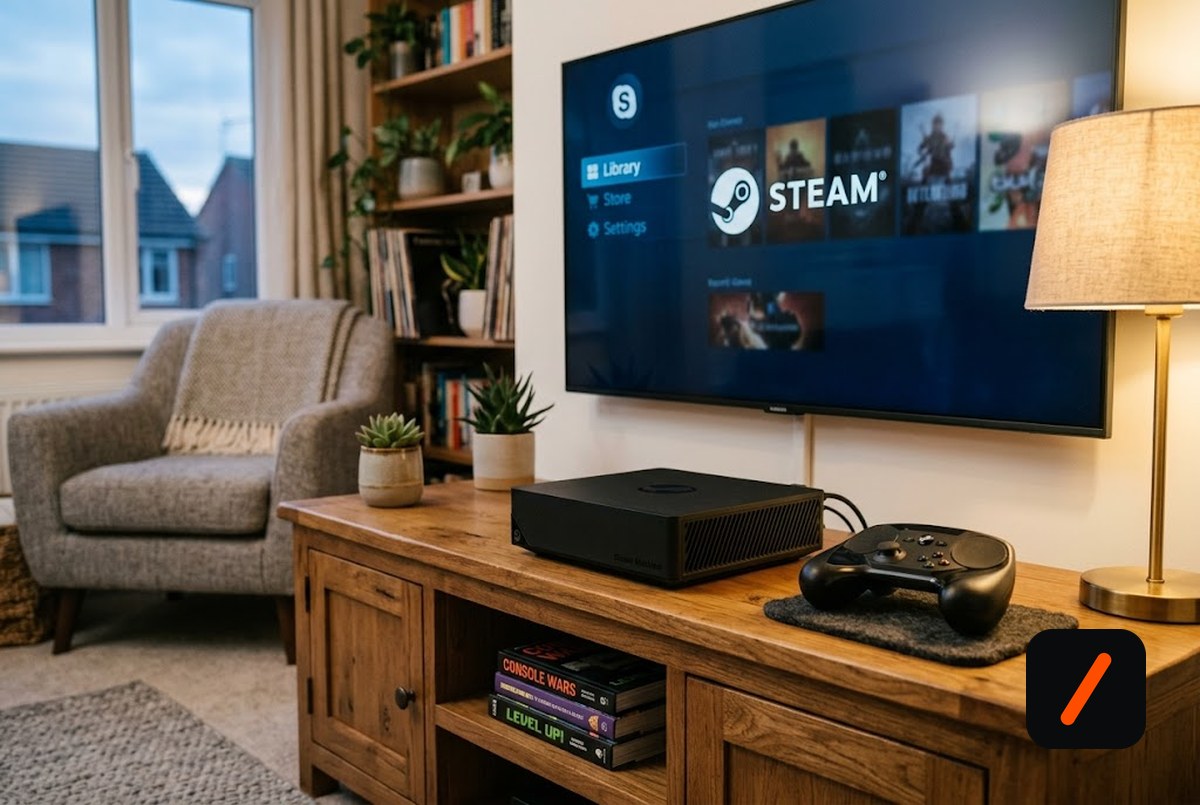
Valve has put a price on the Steam Machine: $1,049 for a compact, living-room computer that runs SteamOS and plugs into your television like a console. Reservations are open, and the first invitations to actually buy one began going out at the end of June. It is Valve's boldest hardware move since the Steam Deck, and unlike the failed 2015 Steam Machines, this one arrives after SteamOS has spent years proving itself on a device people actually love.
- The Steam Machine is priced at $1,049, a SteamOS box built for the TV rather than a desk.
- Reservations are open and the first purchase invitations started going out at the end of June.
- It runs the same SteamOS that made the Steam Deck a hit, now matured over years of updates.
- The price sits above consoles but below a comparable gaming PC, a deliberate middle position.
What exactly is a Steam Machine?
It is a small-form-factor computer that behaves like a console. Instead of Windows and a desktop, it boots straight into SteamOS, a Linux-based operating system with a controller-first, TV-friendly interface built around your Steam library. You sit on the couch, pick up a controller, and launch games, no keyboard, no driver hunting, no desktop management. Under the hood it is still a PC, so it can run the vast Steam catalog through Valve's Proton compatibility layer, which translates Windows games to run on Linux. The pitch is console simplicity with PC openness: the ease of a PlayStation with the library, storefront freedom, and moddability of a gaming PC.
RelatedApple Music Prices Jump to $11.99, First Rise Since 2022
Is $1,049 the right price?
It is the most debatable number here, and the honest answer is that it depends entirely on what you compare it to. Against a PlayStation 5 or Xbox at around five hundred dollars, the Steam Machine looks expensive, and for a pure console buyer it probably is. Against building or buying an equivalent gaming PC, which routinely runs well past a thousand dollars once you add a case, storage, and a capable graphics chip, it looks reasonable, especially with 2026's memory prices inflating every PC build. Valve is not trying to undercut consoles. It is targeting the person who wants a real gaming PC in the living room without assembling one, and for that buyer the price is a shortcut worth paying for.
| Angle | Steam Machine | Steam Deck | Console | DIY gaming PC |
|---|---|---|---|---|
| Form | Living-room box | Handheld | Living-room box | Desk tower |
| OS | SteamOS | SteamOS | Locked console OS | Windows or Linux |
| Library | Full Steam catalog | Full Steam catalog | Walled store | Everything |
| Setup effort | Plug and play | Plug and play | Plug and play | You build it |
| Openness | High, it is a PC | High | Low | Total |
Who is this actually for?
Three groups. First, Steam Deck owners who love SteamOS and want the same frictionless experience on the big screen at higher performance. Second, PC gamers tired of maintaining a Windows machine who want their library on the couch without the desktop baggage. Third, console players curious about PC gaming's cheaper games, deep sales, and mod scene but unwilling to build a rig. The people it is not for are equally clear: pure console buyers chasing the lowest entry price, and hardcore PC builders who want to pick every component. The Steam Machine deliberately sits between those poles, and its success depends on how many people live in that middle.
What is the risk for Valve?
The ghost of 2015 looms. Valve's first Steam Machine push flopped because SteamOS could not run enough games well and buyers had no reason to leave Windows. Everything hinges on whether that is truly fixed, and the evidence is genuinely encouraging: the Steam Deck runs an enormous share of the catalog through Proton, and the compatibility work done for the Deck transfers directly. The remaining risks are price sensitivity in a market anchored by cheap consoles, and the perennial question of whether living-room PC gaming is a category people want or a niche enthusiasts keep hoping will go mainstream. Valve can afford to find out, and unlike last time it is launching from a position of proven software strength rather than a promising demo.
RelatedUBTech's U1 Puts a Silicone-Skinned Humanoid in the Home
- Proton compatibility. The single most important metric is what fraction of the top catalog runs flawlessly out of the box.
- Reservation-to-sale conversion. Interest is easy; watch how many reservations turn into $1,049 purchases.
- Performance per dollar. Independent benchmarks against a similarly priced PC will make or break the value case.
- SteamOS on third-party hardware. If Valve licenses SteamOS widely, the Steam Machine becomes a category, not a product.
Our take
The Steam Machine is a much better idea in 2026 than it was in 2015, for one simple reason: the software is finally ready. Valve spent the Steam Deck era quietly solving the exact problem that killed the first attempt, and it now has a mature, controller-friendly OS that runs most of the world's PC games. At $1,049 it will not win the console price war, and it is not trying to. It is offering a genuine gaming PC you can treat like a console, and for the growing crowd who want PC gaming's freedom without PC gaming's chores, that is a compelling middle path. The open question is size of market, not quality of product. This time Valve is shipping from strength, and that alone makes it worth watching.
- OfficialSteam Machine product page and reservations
- OfficialSteamOS the operating system it runs
- ReferenceProtonDB game compatibility tracking
Original analysis by GenZTech. Source: Valve. Figures current as of July 2026.