
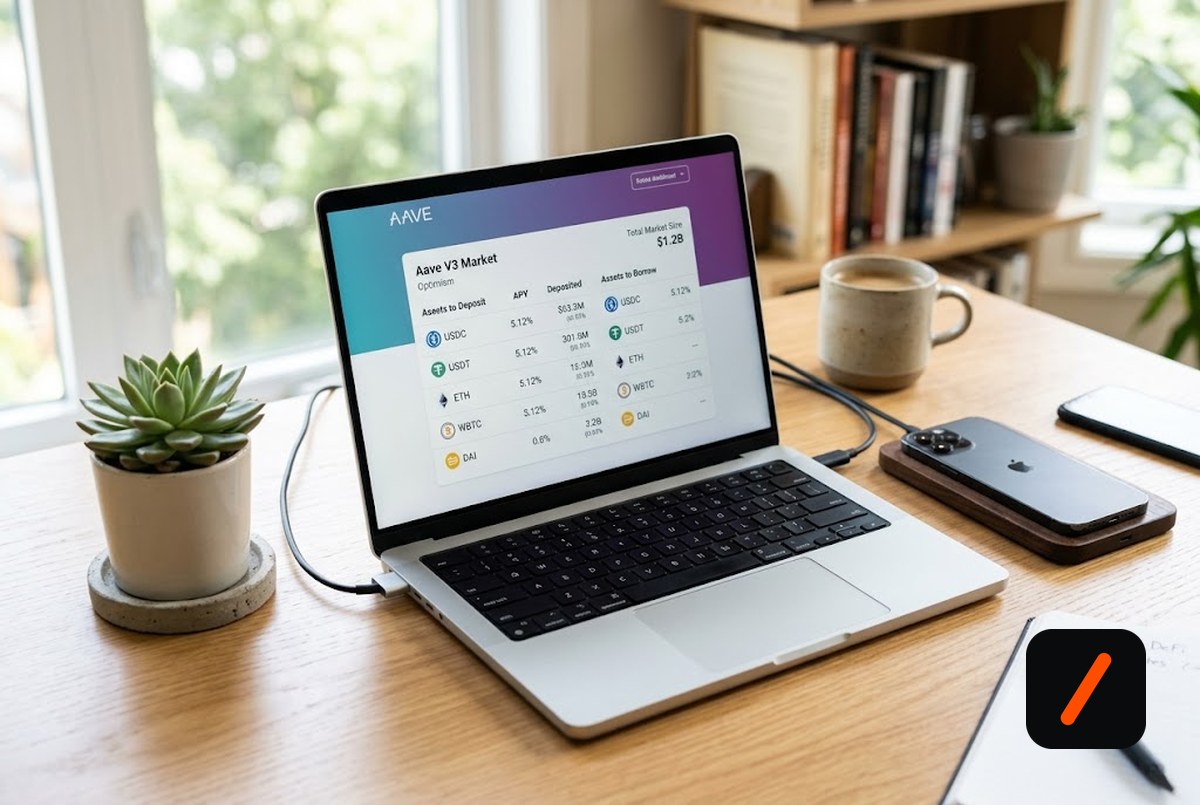
Aave, the largest lending protocol in decentralized finance, is rolling out its biggest architectural change in years. Aave v4 introduces what the team calls a Hub-and-Spoke design, aimed at solving one of DeFi lending's oldest tensions: how to offer many specialized, customizable lending markets without splitting liquidity into a hundred shallow, inefficient pools. Aave Labs has already shipped a codebase and public test network, with the remaining work focused on security as it works through the results of multiple audits. It is a rearchitecture of how billions of dollars in on-chain credit is organized.
- Aave v4 uses a Hub-and-Spoke architecture: a shared liquidity hub feeds many customizable lending markets, the spokes.
- It targets liquidity fragmentation, the problem where adding specialized markets splits capital into shallow, inefficient pools.
- The codebase and a public test network are live; the launch is gated on the results of multiple security audits.
- As the biggest DeFi lender, Aave's design choices effectively set patterns the rest of on-chain lending follows.
What problem does Hub-and-Spoke solve?
Fragmentation. In DeFi lending, depth is everything: deep liquidity means better rates, less slippage, and more resilience. But users want variety too, conservative blue-chip markets, riskier high-yield ones, isolated markets for new tokens, markets for real-world assets. The naive way to offer all of that is a separate pool for each, and that splinters capital into many shallow pools that are individually inefficient and fragile. Hub-and-Spoke breaks the trade-off by putting capital in a shared hub and letting each spoke market define its own rules and risk parameters while drawing on that common pool. You get customization and depth at the same time, which was previously an either-or choice.
RelatedDeFi, explained: banking without the bank
Why does Aave's architecture matter beyond Aave?
Because Aave is the reference implementation the rest of DeFi lending copies. As the largest lending protocol, its design decisions ripple outward: forks, competitors, and new entrants tend to adopt the patterns Aave proves out. If Hub-and-Spoke works, it likely becomes the standard mental model for on-chain lending, the way pooled liquidity did before it. That is why the v4 rollout is worth watching even if you never touch Aave directly. It is not just a product update, it is a bet on the next structural template for how billions in on-chain credit gets organized, and the whole sector tends to follow the leader.
| Model | Aave v4 Hub-and-Spoke | One big shared pool | Many isolated pools |
|---|---|---|---|
| Liquidity depth | Shared, deep | Deep | Shallow per market |
| Market customization | High (per spoke) | Low | High |
| Risk isolation | Per spoke | Shared risk | Strong |
| Capital efficiency | High | High | Low |
Why is launch gated on audits?
Because in DeFi, the smart contract is the bank, and a bug is not a glitch, it is a theft. Aave Labs has shipped the v4 codebase and a public test network, but the remaining work is security, addressing the findings of multiple audits before real money touches the new architecture. That caution is warranted and, frankly, reassuring. DeFi's history is littered with protocols that rushed complex new designs to mainnet and got drained, and the first half of 2026 alone saw more than a billion dollars lost across the sector, with legacy contracts that skipped fresh reviews emerging as a recurring target. A rearchitecture of the largest lender is exactly the kind of change that must not ship until the audits are clean.
How does this fit DeFi's 2026 mood?
It fits a sector maturing in layers rather than exploding. The prevailing theme in 2026 is that infrastructure and sound engineering matter more than hype, and that serious protocols are professionalizing. Aave v4 is a very on-trend move in that sense: an incremental, security-first, capital-efficiency-focused upgrade rather than a flashy new token or yield gimmick. It reflects a DeFi that is trying to become durable financial plumbing, where the wins come from better architecture and tighter risk management, not from marketing. That is a healthier posture than the yield-chasing cycles of earlier years, even if it makes for less exciting headlines.
RelatedAave in Talks to Sell Kraken 15% Stake at $385M
- Audit results. Clean audits are the gate. Any serious finding delays launch, and rightly so.
- Liquidity migration. Whether users and capital move from v3 to v4 smoothly is the real adoption test.
- Spoke experimentation. The interesting markets will be the customized spokes others build. Watch what launches.
- Copycats. If Hub-and-Spoke works, expect competitors to adopt the pattern fast, confirming Aave's role as the template-setter.
Our take
Aave v4 is the kind of upgrade that signals a maturing sector: unglamorous, security-first, and aimed at a genuine structural problem rather than a marketing beat. Liquidity fragmentation is a real constraint that has quietly limited how much specialization DeFi lending could offer, and Hub-and-Spoke is a genuinely clever answer, keeping capital deep while letting markets differentiate. The measured rollout, codebase and testnet first, mainnet only after audits clear, is exactly the discipline DeFi has too often lacked, and given the sector lost over a billion dollars to exploits in the first half of the year, that caution is a feature. If the audits come back clean and liquidity migrates, this likely sets the template the rest of on-chain lending copies. The risk is entirely in execution, because complex new architecture is precisely where DeFi has been burned before. Watch the audit reports, not the announcement.
- OfficialAave protocol site and v4 documentation
- GovernanceAave Governance v4 proposals and discussion
- ReferenceDefiLlama, Aave live TVL and market data
Original analysis by GenZTech. Figures current as of July 2026. Source: Aave.