
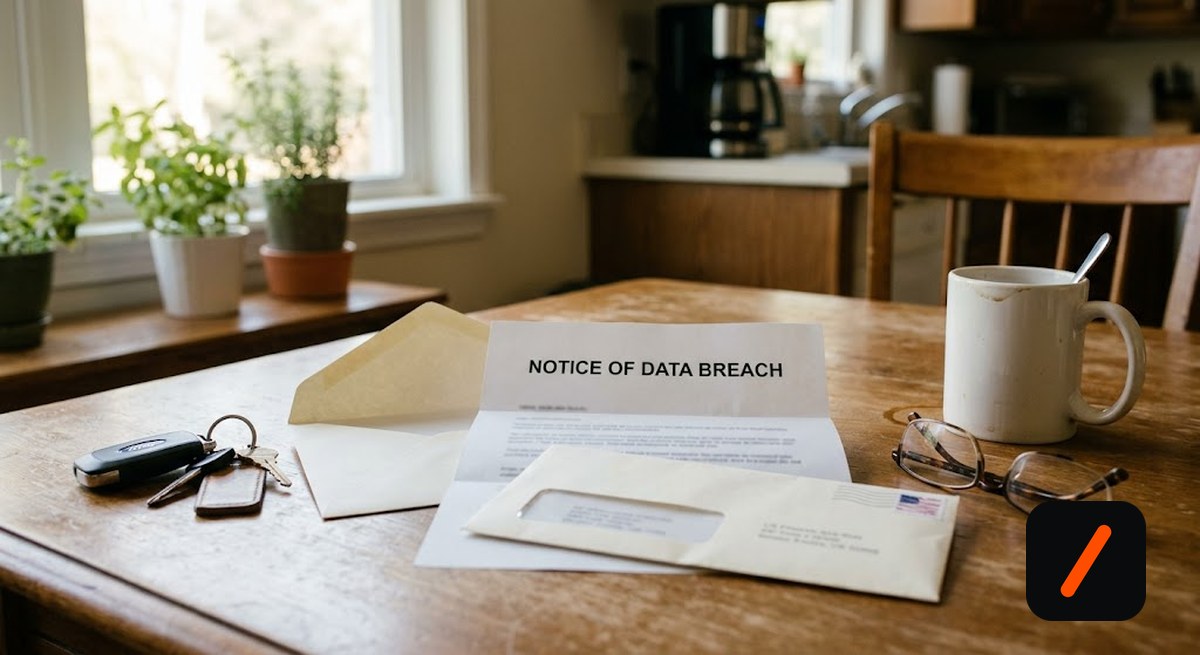
AssuranceAmerica, an Atlanta-based auto and renters insurance provider, detected an intrusion on March 17 and started mailing notification letters to 6.99 million people on July 10. That is 115 days between knowing and telling. The stolen data is names, contact information and driver's license numbers, with Social Security numbers involved in some cases, and the company has confirmed it is not offering identity theft protection to anyone affected. The breach is one of the largest known leaks of US driver's license data in 2026, and the reason it is that large has nothing to do with how the attackers got in.
- Timeline: an employee was targeted on March 16, the intrusion was detected March 17, the investigation concluded June 15, and notification letters went out July 10.
- Scale: 6.99 million people per the Indiana attorney general listing. An earlier South Carolina filing had estimated roughly 611,000, so the number grew more than tenfold as the investigation ran.
- Stolen: names, contact information and driver's license numbers, with Social Security numbers and Tax IDs implicated in some cases.
- No credit monitoring. AssuranceAmerica is not offering identity theft protection, advising affected people to monitor their own accounts. A class action investigation was announced July 9, a day before letters went out.
What actually happened?
According to a filing with the California Attorney General's office, the incident stemmed from an attack targeting one of AssuranceAmerica's employees on March 16, and the company detected it a day later on March 17. Public breach notices and independent reporting indicate the entry point was a targeted phishing attack against a single employee.
RelatedIDScan Sued After 153 Million Driver's Licenses Leak Online
The response, on the technical side, was competent and fast. AssuranceAmerica disabled the compromised credentials, ejected the threat actors by disabling unauthorized sessions, isolated affected systems and notified law enforcement. It reset passwords, deployed enhanced monitoring and threat detection, and gave staff additional cybersecurity instruction. Detecting a credential compromise within 24 hours is genuinely better than the industry norm, where dwell time is still frequently measured in weeks.
Then the investigation ran until June 15, and the letters went out July 10.
Why is the number 6.9 million?
This is the part that explains the scale, and it is structural rather than technical. AssuranceAmerica is a managing general agency. It does not simply sell its own policies to its own customers. It manages non-standard auto, renters and commercial auto policies through a network of roughly 9,500 agents across 14 states.
That means the customer data does not belong to AssuranceAmerica in the way a normal insurer's does. It flows through AssuranceAmerica's platform from thousands of independent agents, which is why a compromise at the platform level triggers notification obligations across the entire network. The 6.99 million people affected mostly never chose AssuranceAmerica, never heard of AssuranceAmerica, and have no relationship with it. They bought insurance from a local agent, and their driver's license number ended up on a platform they were never told about.
The estimate growing from roughly 611,000 in an early South Carolina filing to 6.99 million in the Indiana listing is that structure being discovered in real time. This is the aggregation risk that intermediary platforms carry and rarely disclose: the blast radius of a single compromised employee account is the union of every agent's book of business.
Why does a driver's license number matter more than a password?
Because you cannot rotate it. A stolen password is an inconvenience: you change it, and the stolen copy is worthless within minutes. A driver's license number is a durable identifier tied to a physical document, issued by a state, and replacing it means a trip to the DMV and, in many states, a compelling reason. Most people will carry the same number for years.
That makes license numbers useful for exactly the fraud that survives credit monitoring: synthetic identity creation, account takeover at institutions that use license numbers as knowledge-based verification, and fraudulent insurance or loan applications. The half-life of the stolen data is measured in years, and the utility to an attacker does not decay on any schedule the victim controls.
Which is what makes the company's remediation stance notable. AssuranceAmerica confirmed it is not offering identity theft protection services to affected individuals, instead advising them to monitor their financial accounts and credit reports. For a breach whose signature data element is a number the victim cannot change and did not know was held, telling people to watch their own credit is a thin answer.
RelatedValve warns Steam hardware buyers of CEVA data breach
| Driver's license number | Password | Payment card | |
|---|---|---|---|
| Can the victim change it? | Rarely, requires the DMV | Yes, instantly | Yes, issuer reissues |
| Who bears the cost? | The victim | The victim, briefly | The issuer, usually |
| Useful lifetime to an attacker | Years | Until rotated | Until reported |
| Detected by credit monitoring? | Only after misuse | No | Usually |
| Fraud it enables | Synthetic identity, KBA bypass | Account takeover | Card fraud |
| Remediation offered here | None | n/a | n/a |
Was 115 days too long?
The defensible answer is that scoping a breach across a 9,500-agent network is genuinely hard, and notifying people before you know who was affected produces both false alarms and missed victims. The investigation concluding on June 15, roughly 90 days after detection, is not obviously unreasonable for an intermediary of that shape. The company had to work out whose data was on its own platform.
The harder question is the 25 days between concluding the investigation on June 15 and mailing letters on July 10. Once you know the scope, the remaining work is logistics, and every day of it is a day the affected person does not know their license number is circulating. The gap was long enough that Edelson Lechtzin LLP announced a class action investigation on July 9, before most affected individuals had received anything at all. When the plaintiffs' bar reaches your customers before your own notification letters do, the timeline has failed regardless of whether it was legally compliant.
The deeper problem is that notification statutes are keyed to the breached company's investigation, not the victim's exposure. The clock that matters to a fraudster started on March 16. The clock that matters legally started whenever counsel decided the scope was final.
- The class action. The no-credit-monitoring decision is the fact pattern plaintiffs will build on, and it will be cheaper in hindsight to have offered it.
- Whether the count grows again. It went from ~611,000 to 6.99 million once. Intermediary breaches have a habit of expanding as more agents' books get counted.
- MGA and intermediary risk generally. The lesson here is not phishing. It is that platforms nobody has heard of hold identity data for millions who never chose them.
- State pressure on notification windows. A 115-day gap that is legally fine is the kind of thing that produces new statutory deadlines.
Our take
The security story here is unremarkable and that is the point. One employee was phished, credentials were abused, the company caught it in a day and kicked the attackers out. By the standards of incident response that is a good outcome, and if this were a story about detection engineering, AssuranceAmerica would come out looking fine.
It is not that story. It is a story about who holds your identity documents and whether you have any idea. Nearly seven million people are about to learn that a managing general agency in Atlanta had their driver's license number, because they bought car insurance from a local agent who used a platform they were never told about. They cannot change the number, they were told 115 days after the company knew, and they are being advised to check their own credit reports. Every part of that is legal. The part that should not survive contact with a regulator is the last one: if the data you lost is a permanent identifier the victim cannot rotate, monitoring is not remediation, it is a suggestion that they do the remediation themselves.
- FilingCalifornia AG breach notification list the filing describing the March 16 targeting and March 17 detection
- FilingIndiana AG security breach listing the 6.99 million figure and the July 10 notification date
- OfficialAssuranceAmerica company structure and agent network
Original analysis by GenZTech. Timeline and victim count per AssuranceAmerica's filings with the California and Indiana attorneys general. Social Security number exposure is described as affecting some cases and is not confirmed for all notified individuals.