
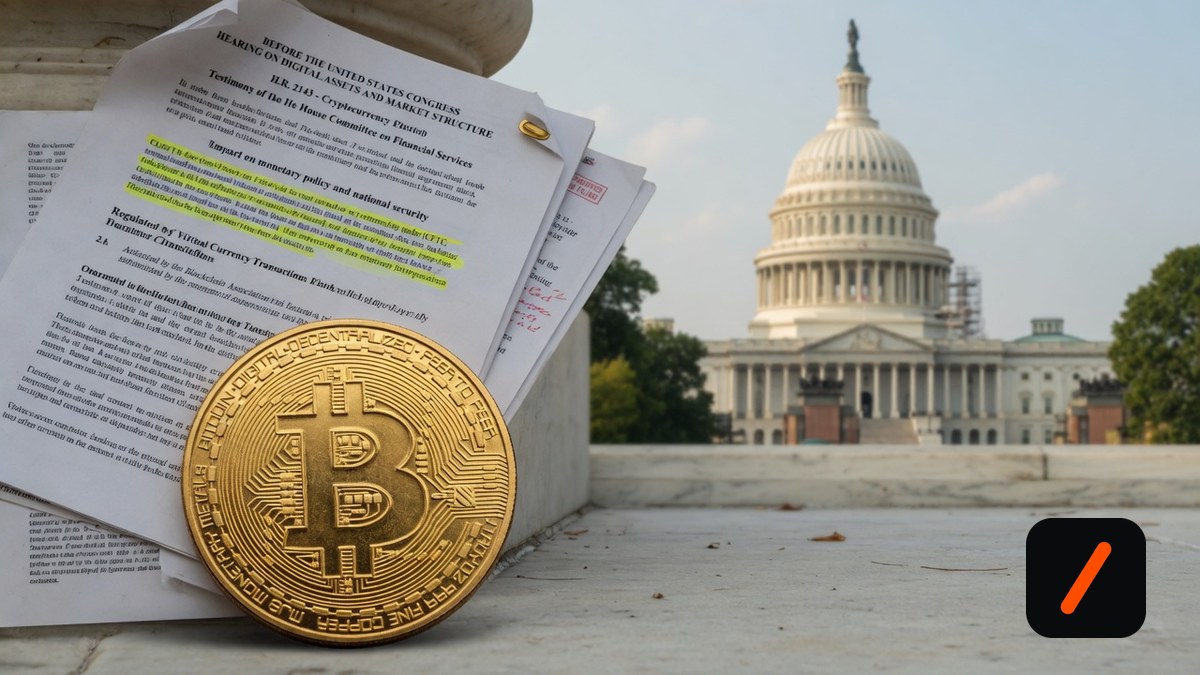
The CLARITY Act is the market-structure bill the crypto industry has wanted for years, and its odds of passing in 2026 are now rated roughly 50/50. It would write into statute a simple division of labor: digital commodities like Bitcoin and Ethereum regulated by the CFTC, fundraising tokens regulated by the SEC, and payment stablecoins overseen by banking regulators. The House passed its version last year and the Senate Banking Committee advanced its own in May, but final passage remains uncertain, which is why this is the catalyst traders keep watching even in a bearish, "extreme fear" market.
- The CLARITY Act sorts tokens into three legal buckets with three regulators, replacing today's regulation-by-enforcement fog.
- Bitcoin and Ethereum would be treated as digital commodities under the CFTC; capital-raising tokens fall to the SEC.
- Passage this year is roughly 50/50: House passed, Senate Banking advanced its version, floor timing uncertain.
- An add-on, the Blockchain Regulatory Certainty Act, would shield non-custodial software developers from money-transmitter rules.
What would actually change?
For years, US crypto companies have operated under regulation by enforcement, unsure whether a given token is a security, and often finding out only when the SEC sued someone. The CLARITY Act replaces that uncertainty with categories written into law. If a token is a sufficiently decentralized digital commodity, like Bitcoin or Ethereum, it falls under the CFTC, a lighter-touch commodities regulator. If it is sold to raise money for a project, it is treated more like a security under the SEC. If it is a payment stablecoin, banking regulators oversee it. The value is not that any single bucket is favorable; it is that businesses would finally know which rules apply before they build, instead of after they get sued.
RelatedThe CLARITY Act Hits the Senate Floor This July
Why is passage only 50/50?
Because the legislative path is genuinely hard. The House cleared its version last year and the Senate Banking Committee advanced its own in May, but getting a full Senate floor vote, reconciling the two versions, and doing it in a crowded calendar is where crypto bills have died before. There are also substantive disputes, over how "decentralized" a token must be to escape the SEC, over consumer protections, and over Senator Ron Wyden's push to attach the Blockchain Regulatory Certainty Act so that non-custodial software developers are not classified as money transmitters. Each of those fights is a place the bill can stall. Fifty-fifty is an honest read: real momentum, real obstacles.
What it means for the market
Clear rules are broadly bullish for US crypto, and the market treats CLARITY as its biggest structural catalyst. Regulatory certainty lets institutions participate without legal ambiguity, encourages exchanges and custodians to operate onshore, and reduces the risk premium that has kept some capital on the sidelines. The tokens most directly helped are the large caps most likely to qualify as digital commodities, Bitcoin and Ethereum, which would gain the clearest legal footing. The context makes the stakes vivid: the market is in an "extreme fear" phase, with total crypto market cap around $2.2 trillion, Bitcoin near $62,000 and down roughly 54% from its all-time high, and crypto public companies battered (Gemini's stock down about 89% from its debut). In that mood, a durable regulatory framework is exactly the kind of catalyst investors are waiting on for a rerating, which is also why disappointment if it stalls would sting.
Our take
The CLARITY Act is the most important thing happening in US crypto that is not a price chart, because rules of the road matter more over a full cycle than any single rally. The three-bucket structure is sensible and roughly what a maturing market needs, clear jurisdiction beats regulation by lawsuit almost regardless of the details. The honest caveat is that legislation is slow and fragile, and 50/50 odds mean serious people think it might not happen this year. Traders betting on passage as a near-term catalyst should size for disappointment; builders should welcome even a delayed version, because certainty later still beats fog forever. This is factual analysis, not investment advice, but the signal for anyone watching is simple: the fundamentals of US crypto policy hinge more on this bill than on the next candle.
RelatedCLARITY Act Dies in Senate 46-43, Crypto Bill Over for 2026
- Senate floor timing. Whether leadership schedules a vote at all is the first real gate.
- The decentralization test. How the final text defines a "digital commodity" decides which tokens escape the SEC.
- The Wyden amendment. Developer protections could make or break industry support.
How we got here
The road to the CLARITY Act runs through years of jurisdictional fighting. The SEC argued that most tokens are unregistered securities and pursued that view through enforcement actions; the industry countered that applying decades-old securities law to blockchain assets was both a poor fit and deeply unpredictable. Courts issued mixed rulings, leaving no clear line between a security and a commodity. That vacuum is precisely what the bill tries to fill with statute rather than case-by-case litigation. It is why the industry has lobbied hard for it, and why even skeptics of crypto acknowledge that clearer rules, whatever their exact shape, would be an improvement over regulation delivered one lawsuit at a time.
- AnalysisThe Motley Fool 2026 passage odds and scenarios
- ReportingCoinDesk Policy market-structure legislation coverage
- OfficialCongress.gov bill text and status
Original analysis by GenZTech. Not investment advice. Figures current as of July 2026.