
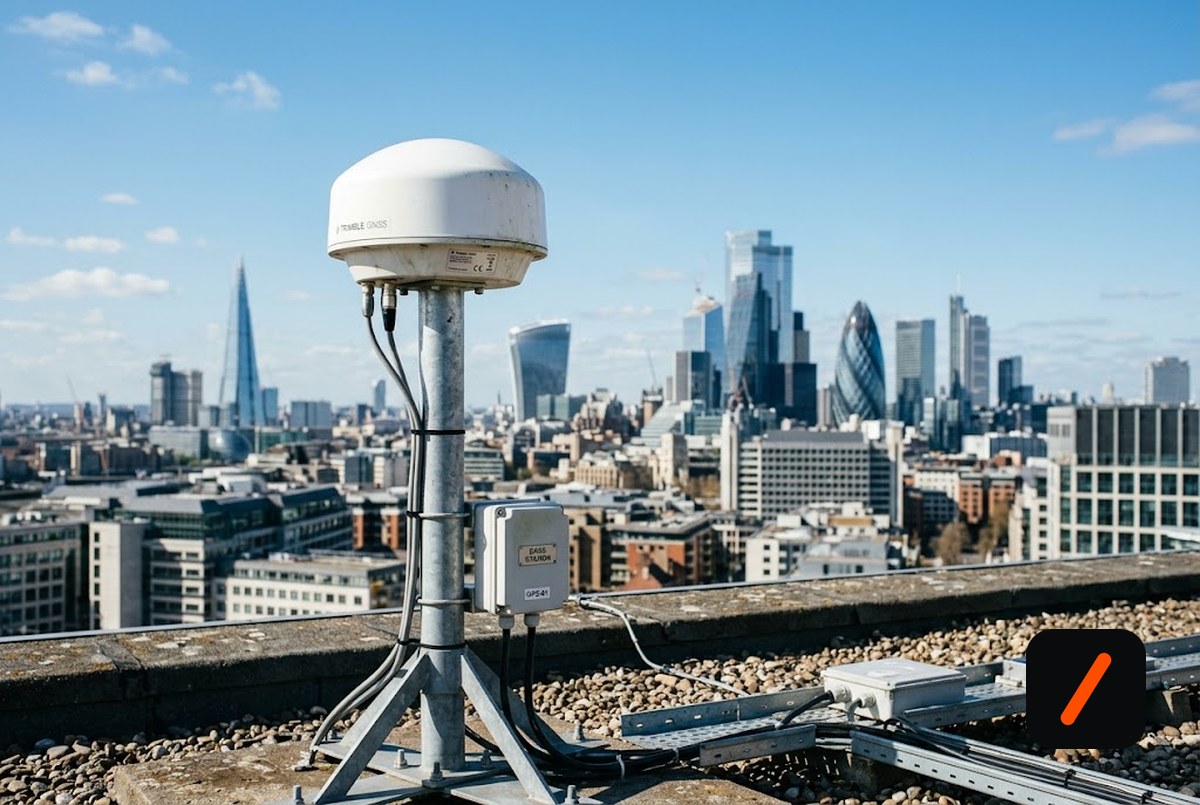
GEODNET is building the invisible layer that makes robots, drones, and autonomous machines know where they are within a centimeter, and it is doing it as a decentralized physical network instead of a government or corporate monopoly. More than 8,000 privately operated GNSS base stations feed a network that delivers centimeter-level positioning corrections, replacing the expensive, closed correction services that precision GPS normally requires. It is one of the clearest examples of DePIN's serving-over-mining shift: GEODNET reports about $8.3 million in annual recurring revenue, and 80% of that revenue funds a buy-and-burn of its GEOD token.
- Over 8,000 base stations provide centimeter-accurate GNSS corrections, the precision self-driving machines and drones need.
- It replaces costly government and corporate correction networks with an open, incentivized alternative.
- Real revenue: about $8.3M ARR, with 80% funding a GEOD buy-and-burn and 20% to the foundation.
- Token burns have offset roughly 70% of issuance recently, though team and investor unlocks continue through late 2026.
What problem does GEODNET actually solve?
Standard GPS is accurate to a few meters, which is fine for driving directions and useless for a robot. Autonomous tractors, delivery drones, survey equipment, and self-driving systems need to know their position within a centimeter, and getting there requires correction data from a nearby fixed base station. Traditionally that data comes from expensive networks run by governments or corporations, priced and gated accordingly. GEODNET decentralizes it: independent operators deploy GNSS base stations, the network aggregates their signals into centimeter-level corrections, and machines pay to use them. It is described, aptly, as the invisible glue that makes the coming robot revolution safe and reliable, and it is exactly the kind of physical-world utility DePIN was supposed to deliver.
Related375ai's DePIN Engine: Proof of Data and the $EAT Burn Loop
Why is the revenue the important number?
Because DePIN in 2026 is being sorted into networks with real customers and networks that are just token-emission schemes, and GEODNET is on the right side of that line. It reports roughly $8.3 million in annual recurring revenue from customers paying for positioning, not from speculation. That revenue drives a disciplined token mechanic: 80% of it goes to buying GEOD on the open market and burning it, with 20% to the foundation. Recent burns have offset around 70% of new token issuance, and the network has pushed toward deflationary at times. This is the serving-over-mining transition in one company, value accruing to the token because outside customers pay for a service, which is the hardest and most necessary shift in the entire sector.
| Property | GEODNET | Traditional correction service |
|---|---|---|
| Ownership | Decentralized, 8,000+ operators | Government or corporate |
| Accuracy | Centimeter-level | Centimeter-level |
| Cost model | Open, incentivized | Expensive, gated |
| Revenue use | 80% buys and burns GEOD | Retained by provider |
What are the risks?
Two stand out. First, tokenomics timing: GEODNET still has team and investor unlocks running at about $4 million per month through late 2026, so even with heavy burns, new supply keeps arriving and can pressure the token near-term. Second, the sector-wide gap between usage and price. Across DePIN, real network usage has grown while token prices fell, with positioning and mapping tokens down sharply from a year earlier despite rising adoption. GEODNET's revenue and burn discipline are genuine strengths, but they do not immunize the token from a broader DePIN drawdown or from its own unlock schedule. The network is real; the token is still a volatile, early-stage asset.
- ARR growth. The whole thesis is paying customers. Watch revenue climb from the ~$8.3M base, or stall.
- Burn versus unlocks. Burns offset ~70% of issuance, but $4M/month unlocks continue. The net supply direction is the key token signal.
- Robotics demand. GEODNET is a bet on autonomous machines scaling. Adoption by AV, drone, and survey fleets is the real growth driver.
Our take
GEODNET is one of the more convincing DePIN stories precisely because it is boring in the right way. Centimeter-accurate positioning is unglamorous infrastructure, but it is a genuine need for the robots, drones, and autonomous machines everyone expects to multiply, and building that layer as an open network instead of a gated corporate service is exactly the use case DePIN was pitched to solve. The revenue is real, the buy-and-burn is disciplined, and the serving-over-mining transition it embodies is the healthiest sign a DePIN project can show. The caution is the token, not the network: ongoing unlocks and a sector where price has lagged usage mean GEOD can stay volatile even as the fundamentals improve. Judge GEODNET by its ARR and its station count, not its chart. On those terms, it is quietly doing the hard, necessary work most of the sector only talks about.
- Officialgeodnet.com network, stations, and coverage
- ReferenceCoinGecko · GEODNET GEOD price and supply
- ReferenceFalconX · DePIN activity sector context
Original analysis by GenZTech. Not financial advice; crypto is highly volatile. Source: KuCoin.