
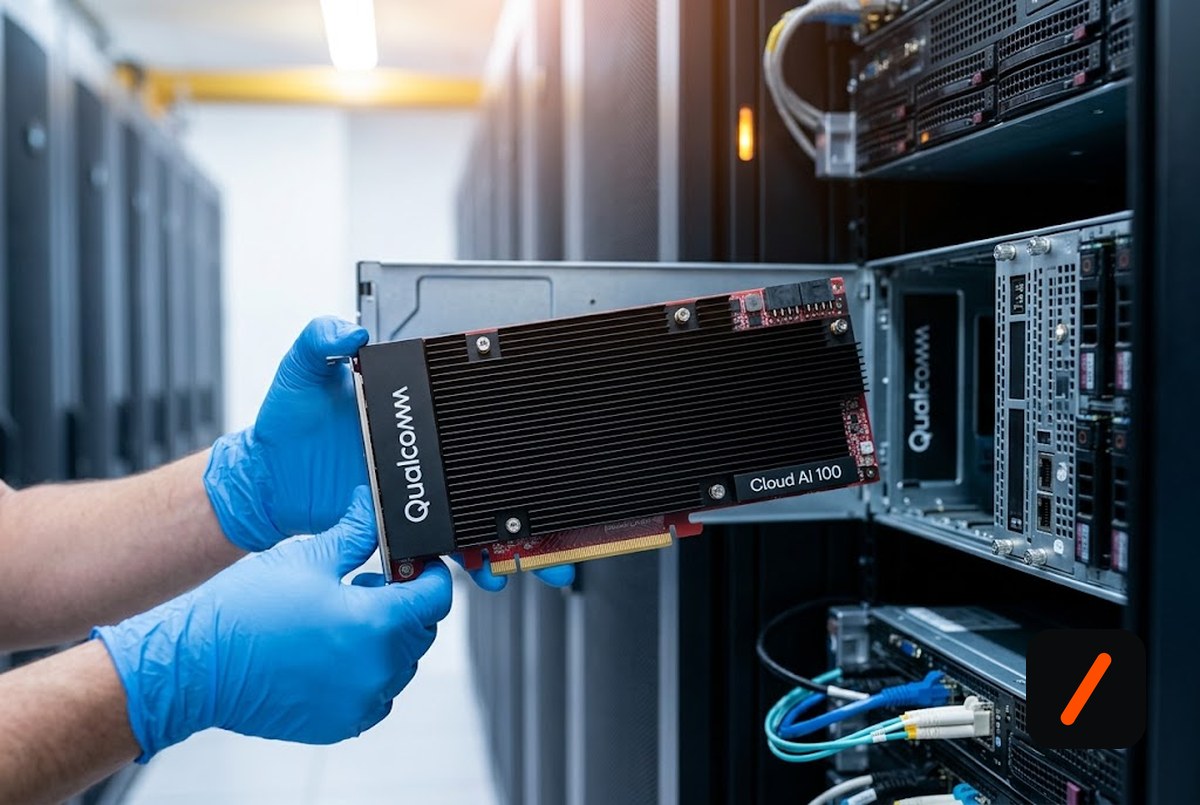
Qualcomm, the company inside most Android phones, is pushing into the data center with two AI accelerators, the AI200 arriving in 2026 and the AI250 following in 2027. Both target inference, the job of running already-trained models to answer queries, rather than the training that Nvidia dominates. Saudi AI firm Humain is the first announced customer with a 200-megawatt deployment, and the bet is simple: as AI shifts from building models to serving them at scale, the money follows inference, and inference is more open to competition.
- Qualcomm's AI200 (2026) and AI250 (2027) are data-center accelerators built for inference, not training.
- The AI250 uses near-memory computing for a claimed roughly 10x higher memory bandwidth, the bottleneck that governs inference speed.
- Humain is the launch customer with a 200-megawatt deployment, a serious first order.
- Custom AI chips are the fastest-growing slice of the market, with ASIC shipments projected up 44.6% in 2026 versus 16.1% for GPUs.
Why attack inference instead of training?
Training a frontier model is a brutal, capital-intensive event that happens a handful of times. Inference is forever. Every chat message, every code completion, every agent step is an inference call, and as AI moves into everyday products the volume of inference dwarfs training by orders of magnitude. That changes the buying criteria. Training rewards raw performance and Nvidia's mature software moat. Inference rewards cost per token, energy per query, and memory bandwidth, because serving is often bottlenecked not by compute but by how fast a chip can move a model's weights in and out of memory. That is a narrower, more winnable fight, and it is why Qualcomm, AMD, Google, Amazon, and a wave of startups are all crowding in.
RelatedGoogle Launches Four TPUs Into Orbit With Project Suncatcher
Qualcomm brings a real advantage to that fight: decades of designing chips for phones, where every milliwatt counts. Power efficiency is not a nice-to-have in a data center paying for hundreds of megawatts. It is the whole economic model. A chip that delivers the same throughput at lower power directly lowers the cost of every answer served.
What is actually different about the AI250?
The headline feature is memory. The AI250 introduces a near-memory computing architecture that Qualcomm says delivers roughly ten times the effective memory bandwidth of conventional designs. Bandwidth is the quiet king of inference performance. Large models spend much of their time waiting to read weights from memory, so a chip that shortens that trip can serve more users per second and hold larger models close to the compute. The AI200 lands first in 2026 as the volume workhorse, while the AI250 in 2027 is the architectural leap that Qualcomm hopes redefines the efficiency curve.
| Angle | Qualcomm AI200 / AI250 | Nvidia GPUs | Google TPU |
|---|---|---|---|
| Primary target | Inference | Training + inference | Training + inference |
| Edge | Power efficiency, memory bandwidth | Peak performance, CUDA software | Vertical integration |
| Availability | AI200 in 2026, AI250 in 2027 | Shipping at scale | Google Cloud only |
| First customer | Humain, 200MW | Everyone | Google, Anthropic, others |
| Sold externally? | Yes | Yes | No, rented as cloud |
Can Qualcomm crack Nvidia's software moat?
This is the hard part, and honesty demands naming it. Nvidia's dominance is only half silicon. The other half is CUDA and years of tooling that make its chips the path of least resistance for every AI engineer. A competitor can match or beat the hardware and still lose because porting a workload is painful. Qualcomm's answer is to compete where the software gap is smallest. Inference workloads are more standardized than training pipelines, and a growing stack of runtimes and compilers can target multiple backends, so the switching cost of moving inference off Nvidia is falling. It is not zero, but a 200-megawatt customer signing on suggests the friction is now low enough for large buyers to take the leap for the right price and power profile.
RelatedQualcomm bets $4B on Modular to own the AI software stack
Who is affected if this works?
Everyone who pays for AI. More credible inference silicon means more competition, and competition on the largest recurring cost in AI pushes the price of every answer down. Cloud providers get leverage to negotiate against Nvidia. Enterprises get options for on-premises inference that were not viable before. And the broader shift, hyperscalers and now Qualcomm building their own accelerators, chips away at the assumption that one company must own the whole AI hardware stack. The risk is fragmentation: more chips means more runtimes to support and more ways for software to break. But that is the healthy kind of problem, the kind that comes with a market opening up rather than closing down.
- AI200 real-world throughput. Launch specs are marketing until independent inference benchmarks land. Watch tokens per second per watt.
- The AI250 memory claim. A 10x bandwidth leap is extraordinary. Confirm it survives contact with production models.
- Customer count past Humain. One flagship deal proves interest. A second and third prove a market.
- Software readiness. The chip is only as useful as its compiler. Watch which inference runtimes ship first-class Qualcomm support.
Our take
Qualcomm entering the data center is smarter than it first sounds, because it is not trying to beat Nvidia at Nvidia's game. It is betting that the game itself is changing, from a training race a few companies can afford to an inference market that every product with an AI feature must pay into forever. In that market, power efficiency is a moat Qualcomm has spent twenty years building in your pocket. The AI250's memory architecture is the piece to watch, and the Humain deal proves buyers are willing to look past the Nvidia default when the economics are right. This will not dethrone Nvidia. It does not need to. It only needs to make inference a competitive market, and even that would reshape the cost of AI for everyone.
- OfficialQualcomm AI accelerators AI200 and AI250 product pages
- ReferenceTom's Hardware semiconductors data-center AI chip coverage
- BenchmarkMLPerf Inference standard inference benchmarks
Original analysis by GenZTech. Source: Qualcomm. Figures current as of July 2026.