
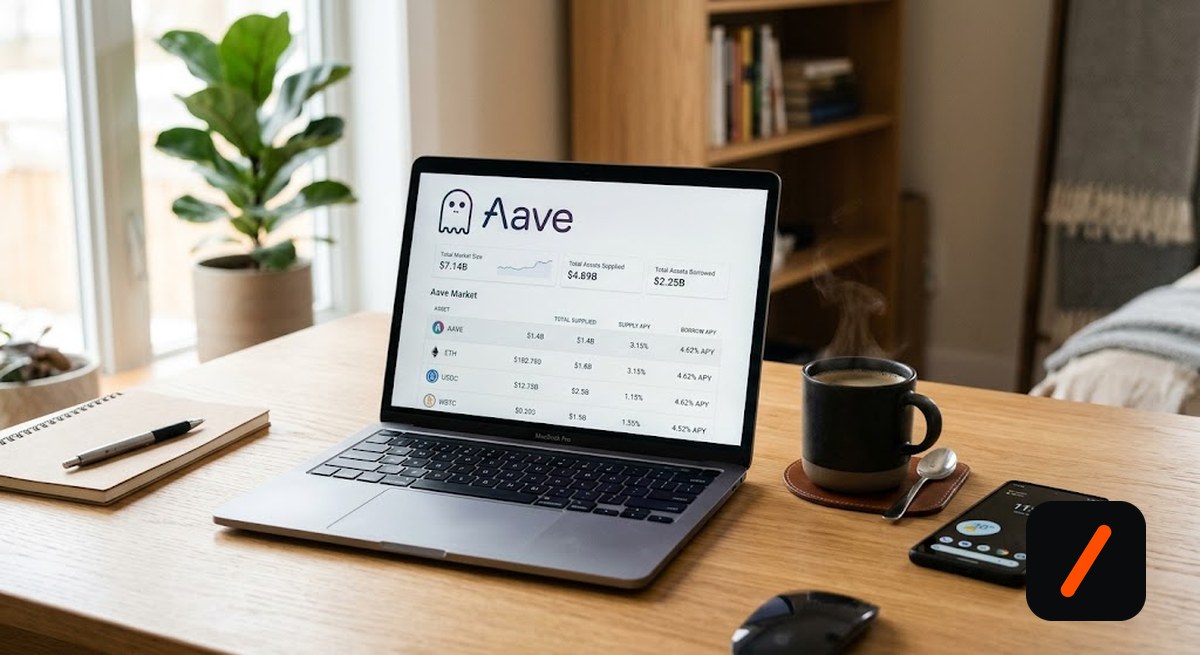
Aave, the largest decentralized lending protocol, has unveiled Aavenomics 3.0, a redesign that hardcodes its token buyback at the protocol level and routes 100% of revenue from the Aave protocol, the GHO stablecoin, and associated ecosystem products directly to the DAO treasury. Alongside it, Aave is expanding its V3 lending markets and GHO onto Monad, a high-performance Layer-1 built for speed and low fees. Together the moves tighten value accrual to the DAO and push Aave onto faster rails.
- 100% of revenue to the DAO. Protocol, GHO, and ecosystem income all flow to the treasury under a protocol-level rule, not a discretionary vote.
- Buybacks become hardcoded. The token buyback shifts from a program that can be started and stopped to an automatic, protocol-embedded mechanism.
- GHO expands to Monad. Aave's V3 markets and the GHO stablecoin arrive on a high-throughput L1, aiming for cheaper, faster lending.
- Timing is defensive. DeFi TVL is down roughly 37% year to date and Q2 was the most-hacked quarter on record, so credible tokenomics matter more than ever.
What changed with Aavenomics 3.0?
Two things. First, Aave is making its token buyback a hardcoded, protocol-level mechanism rather than a program the DAO turns on and off by vote. That removes discretion and the uncertainty that comes with it. Second, and more consequentially, 100% of the revenue generated by the Aave protocol, the GHO stablecoin, and associated ecosystem products is now automatically routed to the DAO treasury. In plain terms, the protocol is being wired so that all the value it produces flows to a single place and is put to work systematically, instead of being split, debated, or left idle.
RelatedEigenLayer Becomes EigenCloud and Routes Fees to Buybacks
Why route everything to the DAO?
Because credible, mechanical value accrual is what separates a durable protocol token from a speculative one. By hardcoding the buyback and directing all revenue to the treasury, Aave gives holders a clear, rules-based answer to the question every DeFi token faces: what does the protocol's success actually do for the token? Discretionary programs invite governance fights and can be paused at the worst moment; a protocol-level rule is predictable and hard to reverse quietly. It is a bet that transparency and automation build more trust than flexibility.
What does the Monad expansion add?
Reach and performance. By bringing its V3 lending markets and the GHO stablecoin onto Monad, a high-throughput Layer-1 designed for fast, cheap transactions, Aave extends its footprint to a chain built for exactly the kind of frequent, low-margin interactions that lending and stablecoin activity generate. Cheaper, faster execution lowers the friction of borrowing, lending, and minting GHO, and it plants Aave's flag on an ambitious new network rather than ceding that ground to competitors. Expanding GHO in particular is how Aave grows the stablecoin whose revenue now feeds the treasury.
Why does the timing matter?
Because DeFi is under pressure. Total value locked across the sector has fallen roughly 37% year to date to around $70 billion, and Q2 2026 was the most-hacked quarter on record by incident count. In a defensive market, protocols compete on trust and sustainability, not just yield. Aavenomics 3.0 is a direct response: it makes Aave's economics legible and automatic at a moment when users are wary and capital is scarce. Strengthening the token's value proposition while expanding to a faster chain is an attempt to consolidate Aave's leadership precisely when weaker protocols are struggling.
What does it mean for the market?
For the AAVE token, the redesign strengthens the link between protocol usage and token value: more lending and GHO revenue now mechanically funds buybacks and the treasury. That is a bullish structural change if usage holds, though it does not shield the token from a broad DeFi downturn. For the sector, Aave is setting a template, protocol-level revenue routing and automatic buybacks, that rivals will be pressured to match. The signal for investors is that DeFi's leaders are shifting from emissions-driven growth to revenue-driven value accrual, a maturation that favors protocols with real, durable income.
RelatedAave in Talks to Sell Kraken 15% Stake at $385M
What are the risks to the redesign?
The biggest is that mechanical value accrual only works if there is value to accrue. Routing 100% of revenue to the treasury and hardcoding buybacks is powerful when the protocol is generating strong income, but in a shrinking DeFi market with total value locked down sharply, revenue can fall, and an automatic buyback funded by declining fees delivers less than the design promises. Hardcoding also cuts both ways: removing discretion protects against governance meddling, but it also reduces flexibility to respond if conditions demand a different treasury strategy. Expanding to Monad adds smart-contract and bridge surface area at a moment when exploits are at record highs, so security execution matters. And GHO still has to win adoption against entrenched stablecoins for the revenue thesis to compound. The framework is sound; whether it pays off depends on demand Aave does not fully control.
Our take
Aavenomics 3.0 is the right move at the right time. Hardcoding value flows removes the governance uncertainty that has plagued DeFi tokenomics, and doing it during a downturn signals confidence rather than desperation. The Monad expansion keeps Aave from calcifying on incumbency. The real test is demand: mechanical buybacks only matter if the protocol keeps generating revenue, and that depends on borrowers and GHO adoption in a shrinking market. But as a statement that Aave intends to lead DeFi's revenue-first era, this is a strong, disciplined one.
- GovernanceAave — Governance forum
- OfficialAave — Official site
- DataDefiLlama — DeFi TVL and Aave metrics
Original analysis by GenZTech. Details current as of July 2026. Verify parameters on the official Aave governance forum. Not financial advice.