
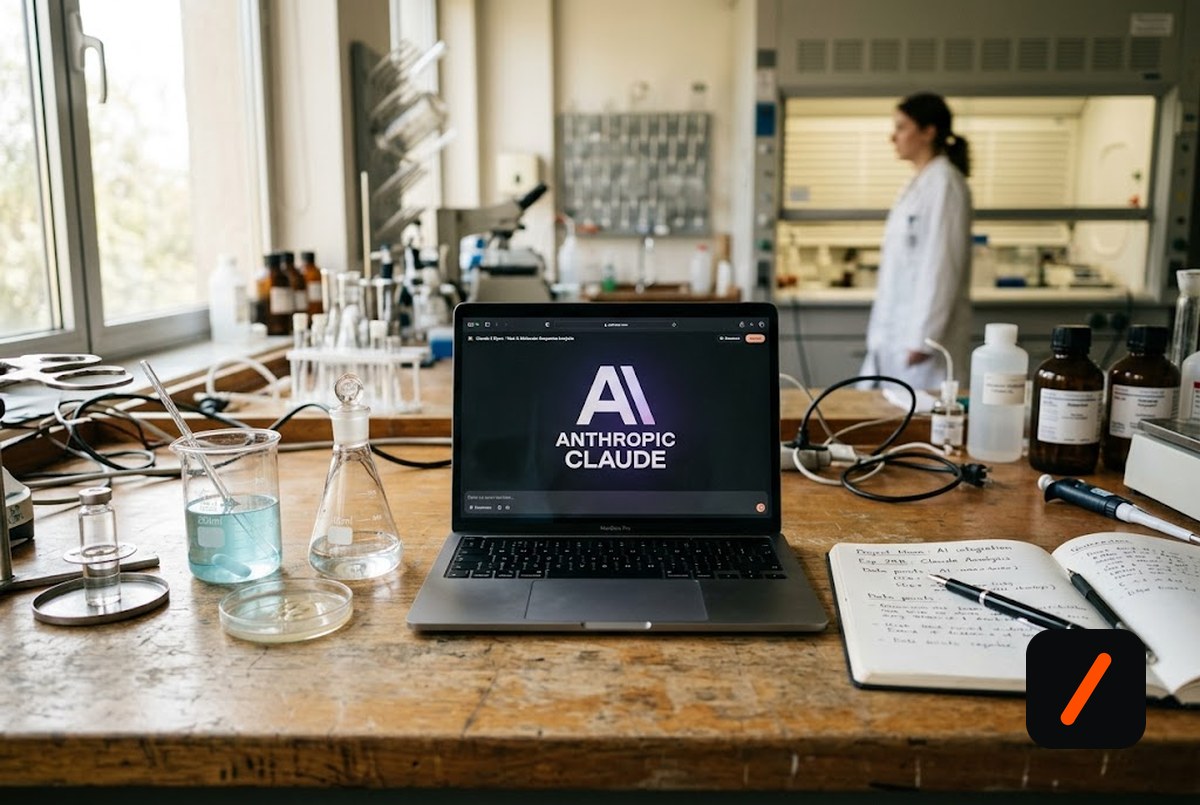
Anthropic has shipped Claude Science, a workbench that connects Claude to more than 60 preconfigured research tools, and it is putting the product to work on an internal drug-discovery program focused on neglected diseases. The move matters because it reframes a frontier model from a writing assistant into a lab operator: something that can pull a dataset, run an analysis, read the result, and decide the next step. Our thesis is simple. The winning AI-for-science bet in 2026 is not a smarter chat box, it is reliable tool orchestration, and Claude Science is Anthropic planting a flag on that ground.
- Claude Science bundles 60-plus tools (literature search, structural biology, cheminformatics, notebook execution) behind one agent so researchers stop stitching APIs by hand.
- Anthropic paired the launch with an in-house program targeting neglected diseases, the kind of low-commercial-return work that rarely gets frontier compute.
- It is available in beta to Pro, Max, Team and Enterprise users, signaling this is a product line, not a demo.
- The strategic read: Anthropic wants to own the scientific-agent category before OpenAI and Google generalize their own tool stacks into it.
What actually launched?
Claude Science is a hosted environment where Claude has standing access to a curated toolset instead of a blank prompt box. Anthropic describes more than 60 preconfigured tools spanning literature retrieval, molecular and structural analysis, data wrangling, and sandboxed code execution. In practice that means a researcher can ask a question in plain language and the model decides which tool to invoke, chains several together, and hands back an answer with its working shown. The company launched it in beta for paying tiers alongside a research initiative of its own, an internal drug-discovery effort aimed at diseases that draw little private investment.
RelatedClaude Cowork vs ChatGPT Work: the agent app war goes mobile
Why does the neglected-diseases angle matter?
Neglected tropical diseases are the textbook market failure: real human burden, thin commercial upside, so the pharmaceutical pipeline mostly skips them. By pointing its own compute and its own model at that gap, Anthropic is doing two things at once. It is stress-testing Claude Science on genuinely hard biology, and it is building a credibility story that a pure benchmark score cannot buy. If the workbench can compress the grunt work of early discovery, the projects that benefit first are exactly the ones that could never afford a large research team.
What is the deeper mechanism most coverage skips?
The interesting engineering is not the model, it is the harness around it. A chatbot that hallucinates a citation is annoying; an agent that runs the wrong assay script and reports a confident wrong number is dangerous. So the hard part of Claude Science is verification: constraining tools, checking outputs, and making the agent show a trail a scientist can audit. This is the same lesson GenZTech has flagged before, that a deterministic tool wired to a model often beats a bigger model alone. Claude Science is Anthropic productizing that lesson.
What does it mean for the market?
For investors the signal is about category control, not a single revenue line. Anthropic, still private, is pushing into the same scientific-agent space that public names touch through their cloud arms: Alphabet via DeepMind and Isomorphic, Microsoft through its Azure AI and research tooling, and a cluster of biotech-software startups. The read is that whoever standardizes the research agent captures durable enterprise spend from pharma, academia and government labs, budgets that are sticky once a workflow is embedded. Watch whether Enterprise seats convert into named lab deployments; that, not the demo, is the moat.
RelatedClaude Opus 5.5 Ships With Agent Benchmarks, Not SWE-bench
Who is affected first?
Academic and nonprofit researchers gain the most obvious upside, because the workbench lowers the fixed cost of a competent research pipeline. Contract research organizations and scientific-software vendors face the sharpest question: if the agent absorbs the connective tissue between tools, what is left to sell is the specialized tool itself, not the integration. And regulators will eventually ask how an AI-run analysis gets validated for anything approaching clinical use.
What could go wrong with a research agent?
The obvious failure is confident nonsense at machine speed. A model that fabricates a citation wastes a reader's time; an agent that silently runs the wrong analysis and reports a clean-looking number can send a research program down a dead end for months. That is why the interesting risk in Claude Science is not raw capability but calibration: does the agent know when it is out of its depth, does it flag uncertainty, and does it leave a trail a domain expert can check line by line. Anthropic has built its brand on safety framing, and this product is where that framing gets tested against hard science rather than a chat transcript. The second risk is over-trust. When a tool feels authoritative, users stop auditing it, and in biology an unaudited result is worse than no result. The right way to read Claude Science is as an accelerator for a competent scientist who still verifies, not a replacement for that scientist. If it is used as the latter, the mistakes will be expensive and quiet.
- Named deployments. Beta access is easy; a published result from a real lab using Claude Science is the proof point.
- Verification tooling. Expect Anthropic to add provenance and audit features, because unaudited agent output has no place in biology.
- Competitive response. If Google or OpenAI ship a comparable science harness within two quarters, this becomes a genuine category race.
- OfficialAnthropic newsroom: Claude Science and research programs product announcement
- ReferenceAnthropic research index methodology and tooling
Original analysis by GenZTech. Primary source: Anthropic.