
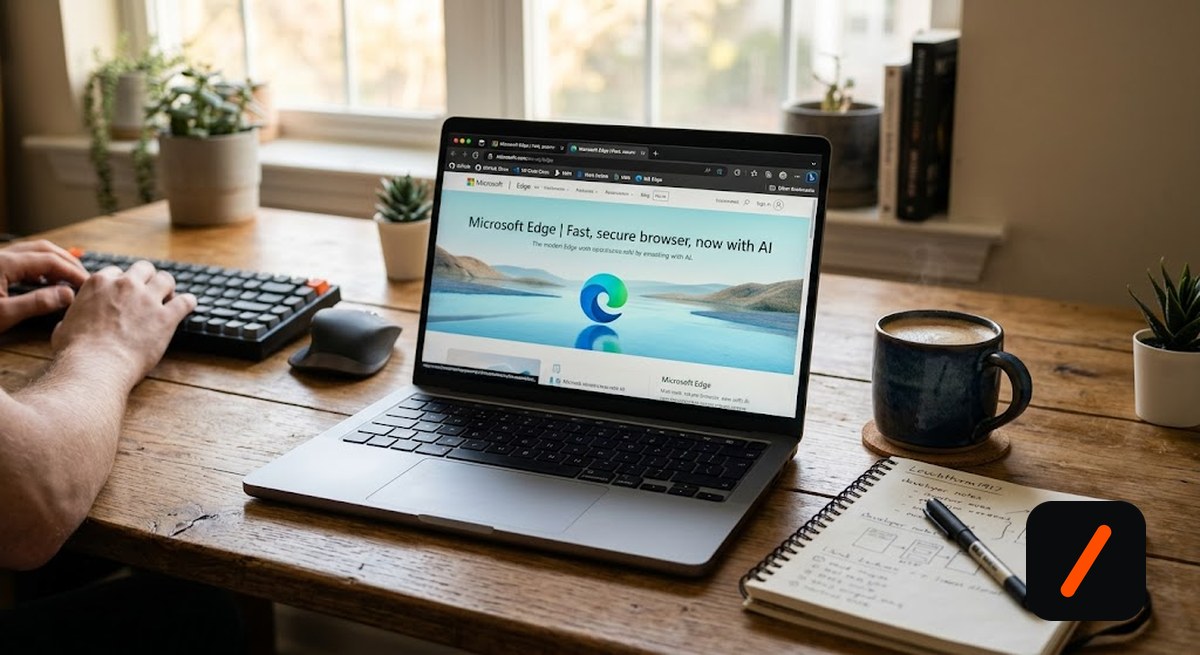
Microsoft Edge 150, released in July 2026, ships a batch of web-platform features that quietly remove real developer pain: the HTML focusgroup attribute for keyboard navigation, Web App Origin Migration so a progressive web app can move to a new domain without losing its install state, and programmatic scroll methods that now return a Promise when the scroll finishes. None is flashy, but together they replace piles of custom JavaScript with built-in platform behavior.
- focusgroup: a new HTML attribute that standardizes arrow-key navigation, roving tabindex, and focus memory for toolbars, tabs, and menus, no custom JS required.
- Web App Origin Migration: lets an installed PWA migrate to a new origin while preserving trust, install state, and permissions.
- Promise-based scrolling: scrollTo and scrollBy now resolve a Promise when a smooth scroll completes, ending timer-and-polling hacks.
- New CSS: AccentColor system colors and a round parameter for the polygon() shape function land too.
What is the focusgroup attribute?
focusgroup is a new HTML attribute that standardizes keyboard navigation for composite widgets: toolbars, tab strips, menus, and radio groups. Historically, making these accessible meant writing JavaScript to manage roving tabindex, wire up arrow-key handlers, and remember which element was last focused when a user tabbed back into the group. It was fiddly, easy to get wrong, and a common source of accessibility bugs. With focusgroup, the browser handles all of it declaratively: add the attribute, and arrow-key navigation, focus memory, and correct tab behavior come for free. For teams building design systems, this removes an entire category of hand-written, error-prone code and makes correct keyboard accessibility the default rather than an afterthought.
RelatedWebAssembly's JSPI Finally Closes the Async Gap
Why does Web App Origin Migration matter?
Progressive web apps can be installed to a device like native apps, but that install has historically been chained to a specific origin, the scheme, domain, and port the app was installed from. If a company needed to move its PWA to a new domain, users effectively had to reinstall, losing install state and granted permissions in the process. Web App Origin Migration fixes that: it lets an installed PWA migrate to a new origin while preserving trust, install status, and applicable permissions. That sounds niche until you have lived through a rebrand, an acquisition, or a domain consolidation, at which point it is the difference between a seamless transition and asking every user to start over. It is exactly the kind of unglamorous plumbing that makes PWAs viable for serious products.
What changes with Promise-based scrolling?
Smooth scrolling has long had an awkward gap: you could call scrollTo or scrollBy with smooth behavior, but you had no reliable way to know when the animation finished. Developers papered over this with fixed setTimeout delays or by polling scroll position, both of which are brittle and race-prone. In Edge 150, these methods return a Promise that resolves when the scroll completes, so you can simply await the scroll and then run whatever should happen next, focusing an element, triggering an animation, loading content. It is a small API change that eliminates a whole class of timing hacks and makes scroll-coordinated interactions dramatically more robust.
| Feature | Edge 150 approach | Old approach |
|---|---|---|
| Keyboard nav in widgets | focusgroup attribute | Custom roving-tabindex JS |
| PWA domain change | Origin Migration | Reinstall, lose state |
| After-scroll logic | Awaitable Promise | setTimeout / polling |
| System accent color | AccentColor CSS | Manual theming |
| Rounded polygon shapes | polygon() round param | Hand-computed beziers |
Is this Chromium-wide or Edge-only?
Most of these features flow from the shared Chromium platform, which means what lands in Edge 150 tends to appear in the same generation of Chrome and, on the standards track, works toward availability across Firefox and Safari too. The web platform now advances through a coordinated cadence where features reach "Baseline Newly available" once they ship in the current stable versions of all four major engines. Practically, developers should check Baseline status before relying on any single feature in production, but the direction of travel is clear: capabilities that once required a library or a polyfill are becoming native, interoperable primitives. focusgroup and Promise-based scrolling are strong candidates to become everyday tools rather than Edge curiosities.
RelatedChrome 150 Ships HTML-in-Canvas and Declarative Updates
What should developers do with this?
Audit your custom code against the new primitives. If you maintain a design system, focusgroup can likely delete a meaningful chunk of your keyboard-navigation logic and improve accessibility at the same time. If you ship a PWA and have ever worried about a domain change, Origin Migration is worth designing for now, before you need it. If your UI coordinates actions with scrolling, the Promise-based methods will make that code simpler and less flaky. The theme across all of these is the same: the platform is absorbing patterns that used to live in application code, and the teams that adopt them ship less code, fewer bugs, and better accessibility.
- Baseline status. Track when each feature reaches cross-engine availability before depending on it in production.
- focusgroup adoption. Design-system libraries replacing hand-rolled keyboard nav will be the clearest signal of impact.
- PWA migrations. Real-world rebrands using Origin Migration will prove out the feature.
- Follow-on APIs. Promise-returning scroll methods hint at a broader move toward awaitable browser animations.
Our take
Edge 150 will not headline anyone's release-notes highlight reel, and that is the point. The web platform's most valuable progress is often the least glamorous: taking the tedious, bug-prone patterns developers reinvent on every project and making them native, accessible, and interoperable. focusgroup alone will quietly improve keyboard accessibility across countless sites by making the correct behavior the easy default, and Promise-based scrolling ends a genuinely annoying category of timing hacks. This is the platform doing its job, absorbing complexity so application developers can stop maintaining it. Check Baseline before you ship, then start deleting code.
- OfficialMicrosoft Edge 150 release notes the full web-platform feature list
- ReferenceWeb Platform Baseline cross-browser availability status
- ReferenceMDN: focusgroup documentation for the new attribute
Original analysis by GenZTech. Based on Microsoft Edge 150 release notes as of July 2026.