
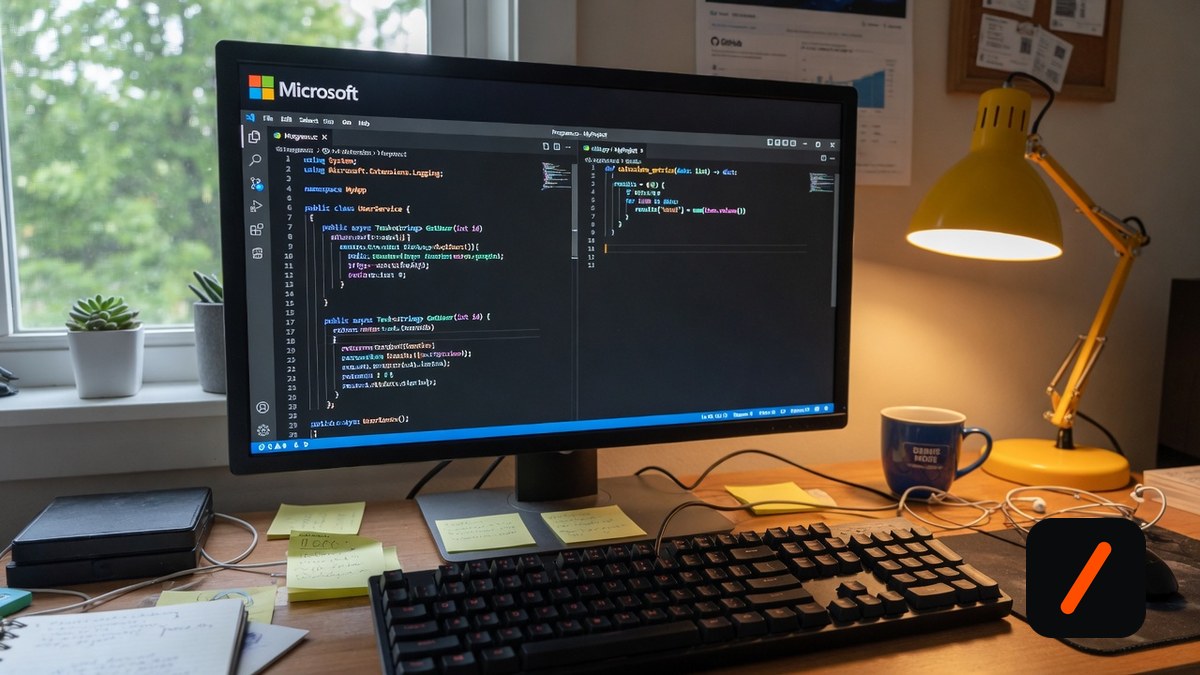
Microsoft shipped Agent Framework 1.0, its production, long-term-support library for building AI agents in both .NET and Python. The release matters less for any single feature than for what it consolidates: it folds Microsoft's two earlier, overlapping agent efforts, Semantic Kernel and AutoGen, into one supported framework. For teams that spent 2025 choosing between competing Microsoft libraries, the message is finally clear about which one to build on.
- Agent Framework 1.0 is the stable, LTS release, positioned as the foundation for orchestrated agents that call tools, span multiple models, and run longer workflows.
- It merges Semantic Kernel and AutoGen, ending the confusing two-track situation and giving both .NET and Python a single API.
- It plugs into Microsoft Foundry, whose hosted agents reached general availability, so an agent can move from laptop to sandboxed cloud hosting without a rewrite.
- The runtime is framework-agnostic at the hosting layer: agents built with LangGraph or the GitHub Copilot SDK can be deployed on the same infrastructure.
What changed for developers?
Until now, a developer starting an agent project inside the Microsoft stack faced a fork in the road. Semantic Kernel was the enterprise-flavored orchestration library; AutoGen was the research-driven multi-agent framework with a different mental model. They overlapped enough to compete and differed enough to make porting painful. Agent Framework 1.0 ends that by unifying the abstractions, agents, tools, workflows, into one library with first-class support in both .NET and Python, and by stamping it with long-term support. LTS is the word that matters to enterprises: it signals API stability and a maintenance commitment, which is what a bank or a Fortune 500 needs before it builds a production system on top.
RelatedGitHub Ships Native Stacked Pull Requests in Preview
How does it fit with Foundry?
The framework is only half the story; the other half is where agents run. Microsoft Foundry's hosted agents reached general availability, offering sandboxed sessions with their own state and filesystem access. The point of coupling the two is a clean path from prototype to production: you build an agent locally with Agent Framework, then deploy it to Foundry's managed runtime without rearchitecting it. Crucially, that runtime is framework-agnostic. Agents written with LangGraph or the GitHub Copilot SDK can be hosted there too, so Microsoft is positioning Foundry as neutral infrastructure while Agent Framework is its opinionated way to author agents. Own the runway even if you do not own the plane.
| Approach | Agent Framework 1.0 | LangGraph | OpenAI Agents SDK |
|---|---|---|---|
| Languages | .NET + Python | Python (+ JS) | Python |
| Backing | Microsoft | LangChain | OpenAI |
| Support model | LTS, production | OSS releases | OSS releases |
| Hosted runtime | Foundry (GA) | LangGraph Platform | Bring your own |
| Multi-model | Yes | Yes | OpenAI-centric |
Who wins from consolidation?
Enterprise .NET shops are the clearest winners. Most agent tooling has been Python-first, leaving the huge base of C# teams underserved; a production-grade, Microsoft-supported .NET agent library is genuinely rare. Python teams inside the Microsoft ecosystem also benefit from finally having one blessed path instead of two half-blessed ones. The competitive read is that this is Microsoft answering LangGraph and the OpenAI Agents SDK not with a flashier feature set but with the thing enterprises actually buy: stability, support, and a hosting story that starts on a laptop and ends in a compliant cloud.
Our take
Consolidation is unglamorous and exactly right. The agent-framework space spent 2025 drowning in options, including two from Microsoft itself, and fragmentation is the enemy of production adoption. By merging Semantic Kernel and AutoGen, committing to LTS, and pairing the library with a GA hosting runtime, Microsoft is telling enterprises the churn is over and it is safe to build. The bet is well aimed: .NET support is a real gap in the market, and framework-agnostic hosting hedges against Microsoft's own library losing the popularity contest. The risk is that developer mindshare still lives in the Python-and-LangGraph world, and mindshare, not enterprise checklists, is what usually decides these platform wars. Microsoft has the better enterprise story; whether it has the better developer story is the open question.
RelatedMicrosoft Open-Sources Comic Chat After 30 Years
- Migration friction. How painful it is to move existing Semantic Kernel and AutoGen projects onto 1.0 will shape adoption.
- .NET traction. If C# teams flock to it, Microsoft owns a market no one else serves well.
- Foundry lock-in. Framework-agnostic hosting is the pitch; watch whether the best experience quietly requires the Microsoft stack end to end.
How this fits the wider agent boom
The timing is not accidental. 2026 is the year "agents" moved from demos to production budgets, and every major platform is racing to be the layer teams standardize on. OpenAI has its Agents SDK, Google is pushing agent tooling through Vertex and its developer stack, and a thriving open-source scene led by LangGraph and CrewAI owns much of the experimentation. Microsoft's advantage is not novelty but reach: it already sits inside the enterprises making these decisions, through .NET, Azure, and GitHub. By shipping a stable, supported framework and a GA hosting runtime together, it is meeting those enterprises where their procurement and compliance processes already live. That is a different competition than winning a Hacker News thread, and it is one Microsoft is unusually well positioned to fight.
- ReportingVisual Studio Magazine Agent Framework 1.0 for .NET and Python
- Officialmicrosoft/agent-framework releases changelog and versions
- OfficialMicrosoft Foundry blog hosted agents general availability
Original analysis by GenZTech. Figures current as of July 2026.