
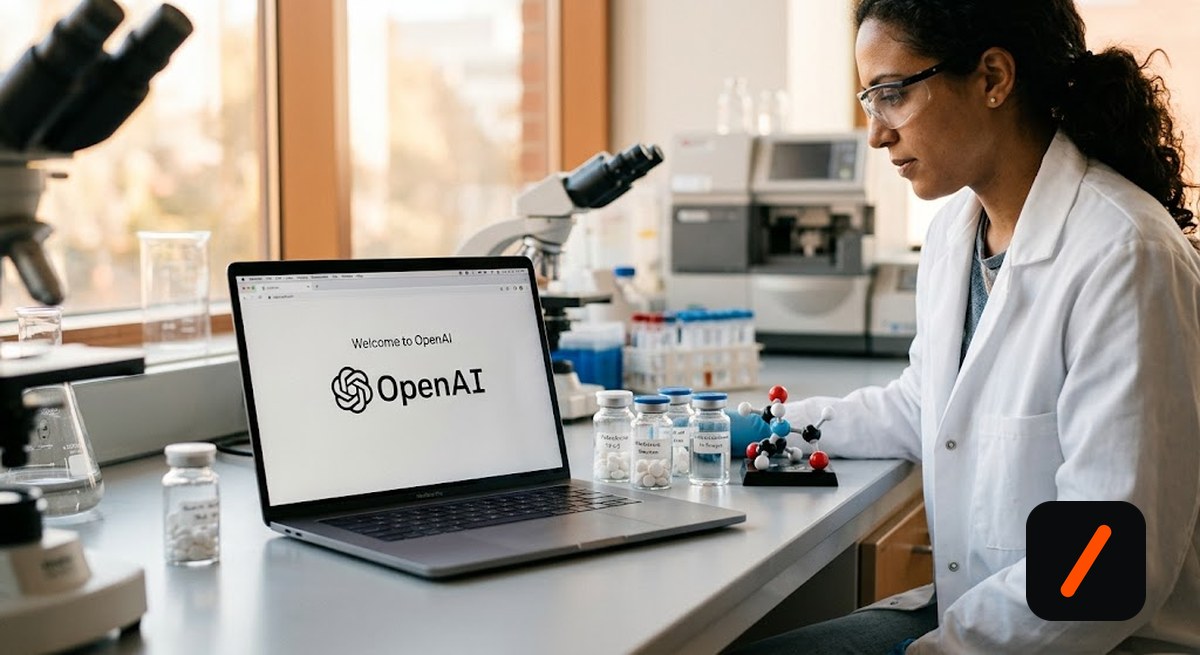
Miles Wang, an OpenAI researcher who joined the lab in 2024 after dropping out of Harvard, is in talks to leave and launch an AI drug-discovery startup at a roughly $2 billion valuation, TechCrunch reported on the afternoon of July 14, 2026. The company would raise about $200 million with Lightspeed in talks to lead, and several other OpenAI researchers are expected to follow him out the door. It is not a done deal, but it is the clearest sign yet that the talent building frontier language models now sees biology as the next place to point them.
- Who: Miles Wang, part of OpenAI's team using AI to accelerate scientific and biological research, is reportedly leaving to found his own company.
- The round: about $200M at a ~$2B valuation, with Lightspeed in talks to lead, per four people cited by TechCrunch. Wang disputed the figures but did not offer corrected numbers.
- The angle: the startup may build AI models that find new uses for existing or previously failed drugs, a repurposing bet that reaches revenue faster than designing molecules from scratch.
- The pattern: it lands the same day Chai Discovery, founded by another ex-OpenAI researcher, was reported raising $400M at a $3.8B valuation. AI-to-biotech is now a migration, not a one-off.
What exactly is Miles Wang building?
Wang is not a career biologist, and that is part of the story. At OpenAI he worked on using models to accelerate scientific and biological research, co-authoring papers including work on measuring AI's ability to speed up wet-lab biology. According to TechCrunch's sources, the new company may focus on AI models that identify new uses for existing drugs, and potentially for compounds that already failed clinical trials for their original purpose. That is a deliberate choice. Designing a novel molecule and carrying it through years of toxicology and Phase-1 through Phase-3 trials is where most drug startups burn a decade and a billion dollars. Repurposing an approved drug means the safety data already exists, so a correct prediction can jump much closer to patients and revenue. For a founder whose edge is machine learning rather than medicinal chemistry, it is the version of the problem where the AI does the heavy lifting. Wang has disputed both the funding figures and the company description reported by TechCrunch, but tellingly did not supply corrected details, and Lightspeed declined to comment.
RelatedOpenAI Shops a $1.5 Trillion Valuation Ahead of a 2027 IPO
Why does repurposing make this a smart first bet?
The economics of drug development are brutal in a way software people usually underestimate. The failure rate for a novel compound entering human trials is roughly nine in ten, and the ones that fail often do so late, after enormous spend, on safety or efficacy grounds no model could have fully predicted. Repurposing changes the risk shape. When you start from a drug that already cleared safety in humans, the remaining question is narrower and far more AI-shaped: does this known-safe molecule bind or modulate a target relevant to a different disease? That is a prediction problem over well-characterized chemistry and biology, exactly the kind of pattern-finding large models are good at, and the downside of a wrong guess is a failed efficacy readout rather than a toxicology disaster. It is the same instinct that made Wang's OpenAI cohort valuable: point a strong predictor at a search space where being right is worth a fortune and being wrong is survivable.
| Startup | Wang's startup | Chai Discovery | Isomorphic Labs | Recursion |
|---|---|---|---|---|
| Reported valuation | ~$2B (in talks) | $3.8B | ~$2B+ post-raise | Public (RXRX) |
| Latest raise | ~$200M (in talks) | $400M | $2.1B Series B (May) | Public markets |
| Founder pedigree | Ex-OpenAI | Ex-OpenAI (Josh Meier) | DeepMind spinout | Biotech-native |
| Core bet | Drug repurposing (reported) | Structure prediction | De novo design | Phenomics + ML |
| Backers | Lightspeed (in talks) | Oak HC/FT, General Catalyst, OpenAI | Thrive, GV, others | Nvidia, public |
The comparison that matters most is Chai Discovery, because it broke the same day and shares the same origin story: a former OpenAI researcher, Josh Meier, raising a mega-round at a multi-billion valuation for AI-driven biology. Two OpenAI alumni commanding $2B-plus valuations for drug companies in a single afternoon is not a coincidence. It is the market pricing in a thesis.
Why are OpenAI researchers leaving for biotech?
Three forces are pushing at once. First, capital: investors poured $11.4 billion into AI drug-discovery companies in 2025, more than double the $5.6 billion of the year before, and about $5.5 billion has already gone in this year, so a credible founder can raise a nine-figure round on a pitch deck. Second, credibility: DeepMind's AlphaFold made protein structure a solved-enough problem to build on, and its Isomorphic Labs spinout raising $2.1 billion in May proved a lab-born AI-bio company can attract pharma-scale money. Third, opportunity cost: a senior researcher inside a frontier lab is one of thousands; the same person founding a company that pairs their modeling skill with a trillion-dollar industry's inefficiency owns the upside. When the person who understands the models best can raise $200 million to aim them at cancer instead of chatbots, some of them will.
RelatedNvidia's $750B AI Deals Just Spooked Its Own Bondholders
What it means for the market
No public stock moves directly on a private round that is still in talks, but the signal for investors is a repricing of the whole AI-bio category. Publicly traded proxies like Recursion Pharmaceuticals (RXRX) and Schroedinger (SDGR) are the liquid way to express the thesis these private mega-rounds validate, and each new $2B-plus valuation resets the benchmark those names are measured against. The larger tell is for big pharma: Eli Lilly (LLY) and Pfizer (PFE) have both been writing checks into AI drug-discovery startups rather than only building in-house, and a wave of well-funded, OpenAI-pedigreed challengers raises the price of the platforms and talent they will eventually want to acquire. The savvy read is to watch which incumbent partners with, or buys, one of these startups first, because that is when the private-market enthusiasm becomes a public-market number. This is analysis, not investment advice.
How the AI-to-biotech wave built up
- 2024$5.6B flows into AI drug discovery. A strong year that 2025 would nearly double.
- 2024Wang joins OpenAI. Works on using AI to accelerate scientific and biological research.
- 2025Funding jumps to $11.4B. PitchBook records more than double the prior year across the category.
- May 2026Isomorphic Labs raises $2.1B. The DeepMind spinout proves AI-bio can attract pharma-scale money.
- Jul 14, 2026Chai Discovery reported raising $400M at $3.8B. Founded by another ex-OpenAI researcher, Josh Meier.
- Jul 14, 2026Wang in talks to launch at ~$2B. About $200M with Lightspeed in talks to lead, per TechCrunch.
- 2026Round closes, or it doesn't. The reported details are unconfirmed and Wang disputes the numbers.
- Does the round actually close? This is reported as in talks, and Wang disputes the figures. A confirmed filing or announcement is the first real milestone.
- Who follows him out. "Several OpenAI researchers" joining would signal a genuine team spinout, not a solo bet, and would tell you how deep the AI-to-bio drain runs.
- Repurposing or de novo. If the company confirms a repurposing focus, expect faster clinical timelines but crowded competition; a from-scratch bet would be slower and riskier.
- Pharma's response. Watch whether Lilly, Pfizer or a big platform partners with or acquires one of these OpenAI-pedigreed startups first.
Our take
Strip away the caveats and this is a real signal even if this specific round never closes. The most capable people at the most capable AI lab are concluding that the highest-leverage use of their skills is not the next model, it is pointing existing models at industries where prediction is worth billions, and drug discovery is the obvious first target. A repurposing-first strategy is the smart, unglamorous version of that bet: it plays to an ML founder's strengths and dodges the safety-trial gauntlet that kills novel drugs. The risks are honest. Wang disputes the numbers, the biology is harder than a benchmark, and a lot of this $11.4 billion will fund companies that discover nothing. But when two OpenAI alumni command multi-billion-dollar valuations for drug startups on the same afternoon, the story is no longer about one researcher. It is that the AI talent war has a second front, and it runs straight through biotech.
- ReportTechCrunch: OpenAI researcher in talks to launch AI drug-discovery startup the original reporting by Marina Temkin
- Referencemileskwang.com Wang's personal site and research
- ContextIsomorphic Labs the DeepMind spinout that raised $2.1B in May 2026
- FundingGenZTech Funding Tracker our running record of major tech and AI rounds
- DataPitchBook venture funding figures for AI drug discovery
Original analysis by GenZTech. Based on reporting by TechCrunch; figures reported as of July 14, 2026 and unconfirmed.