
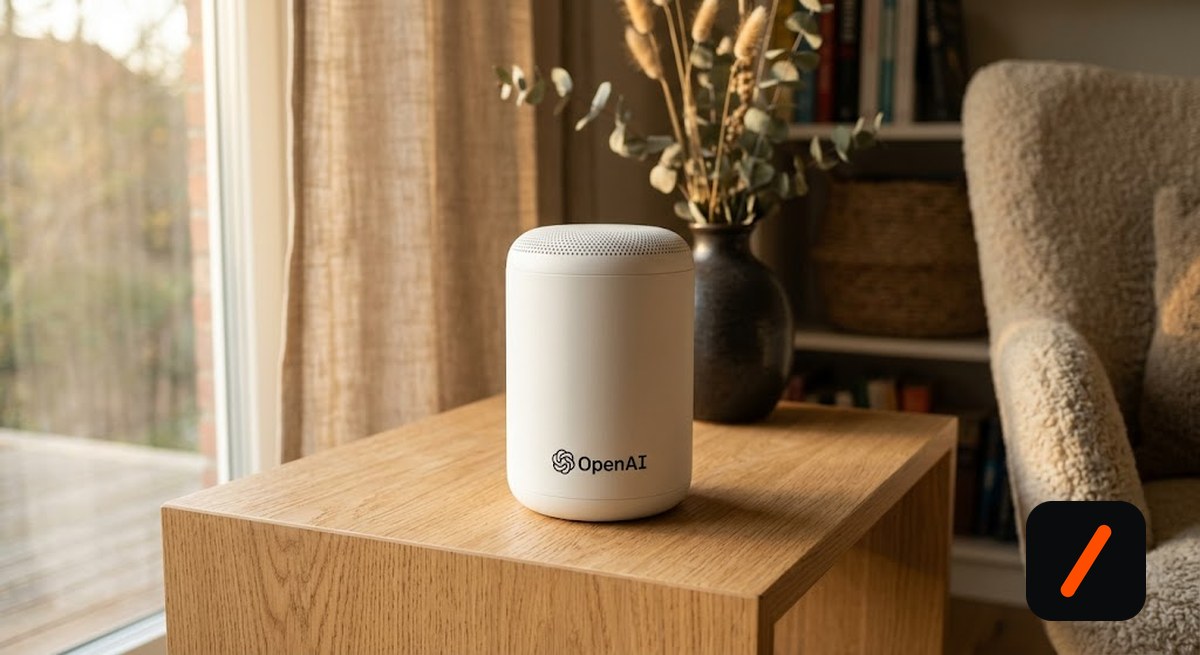
OpenAI's first hardware product will be a portable, screenless smart speaker that watches its surroundings and acts as an always-on AI companion, according to a Bloomberg report published this morning by Mark Gurman. The device relies entirely on voice, packs a camera and sensors to read the room, runs on a battery so it can move between rooms, and is meant to grow more proactive as it learns its owner. OpenAI is weighing a debut later this year before a wider launch expected in early 2027, with a reported price of $200 to $300.
- The first device is a mobile, screen-free speaker built as a "humanlike AI companion" for the home, not a phone or a pair of glasses.
- It includes a camera, environmental sensors, and a Face ID style recognition feature, and it can be used to make purchases by voice.
- OpenAI wants it to be proactive: an internal presentation described it suggesting an earlier bedtime before a morning meeting.
- The product is being designed with Jony Ive's LoveFrom studio following OpenAI's roughly $6.5 billion acquisition of his io hardware team.
What did the report actually say?
Bloomberg's Mark Gurman reported that OpenAI's long-teased hardware push will start with a mobile, screen-free smart speaker designed to be "a new type of home computer for the AI era." The device is meant to sit in the home as a humanlike companion. It relies on voice rather than a display, uses a built-in camera and other sensors to understand its surroundings, and responds based on a user's immediate context. Its core jobs sound familiar: control smart-home appliances, play media, answer questions, respond to messages, and tap the full range of ChatGPT's capabilities. A rechargeable battery lets you carry it around the house instead of tethering it to one outlet. The reported price sits between $200 and $300, and OpenAI may show it later this year before a broader launch that earlier reporting placed in early 2027.
RelatedOpenAI's Astra for Law Brings GPT-6 to Am Law 200 Firms
How is this different from an Amazon Echo?
On paper it is another voice speaker. In practice OpenAI is betting on two things a standard Echo or HomePod does not do. First, the camera and sensors give it situational awareness, so it answers based on what it can see and hear around you, not just the words you speak. It also reportedly includes a Face ID style recognition feature and lets you make purchases by voice, which means it needs to know who is in the room. Second, and more important, it is designed to be proactive. In an internal presentation, employees were told the speaker would observe users and suggest actions to help them hit their goals, the example being a nudge toward an earlier bedtime before a morning meeting. That shift from "assistant that waits for a command" to "companion that volunteers advice" is the entire product thesis, and it is also where the privacy questions start.
| Home speaker | OpenAI (reported) | Amazon Echo | Apple HomePod |
|---|---|---|---|
| Screen | None, voice only | Some models | None (mini) / small |
| Camera | Yes, reads context | No (on speakers) | No |
| Portable | Yes, battery | Mostly plugged in | Plugged in |
| Proactive | Core pitch | Limited routines | Limited |
| Reported price | $200 to $300 | $50 to $150 | $99 to $299 |
Why is OpenAI building hardware at all?
Because ChatGPT lives inside other companies' devices, and OpenAI wants a front door it controls. Every query today runs on an iPhone, an Android, or a browser owned by Apple, Google, or Microsoft. A dedicated home device gives OpenAI its own always-on surface, its own sensor data, and a direct relationship with the user that no platform gatekeeper can throttle. It is the same logic that pushed Amazon and Google into speakers a decade ago, now aimed at an AI that can genuinely converse. The bet is expensive and slow: hardware margins are thin, the smart-home market is crowded and mature, and a 2027 timeline leaves plenty of room for the plan to slip.
- 2025OpenAI acquires Jony Ive's io hardware startup ~$6.5 billion deal
- Feb 2026First reports peg the debut device as a camera smart speaker 2027 launch floated
- July 2026Apple sues OpenAI over alleged trade-secret theft in hardware days before this report
- Jul 14, 2026Bloomberg details the screenless, movable, proactive companion $200 to $300 reported
- Late 2026 / 2027Possible reveal, then wider launch timeline unconfirmed
What does it mean for the market?
The signal for investors is that the home-assistant category, largely written off as a low-margin dead end, is about to get a well-funded new entrant with the strongest AI on the market. Amazon (AMZN) and Alphabet (GOOGL) own the installed base with Echo and Nest, and a credible OpenAI companion pressures both to make Alexa and Gemini-powered speakers genuinely proactive rather than glorified timers. Apple (AAPL) is the most exposed on two fronts: it competes directly with HomePod and a long-delayed smarter Siri, and it just sued OpenAI over trade secrets tied to this very hardware effort, a sign of how seriously Cupertino takes the threat. The read is not "buy or sell" but "watch": whether the incumbents accelerate their own AI hardware, and whether OpenAI can ship physical products on time, are the two variables that decide if this is a real market shift or another slideware companion device.
RelatedChatGPT Told a Pastor to Rest. He Got Pulmonary Embolisms.
- The reveal. Whether OpenAI actually shows hardware this year or the timeline slips again toward 2027.
- Privacy design. How an always-listening, camera-equipped, face-recognizing home device handles data, and what regulators say.
- Apple's lawsuit. Whether the trade-secret suit forces design changes or delays the io team's roadmap.
- Incumbent response. Whether Amazon and Google ship truly proactive speakers before OpenAI ever ships one.
Our take
The hardware here is unremarkable, and that is the point. A screenless speaker with a camera is not new; Amazon and Google tried cameras in the home years ago and mostly retreated. What is new is the intelligence behind it and the ambition to make it act unprompted. If OpenAI can build a device that credibly says "you should sleep earlier tonight" and be right, it changes the relationship people have with a home assistant from tool to roommate. That is also the scary version. An always-on companion that watches, recognizes faces, remembers everything, and spends money by voice is a lot of trust to hand a single company, and OpenAI has not yet earned a track record on consumer privacy. The most telling detail is not the spec sheet, it is that Apple felt threatened enough to sue before the thing even exists. Ship date aside, the industry already believes this device matters.
- OfficialBloomberg: OpenAI's first device Mark Gurman's report with device details
- ReferenceOpenAI x Jony Ive (io) the hardware partnership behind the device
- ReferenceEarlier reporting on the 2027 speaker February 2026 details on price and timeline
Original analysis by GenZTech. Reporting informed by Bloomberg.