
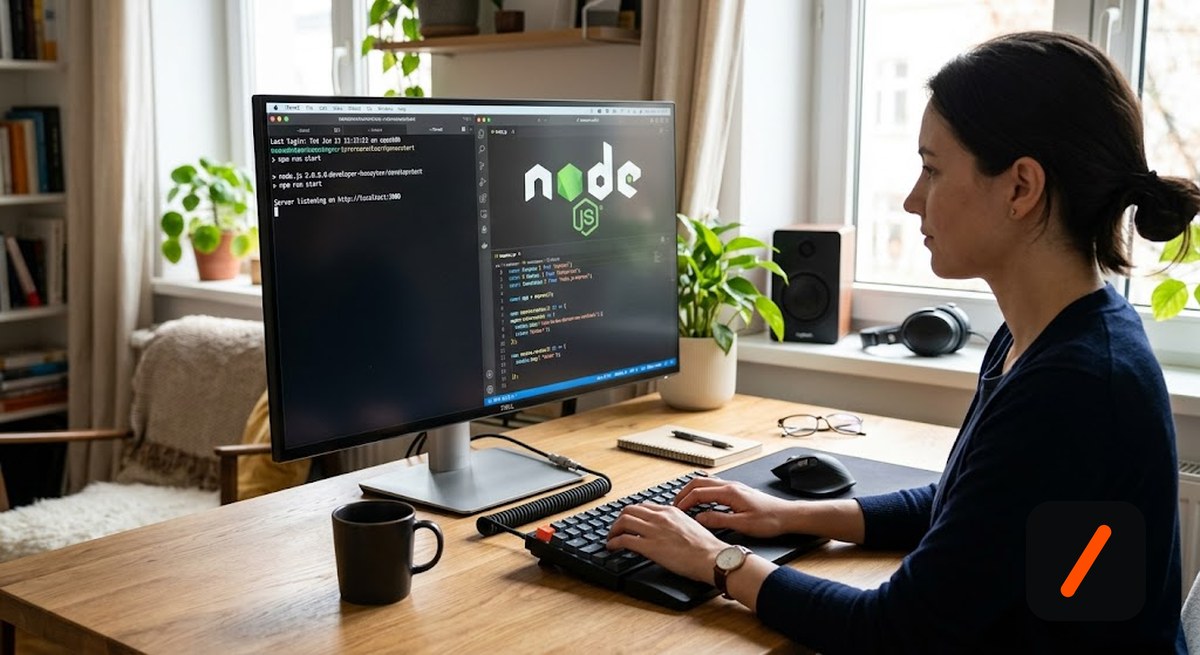
Node.js 26.0.0 is out as the new Current release, and the headline is a genuinely useful one for anyone who has ever fought JavaScript's Date object: the Temporal API is now enabled by default, no experimental flag required. Alongside it, V8 jumps to 14.6, Undici to 8.0, and a cluster of legacy modules get removed. It is also a quietly historic build, the last Node release under the old odd-even numbering before the project moves to a yearly cadence.
- Temporal, the modern replacement for Date, ships on by default with real time-zone, calendar, and duration handling.
- V8 14.6 (from Chromium 146) adds the Upsert Map methods and Iterator.concat sequencing.
- Breaking changes: private _stream_* modules removed, writeHeader() gone, module.register() runtime-deprecated, readable streams now read one buffer at a time.
- Node 26 is Current for six months, becomes LTS in October 2026, and is the last release before the yearly schedule.
Why is Temporal the big deal?
JavaScript's Date has been a running joke for a decade: mutable, timezone-hostile, and full of footguns like zero-indexed months. Temporal replaces it with a proper design that separates instants, wall-clock times, calendar dates, and durations, and handles time zones and non-Gregorian calendars as first-class concepts. Shipping it enabled by default in a runtime, not behind a flag, is the moment it stops being a proposal you experiment with and becomes something you can build on in production. Server code that juggles scheduling, billing periods, or cross-timezone logic gets a correct primitive instead of a pile of moment.js-era workarounds.
RelatedDeno 2.7 Lands Temporal, Windows ARM, and Deploy GA
What could break my app?
The removals are where upgrades bite. The private _stream_* modules are gone, http.Server.prototype.writeHeader() is removed in favor of writeHead(), and module.register() is now runtime-deprecated. The subtle one is behavioral: readable streams now read a single buffer at a time instead of reading ahead, which can shift throughput and backpressure characteristics in data-heavy pipelines. Native addons must be recompiled because NODE_MODULE_VERSION moved to 142, and building from source now requires GCC 13.2 and drops Python 3.9. None of this is dramatic, but it is exactly the kind of change that turns a lazy dependency bump into a failed CI run.
Should I upgrade now or wait?
Node 26 is Current, not LTS, until October 2026, and the project's own guidance is that Current releases suit development and testing while production stays on Active LTS, currently Node 24. The pragmatic move is to start testing against 26 now, especially to shake out the stream and addon changes, and hold production on 24 until 26 crosses into LTS. Adopting Temporal early in non-critical services is a low-risk way to get familiar before it is everywhere.
| Line | Node 26 | Node 24 | Node 22 |
|---|---|---|---|
| Status | Current | Active LTS | Maintenance LTS |
| Temporal default | Yes | No | No |
| V8 engine | 14.6 | Older | Older |
| Best for | Dev / testing | Production | Legacy support |
What about the yearly cadence?
Node 26 being the last odd-even release marks a governance shift toward a predictable yearly major cycle. For teams, that is good news: fewer surprise majors, clearer planning windows, and a release rhythm closer to how large organizations actually schedule upgrades. It is a maturity signal for a platform that still runs a large share of enterprise back ends.
RelatedJava 27 Ships With Post-Quantum TLS and Default G1 GC
- Stream regressions. The one-buffer-at-a-time read change is the most likely source of subtle throughput surprises in data pipelines.
- Temporal adoption. Watch how fast libraries drop Date-based helpers in favor of Temporal now that it is a default.
- LTS date. October 2026 is when 26 becomes production-appropriate; plan the migration window around it.
Our take
Most Node releases are dependency bumps you skim and forget. This one has a headline feature developers have wanted for years, and shipping Temporal on by default is the kind of quality-of-life win that outlasts any benchmark. The removals mean you cannot upgrade on autopilot, but the payoff, correct date handling as a runtime primitive, is worth the CI pass it takes to get there. Test now, migrate at LTS, and delete some moment.js.
What else is in the box?
Beyond the headliners, Node 26 bumps Undici, its HTTP client, to 8.0, refreshes ICU to 78.3 and libuv to 1.52.1, and enables the Percentile extension in the bundled SQLite integration, a small but genuinely useful addition for anyone doing lightweight analytics without a separate database. On the security side the release folds in a fix for a V8 array-index hash-collision issue tracked as CVE-2026-21717, which alone is reason to test the upgrade path rather than sit indefinitely on an older line. The practical migration checklist is short but real: recompile native addons against module version 142, swap any writeHeader() calls for writeHead(), retire private _stream_* imports, and profile stream-heavy code for the one-buffer-at-a-time read change before you promote anything to production.
- OfficialNode.js 26.0.0 release notes nodejs.org
- ReportNode.js 26: Temporal by default, V8 14.6, deprecations InfoQ
Original analysis by GenZTech. Reporting via nodejs.org.