
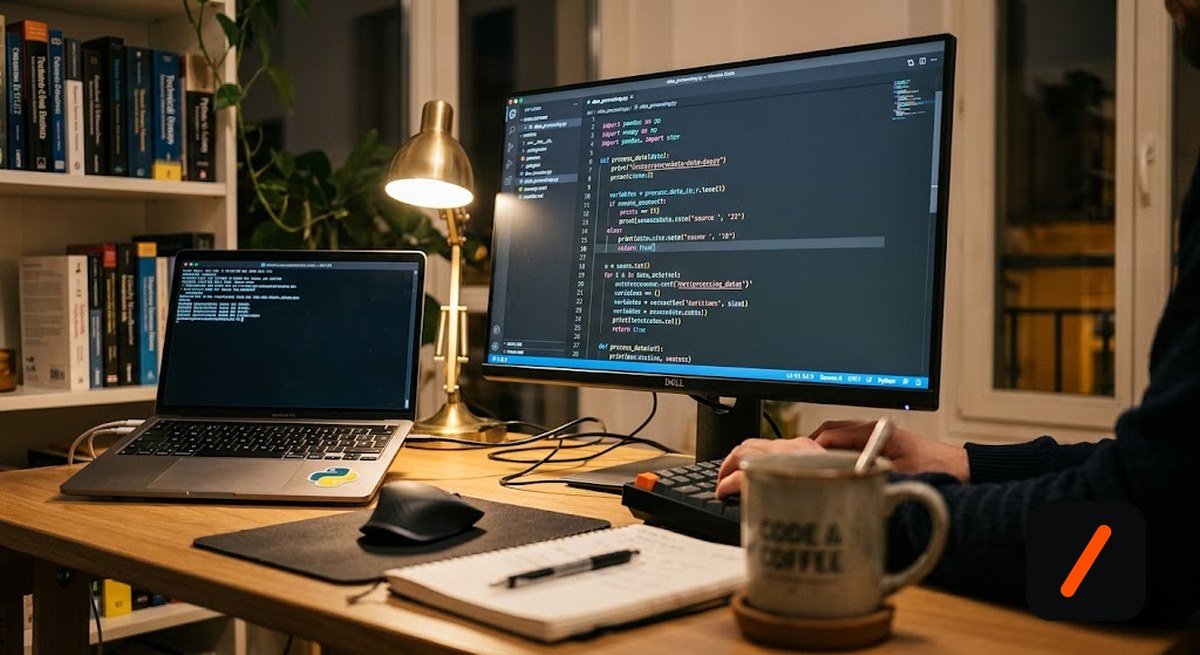
Python 3.14 is the release where the Global Interpreter Lock, the 30-year-old rule that let only one thread run Python at a time, stops being a fact of life. The free-threaded build is now officially supported instead of experimental, and 2026 is the year the ecosystem catches up: the libraries you actually use are beginning to ship free-threaded wheels, which is what turns "no-GIL" from a compiler flag into real parallel speed.
- The GIL is not gone, it is optional. Python 3.14 ships two builds, standard and free-threaded, so the change is opt-in and existing single-threaded code keeps its behavior.
- Officially supported changes everything. In 3.13 free-threading was experimental; in 3.14 it is a supported build, which is the signal maintainers were waiting for before investing in compatibility.
- The bottleneck was never the language, it was the lock. CPU-bound Python could not use multiple cores in one process; free-threading lets threads run genuinely in parallel for the first time.
- 2026 is the ecosystem year. The runtime works; the remaining work is C extensions and packages shipping free-threaded wheels so real apps see the benefit.
What did the GIL actually do?
The Global Interpreter Lock is a mutex inside CPython that guarantees only one thread executes Python bytecode at any moment. It made the interpreter simpler and single-threaded code fast, and for I/O-bound work, waiting on a network or a disk, it was mostly invisible because threads release the lock while they wait. The pain was CPU-bound work: if you wanted to use all your cores to crunch numbers, threads were useless because they serialized on the lock, so Python programmers reached for multiprocessing, which copies memory across processes and pays a heavy communication tax. Free-threading removes the lock so threads can finally do parallel CPU work inside one process, sharing memory directly.
RelatedDeepSeek Ports Its Core AI Kernels to Huawei Ascend
Why is 3.14 the turning point and not 3.13?
Because "experimental" and "supported" are different promises to the ecosystem. Free-threaded CPython first shipped as an experimental option, which meant maintainers of the big C-extension libraries, the numerical and data packages that hold up most of Python's real workloads, had little reason to do the hard work of making their code thread-safe against a build that might change or disappear. Officially supported status in 3.14 flips that calculus. It tells maintainers the no-GIL build is here to stay, worth testing against, and worth shipping compatible wheels for. That is why 2026 is the year the story moves from "the runtime can do it" to "your dependencies can too."
| Trait | Free-threaded build | Standard build |
|---|---|---|
| GIL | Disabled | Enabled |
| Threads on CPU work | Run in parallel | Serialize on the lock |
| Single-thread speed | Small overhead | Baseline |
| C-extension needs | Thread-safe wheels | Existing wheels |
| Status in 3.14 | Officially supported | Default |
What is the catch?
Two real ones. First, single-threaded code can run slightly slower in the free-threaded build because removing the lock adds bookkeeping the standard build does not pay, so you only come out ahead when you actually parallelize CPU work. Second, and bigger, is the C-extension problem: a decade of native libraries assumed the GIL protected their internal state, and running them without it can expose data races. Making those extensions thread-safe is careful, unglamorous work, and until the packages you depend on ship free-threaded wheels, flipping to the no-GIL build can mean crashes or subtle bugs rather than free speed. That is precisely why the officially-supported milestone matters: it is the starting gun for that migration, not the finish line.
Who benefits first?
Anyone whose bottleneck is CPU inside one process and who has been paying the multiprocessing tax to work around it. Data pipelines, scientific computing, web servers doing meaningful in-process computation, and increasingly the glue code around AI workloads that shuffles and transforms data on the way to a GPU. For these, free-threading means using every core with plain threads, shared memory, and none of the serialization and copy overhead that multiprocessing forces. It also simplifies code: a thread pool is easier to reason about than a process pool with its pickling and inter-process plumbing. The people who see nothing are those whose Python is already I/O-bound or already offloads the heavy math to native libraries that hold their own locks.
RelatedZig Nears 1.0 With a Radical New I/O Model
- Wheel coverage. Track how many of the top C-extension packages ship free-threaded wheels; that number is the real progress bar for adoption.
- Default flips. Watch for the first major distributions and cloud runtimes offering the free-threaded build by default, the signal it has crossed from opt-in to normal.
- Faster CPython. Free-threading lands alongside the broader effort to speed up the interpreter; the two together reshape where Python is fast.
Our take
The GIL was the single most-complained-about limitation in Python for a generation, and the reason so many teams quietly rewrote hot paths in Go, Rust, or C. Python 3.14 does not magically make every program four times faster, and anyone selling it that way is skipping the C-extension reality that will define the next two years. But "officially supported" is the milestone that actually matters, because it is the one that convinces the ecosystem to move, and the ecosystem moving is what makes a language feature real. The GIL is not dead yet, it is optional and the default still has it, but 3.14 is the release where its end went from a research project to a schedule. For a language this widely used, that is a genuinely big deal.
- Official Python 3.14 What's New free-threaded build status and changes
- Governance PEP 703, making the GIL optional the design and rollout plan
- Analysis InfoWorld, Python starts 2026 with a bang the ecosystem momentum this year
Original analysis by GenZTech. Details via the Python 3.14 release notes.