
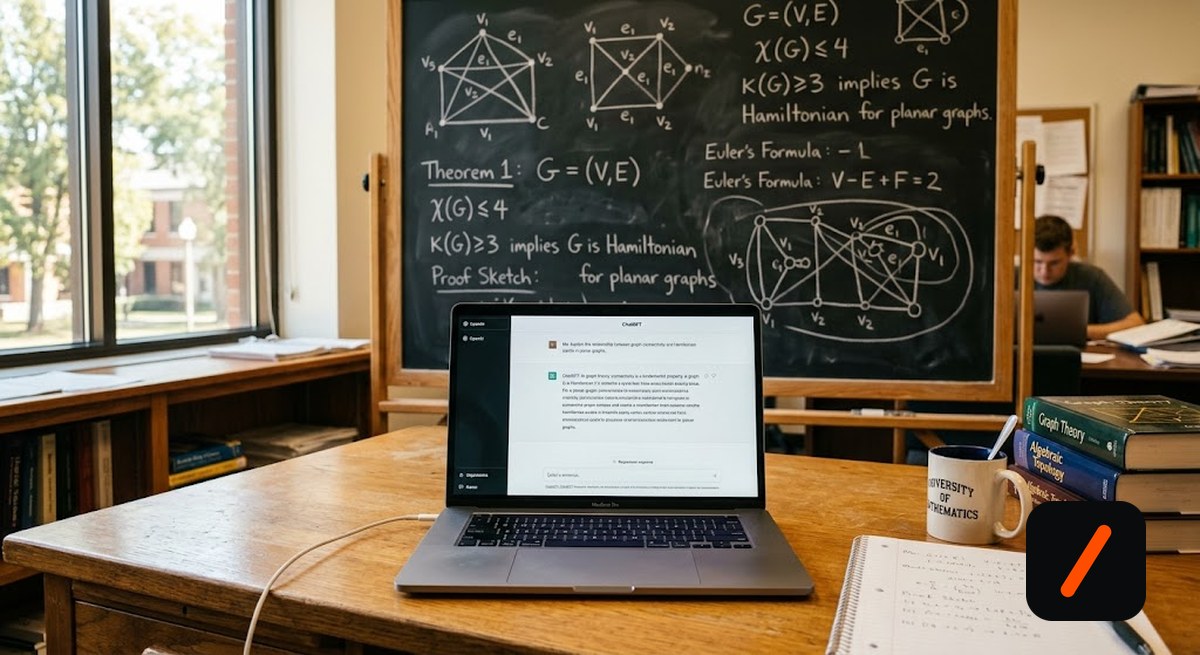
OpenAI says its top-tier GPT-5.6 Sol Ultra model produced a complete proof of the Cycle Double Cover Conjecture, a graph-theory problem that had resisted mathematicians for roughly 50 years, and it did so in under an hour by splitting the work across 64 reasoning subagents running in parallel. If the proof holds up under human and formal review, it is the most consequential single result an AI system has claimed in pure mathematics. The honest caveat: a machine-generated proof is a claim until the community checks it, and that verification is now the real story.
- GPT-5.6 Sol Ultra, the strongest tier of the series OpenAI launched July 9, reportedly output a full proof of the Cycle Double Cover Conjecture in less than 60 minutes.
- The run used 64 subagents in parallel, each chasing different lemmas and cases, with a coordinating model stitching the pieces into one argument.
- The conjecture, open since the 1970s, says every bridgeless graph has a set of cycles covering each edge exactly twice, a deceptively simple statement with no known general proof.
- The result matters less as a math headline and more as a signal: frontier models can now sustain long, multi-step formal reasoning, not just pattern-match.
What is the Cycle Double Cover Conjecture?
Stated plainly, it claims that in any bridgeless graph (a network where you cannot disconnect it by cutting a single edge), you can find a collection of cycles such that every edge lies on exactly two of them. It sounds almost trivial, which is part of its fame. The conjecture was posed independently by George Szekeres and Paul Seymour in the 1970s, and despite enormous effort it has never been proven in general, only for special classes of graphs. It sits in the same family of stubborn combinatorial problems where the statement fits on one line and the proof, if it exists, has hidden for half a century.
RelatedMathematician Says OpenAI Pressured Him Over Navier-Stokes Credit
Why does the parallel-subagent approach matter?
The interesting engineering claim is not that a model "knew" the answer. It is that OpenAI ran 64 copies working different angles at once, then reconciled their outputs. That mirrors how human research teams and automated theorem provers actually make progress on hard problems: breadth-first exploration of cases, aggressive pruning of dead ends, and a verification layer that trusts nothing. If the method generalizes, the takeaway is that raw model quality is only half the equation. The orchestration, the ability to spawn, coordinate, and check many reasoning threads, is becoming its own frontier.
It also reframes compute. A one-hour run across 64 agents is a large, expensive job. The result suggests labs are willing to spend serious inference budget to buy a single hard answer, which is a very different economics than chat.
Who actually verifies an AI proof?
This is where enthusiasm should meet discipline. A proof is only accepted when experts, and ideally a formal system like Lean or Coq, confirm every step. Machine-generated arguments have a track record of looking airtight while quietly leaning on an unproven assumption. The credible path forward is a formalization: translate the output into a proof assistant that mechanically checks it. Until that happens, the correct posture is cautious interest, not celebration. OpenAI announcing a proof and the mathematics community accepting a proof are two separate events, and only the second one counts.
RelatedOpenAI's Astra Solves Ten Open Math Problems for $2,000
- Formal verification. Whether the proof is machine-checked in Lean or reviewed by graph theorists, not just posted.
- Reproducibility. If independent teams can rerun the subagent method on other open problems.
- Compute disclosure. How much inference the one-hour run actually consumed, which sets the real cost of "AI does math."
What does it signal for the AI race?
For investors and builders, the signal is capability depth, not a product. There is no ticker that moves directly on a graph-theory proof. But it strengthens the narrative that inference-heavy, agentic reasoning is where the next capability jumps come from, which favors the compute suppliers and the labs that can afford long parallel runs. It also raises the bar for rivals: a headline like this pressures every frontier lab to show comparable reasoning feats, and that competition is exactly what pushes capability forward. The read for anyone tracking the field is that the interesting benchmark is shifting from "can it answer" to "can it discover."
Our take
Treat this as a promising data point wrapped in an unverified claim. If the proof survives formal checking, it is a genuine milestone: an AI system contributing a real result to open mathematics, produced by orchestrating dozens of reasoning agents rather than a single lucky sample. If it does not, it becomes a cautionary tale about how convincing a wrong proof can look. Either way, the method is the message. The frontier is no longer just bigger models, it is many models thinking together under a verifier that refuses to be impressed. That is a healthier direction than hype, and it is worth watching closely.
- ReportGPT-5.6 launch and capability notes, July 2026 LLM-Stats
- ReferenceJuly 9, 2026 AI launch roundup BuildFastWithAI
- LeaderboardGenZTech AI model leaderboard verified scores
Original analysis by GenZTech. Reporting via LLM-Stats.