
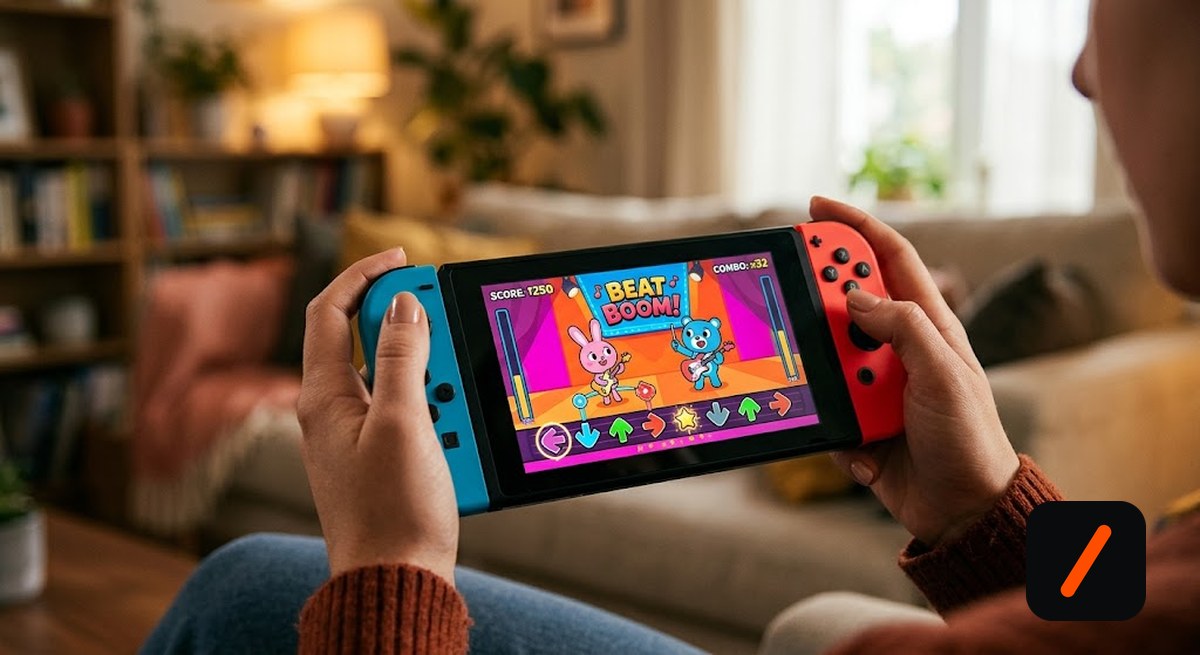
Nintendo is bringing back one of its most beloved cult series with Rhythm Paradise Groove, a colourful collection of timing-based minigames that can be played solo or with friends, featuring original music from longtime collaborator Tsunku. For a franchise that has sat largely dormant since its 3DS entry, the announcement is a genuine event: Rhythm Paradise (Rhythm Heaven in some regions) has one of the most devoted followings in Nintendo's catalog, and its return signals the company is again willing to bet on its weird, precise, deeply charming smaller series.
- Rhythm Paradise Groove is a new entry in Nintendo's rhythm-minigame series, playable solo or with friends.
- It features original music by Tsunku, the producer tied to the series since its inception.
- It ends a long gap for a franchise beloved for its simplicity, humor, and brutal timing precision.
- It arrives among a stacked Nintendo slate, alongside titles like Splatoon Raiders and Cozy Grove: Camp Spirit.
Why is this a big deal for fans?
Rhythm Paradise occupies a rare niche: a series that is mechanically simple, tap in time, yet demands genuine precision and rewards it with some of the most memorable, absurd little scenes Nintendo has ever made. It built a fervent community precisely because it never chased mass-market scale, which is also why it kept going quiet. A new mainline entry with Tsunku's involvement is the thing fans have asked for through years of dormancy, and Nintendo choosing to make it signals confidence that the audience is still there and worth serving.
RelatedStar Fox Returns as a Full Series Reboot on Switch 2
What do we actually know?
The confirmed details are deliberately light: it is a colourful collection of rhythm minigames, playable alone or with friends, with original Tsunku music. That last point matters more than it sounds. Tsunku's compositions and pop sensibility are inseparable from the series identity; his return is a signal that this is a real continuation rather than a spin-off wearing the name. Beyond that, Nintendo is keeping specifics, exact modes, song count, and multiplayer structure, close, which is standard for the company ahead of launch.
Where does it fit in Nintendo's slate?
It lands in a notably deep stretch for Nintendo, alongside single-player-focused entries like Splatoon Raiders and cozy titles like Cozy Grove: Camp Spirit. That context is telling. Rather than leaning only on system-selling giants, Nintendo is filling its calendar with distinctive smaller experiences, and reviving a dormant rhythm franchise fits that pattern of mining its catalog for variety. For players, it means the schedule is less about one blockbuster and more about breadth.
| Trait | Rhythm Paradise Groove | Typical big Nintendo title |
|---|---|---|
| Core loop | Timing minigames | Exploration / action |
| Session length | Short, pick-up-and-play | Long-form |
| Music role | Central (Tsunku) | Supporting |
| Audience | Devoted cult following | Mass market |
Can it win new players?
The series' strength, immediate simplicity, is also its accessibility advantage. Anyone can grasp tapping in time, and the local co-op angle makes it an easy sell for casual and family play. The risk is that its brutal timing windows and offbeat humor have always been an acquired taste, and rhythm games remain a niche genre commercially. Groove's job is to keep the precision that fans love while being welcoming enough at the entry point to convert curious newcomers.
RelatedCozy Grove: Camp Spirit Brings the Ghost Bears Back
- Mode reveal. How deep the multiplayer and content offering is will decide whether this is a full entry or a lighter package.
- Difficulty tuning. The series lives on precise timing; too easy loses fans, too punishing loses newcomers.
- Tsunku's soundtrack. The songs are the series' signature; the music reveal is the real hype moment.
Our take
Reviving Rhythm Paradise is a small decision with an outsized signal: Nintendo is still willing to make weird, precise, unmistakably its-own games for a passionate niche instead of only swinging for the biggest possible audience. That is the quality that made the series a cult favorite in the first place. If Groove keeps Tsunku's music front and center and the timing tight, it does not need to sell system-mover numbers to be a win. It just needs to be exactly the strange little rhythm game its fans have waited years for.
Why does the rhythm genre travel so well?
Rhythm games occupy a strange, durable corner of the medium: mechanically shallow enough that anyone can start in seconds, yet demanding enough that mastery feels earned. Rhythm Paradise built its cult on that tension, pairing dead-simple inputs with brutal timing windows and surreal, wordless comedy that needs no localization to land. That combination is why the series traveled across regions and generations despite never chasing blockbuster scale, and why its dormancy stung fans so much. Tsunku's involvement is the load-bearing detail, because in a genre where music is not the backdrop but the entire gameplay, the composer is effectively the game designer. Groove revives a template that ages remarkably well precisely because it was never built to chase trends in the first place.
- OfficialUpcoming games, July 2026 Nintendo
- RoundupJuly 2026 video game releases Screen Rant
Original analysis by GenZTech. Reporting via Nintendo.