
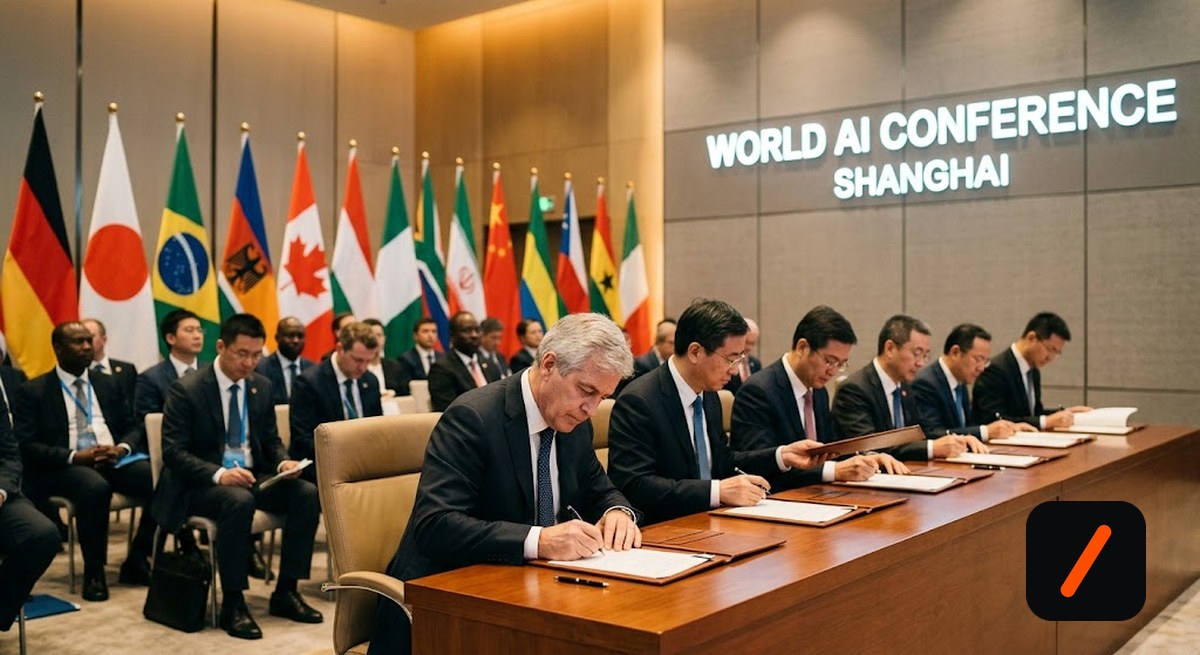
Twenty-nine countries signed an agreement in Shanghai on Thursday, July 16, 2026, establishing the World Artificial Intelligence Cooperation Organization (WAICO), an independent intergovernmental body headquartered in Shanghai. Chinese Foreign Minister Wang Yi signed on behalf of China, and UN Secretary-General António Guterres attended. The detail that matters: China proposed WAICO at last year's World AI Conference and not a single country had formally announced membership until this week. A proposal nobody joined for twelve months just became a treaty organization with 29 founding members overnight.
- Founding members include Russia, Belarus, Serbia, Cuba, Brazil and Venezuela, plus 10 African and 12 Asian countries. Kazakhstan, Laos, Pakistan and Indonesia are named signatories. Russia sent Digital Development Minister Maksut Shadayev.
- Headquartered in Shanghai, which makes it the first intergovernmental AI body based outside the Western institutional orbit.
- The timing is deliberate. The signing was staged on the eve of the World AI Conference and the High-Level Conference on Global AI Governance, running in Shanghai July 17-20, where Xi Jinping is expected to lay out Beijing's governance vision.
- No major US technology firms attended the Shanghai summit, which is itself the story about where this is heading.
What was actually signed?
An agreement establishing WAICO as an independent intergovernmental international organization headquartered in Shanghai. Per the text, the organization will "uphold the purposes of the UN Charter, be committed to extensive consultation and joint contribution for shared benefit and adhere to a people-centred approach," and aims to advance international cooperation and global governance on AI, ensuring the technology is safe, fair and beneficial.
RelatedSpaceX will run xAI's unpermitted turbines until July 2027
Read that carefully, because what is absent is as important as what is present. There is no published enforcement mechanism, no compute threshold, no model evaluation requirement, no licensing regime. It is a founding charter, not a rulebook. The rules, if any, come later, which is precisely why the membership list is the news rather than the text.
Why did 29 countries join now?
Because the offer changed. China proposed this body a year ago into a vacuum and got no takers. In the intervening year, two things happened. First, the EU AI Act moved from principle to compliance burden, and for countries with no domestic frontier lab, a regime whose main effect is regulating access to other people's models is not an attractive club. Second, Chinese open-weight models became genuinely good and genuinely available, which we saw again this week with Moonshot's Kimi K3.
That is the actual mechanism, and most coverage skips it. At last week's UN AI dialogue, Reuters reported that Washington argued heavy regulation would stifle breakthroughs while Beijing framed its low-cost, open-source models as a public good that could narrow global AI inequality. WAICO is the institutional form of that argument. For a country that will never train a frontier model, the pitch "join a body where the weights are shared with you" beats "comply with rules written where the models are." China spent the year building the leverage that made the invitation worth accepting, and open weights are that leverage.
Does it have any actual power?
Not yet, and possibly not ever in the way the EU does. Three things are missing. It has no regulatory jurisdiction over the labs that matter, since none of the countries hosting frontier AI development, the US, the UK, and the EU states, are founding members. It has no enforcement text that has been published. And it has no compute: the founding membership is drawn overwhelmingly from countries that are net consumers of AI, not producers.
What it does have is standing. An intergovernmental organization with a UN-Charter-referencing charter, a permanent Shanghai headquarters, the Secretary-General in the room, and 29 flags is a venue. Venues accumulate. They set defaults, publish standards, and become the place a certain conversation happens. The EU AI Act was also once a document with no enforcement.
| Dimension | WAICO | EU AI Act | G7 Hiroshima Process |
|---|---|---|---|
| Type | Intergovernmental treaty body | Binding regulation | Voluntary code |
| Founded | Jul 16, 2026 | 2024 | 2023 |
| Members | 29 founding states | 27 EU states | G7 + partners |
| Seat | Shanghai | Brussels | Rotating |
| Enforcement | None published | Fines up to 7% turnover | None |
| Hosts frontier labs? | No | Limited | Yes |
| Core pitch | Access and shared benefit | Risk control | Safety coordination |
Who does this affect?
If you ship software internationally, the near-term answer is nobody, and you should be suspicious of anyone telling you otherwise this week. There is no compliance obligation attached to a founding charter. The medium-term answer is more interesting: a 29-member bloc with a permanent secretariat is a standards-setting venue, and standards eventually become procurement requirements. If WAICO publishes model-provenance or data-sovereignty expectations that its members adopt for public-sector purchasing, that reaches anyone selling into those markets.
RelatedOpenAI's First Device Is a Screenless Smart Speaker
The group with the most immediate exposure is Western AI labs, and the absence of US technology firms from the Shanghai summit is a genuine strategic problem rather than a scheduling one. A governance bloc covering a substantial share of the world's population is being organized around the premise that open weights are a public good and that the labs which do not share them are the problem. That framing gets easier to sell every time a Chinese lab ships a competitive open model and a US lab does not.
- Jul 2025China proposes WAICO at the World AI Conference no country announces membership
- Jul 2026US and China set out rival approaches at a UN AI dialogue regulation vs open weights as public good
- Jul 16, 202629 countries sign the WAICO agreement in Shanghai Wang Yi signs; Guterres attends
- Jul 17–20, 2026World AI Conference; Xi expected to set out governance vision where the substance may appear
- Does a rulebook follow the charter? WAICO is a venue until it publishes something a member has to do. Watch the July 17-20 conference for the first substantive text.
- Does any G20 economy outside the founding 29 join? Brazil and Indonesia are already in. A second-wave signatory with a real tech sector would change the weight class.
- Is open-weight access made an explicit membership benefit? If Chinese labs formally route preferential access through WAICO, the body acquires the leverage its charter lacks.
- Does the US or EU build a counter-offer for non-producer states? Right now the West is selling compliance and China is selling access. Only one of those is a gift.
Our take
The instinct to dismiss this is understandable and wrong. WAICO has no enforcement power, no frontier labs, and a charter of pleasant abstractions, so on any checklist of regulatory teeth it scores zero. But that checklist measures the wrong thing. What changed this week is not that a rulebook appeared; it is that a proposal which sat empty for a year suddenly attracted 29 states, and the reason it did is that China spent that year making its open models good enough to be worth organizing around.
That is the connection worth holding onto, and it is why we ran this story alongside Kimi K3 today. Those are not two stories. A lab shipping a 2.8T open-weight model and a foreign ministry chartering an AI body 24 hours apart, in the same city, in the same week, is one strategy with two instruments. The West is offering the developing world a compliance regime for models it cannot see. China is offering weights it can download, plus a seat. We would not bet on the compliance regime winning that argument on merit alone, and the empty chairs where the US technology firms should have been in Shanghai suggest nobody is seriously contesting it yet.
- OfficialXinhua: 29 countries sign agreement on establishing World AI Cooperation Organization the signing, membership and charter language
- GovernanceWorld AI Conference, Shanghai July 17-20 programme and High-Level Conference on Global AI Governance
- ReferenceGenZTech: Kimi K3, the largest open model ever the open-weight leverage underwriting the diplomacy
Original analysis by GenZTech. Signing reporting via Global Times and The Next Web.