
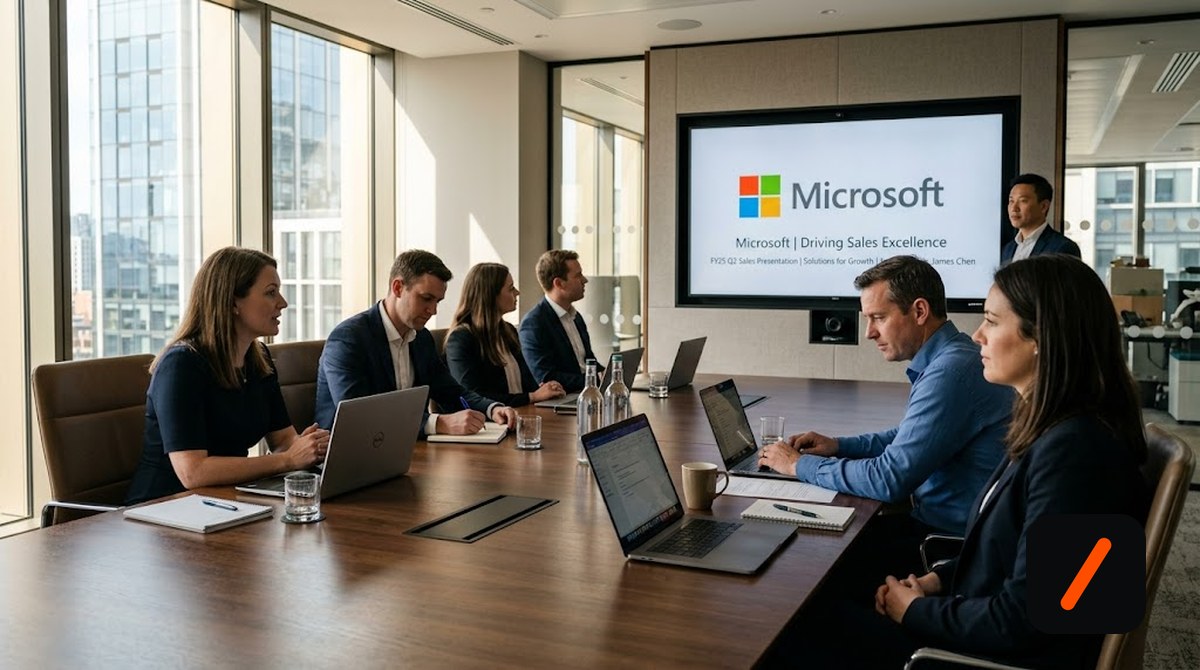
Microsoft has started coaching its global sales force to actively talk down OpenAI and Anthropic, according to a Bloomberg report published on the morning of July 15. In internal fiscal-year strategy meetings held this week, executives told staff to pitch Microsoft as the cheaper, more secure, and more complete alternative to the two AI labs it also partners with. That is a striking turn for a company that has poured billions into OpenAI and licenses Anthropic's Claude inside its own Copilot products.
- Microsoft's FY2027 sales script rests on three attack lines: lower cost, tighter enterprise security, and a "complete system" versus rivals it casts as "selling parts."
- EVP Jacob Andreou showed staff a side-by-side of Microsoft Copilot against Anthropic's Claude, calling the rival model slower, less accurate, and weaker on enterprise security integrations.
- EVP Jay Parikh urged the team to repeat the "complete system, not parts" line all year, while CEO Satya Nadella framed AI cost control as customers' top concern for the year ahead.
- The playbook lands as Microsoft quietly swaps OpenAI and Anthropic models for its own cheaper MAI models inside Excel and Outlook.
What did Microsoft actually tell its salespeople?
According to Bloomberg, executives used internal presentations this week to lay out the sales strategy for the fiscal year that began this month. The message was blunt: Microsoft offers lower costs, stronger security controls, and a more complete suite of products than the standalone AI labs. Executive Vice President Jay Parikh told staff that while competitors are "selling parts," Microsoft is offering a complete system, and he framed that line as the narrative the team should broadcast all year. Executive Vice President Jacob Andreou went further with a direct product comparison, presenting a side-by-side analysis of Microsoft's Copilot against Anthropic's Claude inside the Microsoft 365 office suite, and characterizing the rival model as slower, less accurate, and lacking the enterprise-grade security integrations large customers need.
RelatedNvidia's $750B AI Deals Just Spooked Its Own Bondholders
Why attack partners it pays billions to?
This is the part that makes the report notable. Microsoft is not a neutral competitor to OpenAI and Anthropic. It remains OpenAI's largest backer and its cloud is a primary home for OpenAI models, and it licenses Anthropic's Claude to power parts of Copilot. Coaching a sales force to undercut both at once is a public admission that the partnership era and the competition era now run in parallel. The motive is cost. Microsoft has been steadily replacing the most advanced OpenAI and Anthropic models with its own cheaper MAI family inside products like Excel and Outlook, where tens of thousands of prompts are now served each week by in-house models. Microsoft AI chief Mustafa Suleyman said last month that Anthropic is extremely expensive and that many customers are urgently seeking alternatives, adding that Microsoft's goal is to reduce and ultimately eliminate what it pays Anthropic.
How strong is the cheaper-and-more-secure pitch?
Cost is the pillar with the hardest evidence behind it. Nadella has said the ability to monitor AI spending and switch to cheaper models will be a top customer concern this year, and Microsoft is leaning on a concrete example: consumer-goods giant Unilever swapped a highly advanced model for a more economical Microsoft version and is projected to save roughly $300 million. That is a number a salesperson can put on a slide. The security and completeness pillars are softer, resting on Microsoft's argument that a model wired directly into Microsoft 365, Entra identity, and its compliance tooling is safer than a bolt-on chatbot. The tension is that Microsoft is publicly calling its own MAI models good enough to displace OpenAI and Anthropic in shipping products while also, at times, conceding those frontier models are more sophisticated.
| Attack line | Microsoft's pitch | What backs it | The counter |
|---|---|---|---|
| Cost | Cheaper models plus spend controls | Unilever cited at ~$300M saved; MAI in Excel/Outlook | Frontier tasks may still need pricier models |
| Security | Native Microsoft 365 and identity controls | Deep Entra and compliance integration | Labs are shipping enterprise security fast |
| Completeness | "Complete system, not parts" | Full app suite plus Azure | OpenAI and Anthropic now field deployment teams |
The rivals are not standing still, which is part of why the pitch exists. Amazon, Anthropic, and OpenAI have all built out AI deployment groups this year, with Anthropic and OpenAI each standing up forward-deployed engineering teams in May to embed engineers with banks, consulting firms, and other large accounts. Those teams move the labs directly onto the enterprise turf Microsoft has long owned through its sales relationships, so the "complete system" message is as much defense as offense.
RelatedMeta's Muse Spark 1.1 Chases Anthropic and OpenAI
How did we get here?
- May 2026OpenAI and Anthropic launch forward-deployed engineering teams labs push into enterprise accounts directly
- Jun 2026Suleyman: Anthropic is "extremely expensive," goal is to cut the bill cost motive stated on the record
- Jul 2Microsoft commits $2.5B and 6,000 staff to an AI implementation unit building its own deployment muscle
- Jul 7Microsoft replaces OpenAI and Anthropic models with MAI in some apps Excel and Outlook prompts shift in-house
- Jul 15Sales force coached to undercut both labs on cost, security, breadth the strategy goes public via Bloomberg
What it means for the market
The signal for investors is that Microsoft is trying to convert its distribution advantage into pricing power over its own AI suppliers. For Microsoft (MSFT), shifting workloads to MAI models improves gross margins on Copilot and reduces a large, growing payment to Anthropic and OpenAI, so watch AI cost-of-revenue commentary on the next earnings call. For Nvidia and the wider infrastructure trade the read is neutral to positive near term, since MAI still runs on GPUs, but a world where the biggest software vendor prizes cheaper models over frontier ones pressures the premium the labs can charge. This is factual analysis, not investment advice: the takeaway is that the competitive front in enterprise AI is moving from raw model quality to cost, security, and who controls the customer relationship, and Microsoft just told its sales force to fight on exactly that ground.
- Win rates, not talking points. The tell is whether Copilot displaces Claude or ChatGPT Enterprise in real deals, not the internal slides.
- MAI quality gap. Microsoft needs its own models to be "good enough" for the tasks it moves in-house, or the cost pitch backfires on accuracy.
- Partner friction. Watch how OpenAI and Anthropic respond to being publicly undercut by a major backer and licensee.
- The Anthropic bill. Suleyman's stated goal is to eliminate it; the pace of that unwind is the clearest number to track.
- ReportingBloomberg — Microsoft gives salespeople tips to knock down Anthropic, OpenAI the original report
- ContextPYMNTS — Microsoft coaches sales staff on costs and security the pitch, summarized
- BackgroundCNBC — Microsoft's $2.5B AI implementation unit its own deployment push
Original analysis by GenZTech. Details current as of July 2026. Reporting via Bloomberg.