
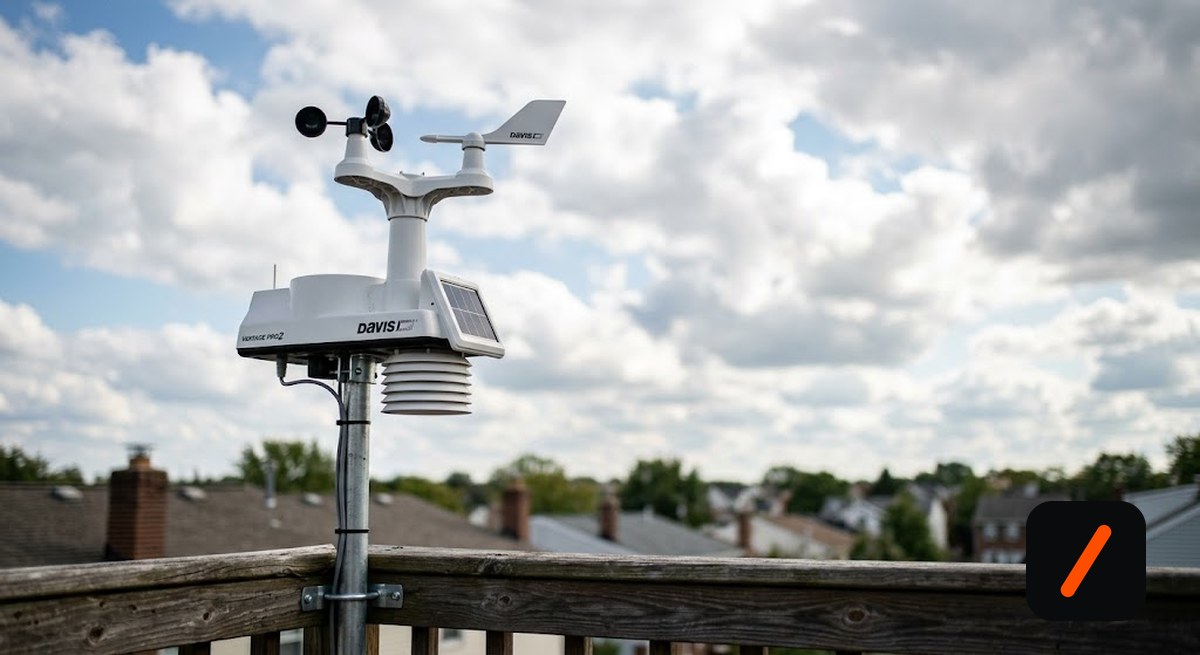
WeatherXM is building something the big weather providers never could: a weather network owned by the people who run it. More than 7,000 community-installed weather stations now feed the network, backed by a community of over 15,000 contributors, and the whole thing is coordinated with crypto-style token incentives rather than a corporate budget. It is one of the clearest examples of DePIN, decentralized physical infrastructure networks, actually working, and it answers the question skeptics always ask: why put real-world hardware on a blockchain at all? The answer is coverage, freshness, and ownership that a centralized provider cannot match.
- WeatherXM links users to over 7,000 weather stations globally, supported by a community of more than 15,000 people.
- Contributors install physical weather stations and earn token rewards for supplying verified, real-time data.
- The network partners with data-verification and storage projects, including work tied to the Filecoin Foundation, to make crowdsourced sensor data trustworthy.
- The DePIN sector reached roughly $18.9 billion in market cap by mid-2026, surpassing the oracle category, with the real winners being networks that earn actual revenue.
Why crowdsource weather at all?
Traditional weather data comes from a relatively sparse grid of official stations, which leaves huge gaps, especially in developing regions and at hyper-local scale. Weather is intensely local: conditions can differ block to block, and a farm or a logistics route needs readings from where it actually is, not from an airport 30 miles away. By incentivizing individuals to install stations, WeatherXM fills those gaps densely and cheaply, building coverage that no single company would fund on its own. The blockchain part is not decoration; it is the coordination mechanism that lets thousands of strangers contribute hardware and get paid fairly for it.
RelatedWingbits Turns Flight Tracking Into a Solana DePIN Network
How do you trust crowdsourced data?
This is the hard problem for every DePIN, and it is why WeatherXM works on verifiable, real-time data pipelines with partners in the storage and verification space, including efforts connected to the Filecoin Foundation. If anyone can install a station and earn tokens, some will try to game it with fake or manipulated readings. The network's value depends entirely on being able to prove that a reading is genuine, came from a real device, and was not tampered with. Solving data integrity is what separates a real sensor network from a token farm, and it is where serious DePIN projects spend their engineering effort.
Who buys the data?
The customers are the tell. Insurers pricing weather risk, farms making irrigation and planting decisions, and logistics companies routing around conditions all need dense, fresh, local weather data, and they will pay for it. That external demand is the whole point of the "real revenue versus emissions" distinction now dominating DePIN analysis in 2026. A network that only pays contributors from token inflation is a subsidy; a network where outside customers pay for a genuinely useful product is a business. WeatherXM is trying to be the second kind, and in a sector full of the first kind, that ambition matters.
| Approach | Coverage | Funding model |
|---|---|---|
| Official stations | Sparse grid | Government budgets |
| WeatherXM (DePIN) | Dense, hyper-local | Tokens plus data sales |
| Pure emissions DePIN | Varies | Token inflation only |
What is the risk?
DePIN's recurring weakness is the gap between network usage and token price, and WeatherXM is not immune. Many DePIN tokens trade well below where their usage might suggest, and a network can have great coverage while its token languishes. The durable question is whether data revenue grows fast enough to sustain contributor rewards without leaning on token inflation. If external buyers keep paying and coverage keeps expanding, WeatherXM has a real business. If demand stalls, it risks becoming another network that looks busy on-chain but does not convert activity into revenue.
Related375ai's DePIN Engine: Proof of Data and the $EAT Burn Loop
Why does coverage in underserved regions matter?
The most compelling part of the WeatherXM story is where its stations can go that official networks never bothered to. National weather services concentrate their sensors around airports, cities, and wealthy regions, leaving vast rural and developing areas with almost no ground-truth data. Those are often the places where accurate, local weather matters most, for smallholder farmers deciding when to plant, for communities exposed to flooding, and for insurers who cannot price risk they cannot measure. A community-owned model lets a station appear anywhere someone is willing to run one, which can extend dense coverage into regions that a centralized provider would never fund. If WeatherXM keeps lowering the cost and friction of joining, its biggest long-term value may not be in well-covered cities at all, but in filling the enormous blank spaces on the world's weather map.
- Paying customers. Growth in insurers, agriculture, and logistics buying WeatherXM data.
- Data integrity. How well the network proves readings are genuine and tamper-resistant.
- Revenue versus emissions. Whether data sales, not token inflation, fund contributor rewards.
Our take
WeatherXM is DePIN at its most convincing, because the use case is obvious and the coverage gap is real. Nobody disputes that dense, local weather data is valuable, and a community-owned network is a genuinely clever way to build it. The token mechanics that skeptics roll their eyes at are, here, doing real work: they bootstrap hardware deployment no company would fund alone. The test now is the same one facing all of DePIN in 2026: convert usage into revenue that outlasts the token incentives. If WeatherXM does that, it becomes infrastructure people rely on without thinking about the blockchain underneath, which is exactly what a successful DePIN should feel like.
- OfficialWeatherXM network overview weatherxm.com
- AnalysisDePIN sector guide, 2026 Spoted Crypto
- ReferenceDePIN project and network data DePIN Scan
Original analysis by GenZTech. Reporting via WeatherXM.