
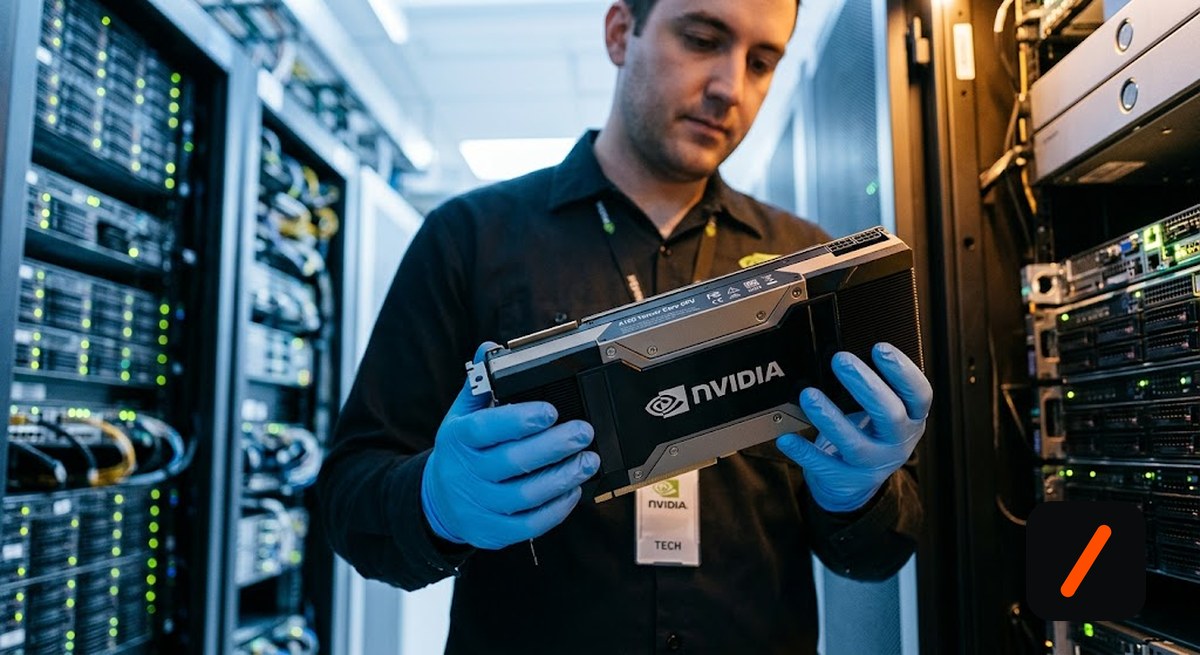
Akash Network, a decentralized marketplace for cloud and GPU compute, has expanded to support Nvidia’s B200 and H200 accelerators and reports GPU utilization holding near 80%. That combination matters: the top-tier hardware AI teams actually want, offered through a DePIN, with utilization that looks like genuine demand rather than idle speculation.
- Akash now supports Nvidia B200 and H200 GPUs, the accelerators AI training and inference teams are chasing.
- Reported GPU utilization near 80% suggests real paying workloads, not empty listed capacity.
- The pitch is compute at up to 80% below centralized clouds by tapping distributed and idle GPUs.
- It fits the 2026 DePIN theme: networks winning on real revenue and demand, not token emissions.
What did Akash add?
Akash Network runs a decentralized marketplace where GPU owners list capacity and AI developers rent it, with bids and settlement handled on-chain. Its ecosystem recently expanded to support Nvidia’s B200 and H200 accelerators, the current top of the AI-compute stack, alongside plug-and-play tools like Akash Chat for multi-model benchmarking and Akash Gen for image generation. The headline operational number is utilization: Akash reports GPU utilization holding near 80%, which the network frames as evidence of genuine demand rather than listed-but-idle hardware. The core value proposition is cost, with the marketplace pitching compute at up to 80% below centralized providers like AWS or Google Cloud by tapping distributed and otherwise-idle GPUs.
RelatedRender Network Rides the AI GPU Compute Crunch
Why does supporting B200 and H200 matter?
Because hardware relevance is the whole game for a compute DePIN. A decentralized marketplace stocked with older GPUs is a curiosity; one that offers the exact accelerators frontier AI teams are fighting to get is a real alternative. B200 and H200 are the parts in shortage across the centralized clouds, so a venue that can supply them, even at variable availability, addresses actual scarcity. That is the difference between a network that exists and one that gets used. Pairing the hardware with ready-made tools lowers the barrier further, letting developers run benchmarks or inference without stitching together their own stack.
What does 80% utilization tell us?
It is the most important number here, and the reason is the DePIN sector’s credibility problem. For years, decentralized infrastructure networks looked busy because token rewards paid people to provide capacity, whether or not anyone rented it. High listed supply with low real usage is the tell of an emissions-driven network. Utilization near 80% points the other way: paying customers actually running jobs on the hardware. In 2026 the DePIN projects gaining respect are precisely the ones that can show external demand, storage deals, compute jobs, mapping contracts, rather than token incentives, and utilization is how you distinguish the two.
- Availability of top GPUs. Supporting B200/H200 is one thing; consistent supply of them is another. Watch real capacity, not just the spec sheet.
- Sustained utilization. One high reading is a snapshot. Durable 70–80% over quarters is the real signal.
- Reliability versus clouds. Cost wins attention; uptime and support win enterprise workloads. That is the harder battle.
What it means for the market
The signal for investors is that the AI compute shortage is creating a real opening for decentralized GPU marketplaces, and the ones with top-tier hardware plus genuine utilization are separating from the pack. Akash competes not with Nvidia (NVDA), whose chips it resells access to, but with centralized clouds on price for price-sensitive workloads. The broader DePIN read is that compute and storage networks tied to AI demand are the categories with demonstrable revenue, while emissions-driven models fade. For anyone tracking the sector, utilization and paying customers are the metrics that matter, not token price. This is analysis, not investment advice.
RelatedNosana Rides AI GPU Demand With Solana Compute Network
Where does decentralized compute actually fit?
It helps to be realistic about which workloads a marketplace like this wins and which it does not. The centralized clouds are strongest where enterprises need guaranteed capacity, tight security and compliance boundaries, service-level agreements, and a support relationship, and no amount of cost advantage overcomes those needs for a regulated bank running production inference. Where a decentralized marketplace competes well is the large and growing middle: researchers, startups and independent teams running training experiments, batch jobs and inference that are price-sensitive and can tolerate variable availability. For those users, paying a fraction of cloud rates for the same B200 or H200 silicon is a genuine unlock, especially in a market where getting the top GPUs from the big providers can mean waitlists and premium pricing. That segment is not a rounding error; it is a meaningful slice of AI compute demand that has been squeezed by the shortage. The strategic question for Akash is whether it can keep top-tier hardware consistently available and reliable enough to graduate from experiments toward more serious workloads over time. Cost gets a team to try the marketplace; reliability is what keeps them. The near-80% utilization suggests the trial phase is going well, but durable enterprise-grade dependability is the harder and more valuable prize.
Our take
Akash adding B200 and H200 is a small headline with a large implication: decentralized compute is starting to compete on the hardware that actually matters, at a moment when that hardware is scarce everywhere. The 80% utilization figure is the part worth holding onto, because it is the metric that separates a DePIN with real demand from one running on token subsidies. The open questions are supply consistency and enterprise-grade reliability, which are exactly where centralized clouds are strongest. But as a lower-cost venue for AI teams priced out of the big providers, this is the version of DePIN that has a reason to exist.
- OfficialAkash Network marketplace and supported GPUs
- ReferenceFalconX DePIN activity and utilization
Original analysis by GenZTech. Figures current as of July 2026. Source: VaaSBlock.