
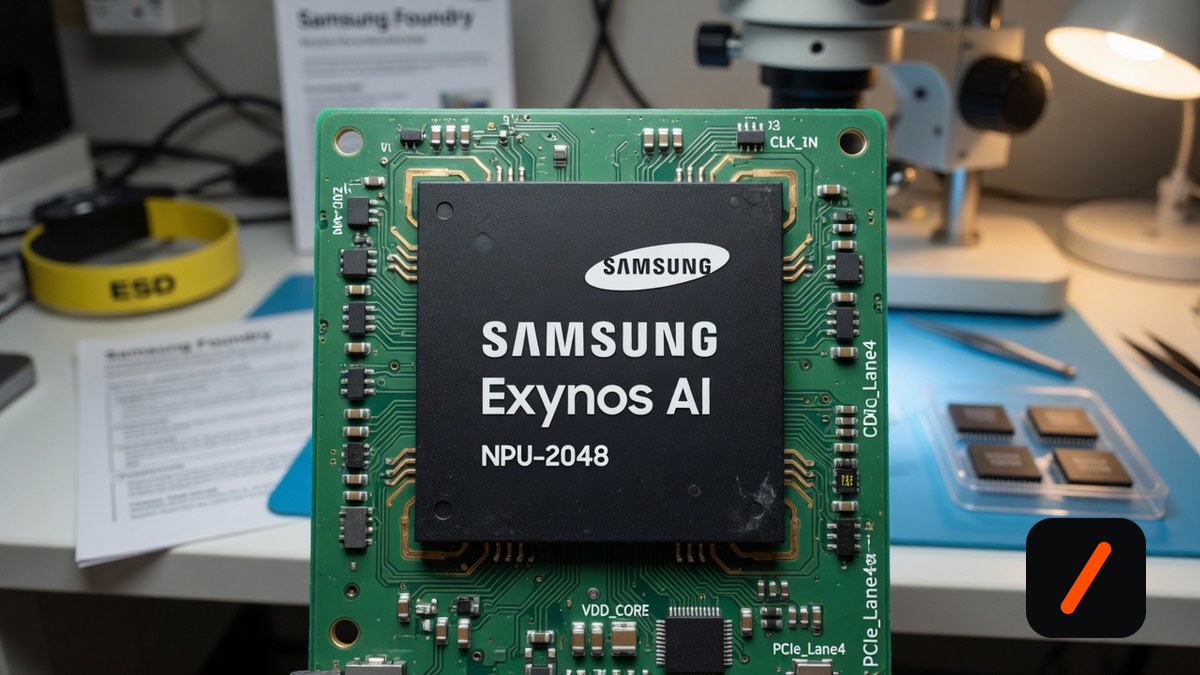
Anthropic is in early discussions with Samsung Electronics to design a custom AI chip, first reported by The Information and confirmed in outline by TechCrunch, and the target is Samsung's 2-nanometer process plus its advanced packaging lines. The company is not replacing anything: it told reporters that Nvidia GPUs, Google TPUs and AWS Trainium stay central to its compute strategy. A Samsung chip, if it happens, would be an additive layer aimed squarely at one problem, the cost of running Claude inference every second of every day.
- The talks are preliminary. Anthropic has not settled what the chip does, how powerful it is, or how it slots into a server, and has not begun detailed design, testing or manufacturing.
- A custom part would sit alongside AWS Trainium, Google TPUs and Nvidia GPUs, likely handling specific Claude inference workloads at scale rather than training.
- It follows OpenAI and Broadcom's "Jalapeno" inference chip, unveiled June 24, which reportedly showed roughly 50% cost savings versus standard GPU inference in early testing.
- The clearest signal of intent is a hire: Anthropic brought on Clive Chan, an early engineer on OpenAI's custom-chip team, in early June.
What did Anthropic actually confirm?
Very little, deliberately. The company said a diversified hardware stack remains pivotal and that it had nothing further to add on Samsung specifically. That hedging matters, because a signed customer is not a shipped chip and Anthropic is still deciding whether to proceed at all. What is real is the direction of travel. Anthropic spent 2026 telling the market that memory and logic supply is strategic, and it put money where its mouth is in May by adding Samsung, SK hynix and Micron to its Series H round as strategic infrastructure partners. Of those three, only Samsung runs a logic foundry able to fabricate a custom accelerator, which is why it is the obvious manufacturing partner if the project advances.
RelatedNvidia's $750B AI Deals Just Spooked Its Own Bondholders
Why build your own inference chip at all?
Training is expensive but bursty. Inference is the opposite: it happens continuously, for every user session, every API call, every coding agent, every enterprise workflow. As Claude adoption climbs, inference becomes the dominant recurring cost, and a chip tuned to one model's architecture and serving pattern can strip out the overhead a general-purpose GPU carries. That is exactly the pitch behind OpenAI's Broadcom-designed Jalapeno, which the company said went from design to production in nine months and showed roughly 50% cost savings versus GPU inference in early tests. If Anthropic can land similar efficiency on Claude's specific shapes, the economics of serving frontier models change materially.
| Effort | Anthropic × Samsung | OpenAI Jalapeno | Google TPU | AWS Trainium |
|---|---|---|---|---|
| Status | Early talks | Unveiled Jun 24, 2026 | Shipping (v7 era) | Shipping (Trn2) |
| Designer | Anthropic (TBD) | OpenAI + Broadcom | Google + Broadcom | Amazon Annapurna |
| Foundry | Samsung 2nm (SF2) | TSMC | TSMC | TSMC |
| Focus | Claude inference | Inference | Train + infer | Train + infer |
| Model-tuned | Yes, in-house model | Yes | Broad | Broad |
The pattern is unmistakable: every lab of scale is trying to own part of its silicon roadmap. TrendForce projects shipments of servers using cloud custom ASICs will grow 44.6% in 2026, nearly triple the 16.1% expected for general-purpose GPU servers. Anthropic is late to this move relative to Google and Amazon, but the Clive Chan hire, an engineer who helped build OpenAI's accelerator from the software layer up, shortcuts a lot of the learning curve.
Why Samsung, and what is the risk?
For Samsung, a marquee AI customer would be a showcase as it tries to close the gap with TSMC in the foundry business. The catch is yield. Samsung entered volume production on its 2nm SF2 node in late 2025, but its first-generation node has faced yield challenges that TSMC's rival N2 process has reportedly navigated more smoothly. A custom chip is only as good as the wafers it ships on, so the manufacturing partner choice is not a footnote. Notably, Samsung is not the only option on the table: Anthropic is also reportedly weighing designs involving Microsoft and the British chip startup Fractile.
RelatedMeta Wants to Rent Anthropic $10B of Compute
What it means for the market
The signal for investors is a slow, structural shift in who captures AI infrastructure spend. If custom inference silicon spreads across the top labs, the marginal GPU that Nvidia sells for inference faces more in-house competition over time, even as training demand stays firmly Nvidia's. Watch Samsung Electronics (005930.KS) as a foundry story: winning Anthropic would validate SF2 against TSMC and lift its system-LSI narrative, while a yield stumble would do the opposite. TSMC remains the incumbent that any custom-chip wave still leans on for the rival labs. This is factual analysis, not investment advice: the read is that inference cost, not model quality, is becoming the competitive battleground, and silicon ownership is how the labs intend to win it.
- Does it move past talks? The tell is a disclosed design partner and a foundry commitment, not a press quote. Until then treat this as exploration.
- Samsung SF2 yields. A Claude chip lives or dies on wafer yield. Watch whether Samsung's 2nm output improves enough to trust with a flagship customer.
- Efficiency proof. The number that matters is cost-per-token versus GPU inference. Jalapeno set the bar near 50%; Anthropic needs a comparable figure to justify the effort.
- Stack diversification. Anthropic keeps saying Nvidia, Google and AWS stay central. Watch whether a custom chip stays a thin inference layer or grows into something larger.
- ReportingTechCrunch — Anthropic discussing a custom chip with Samsung the company's on-record framing
- OfficialAnthropic newsroom Series H strategic partners, compute strategy
- ContextTrendForce custom-ASIC vs GPU server shipment forecasts
Original analysis by GenZTech. Details current as of July 2026. Reporting via The Information.