
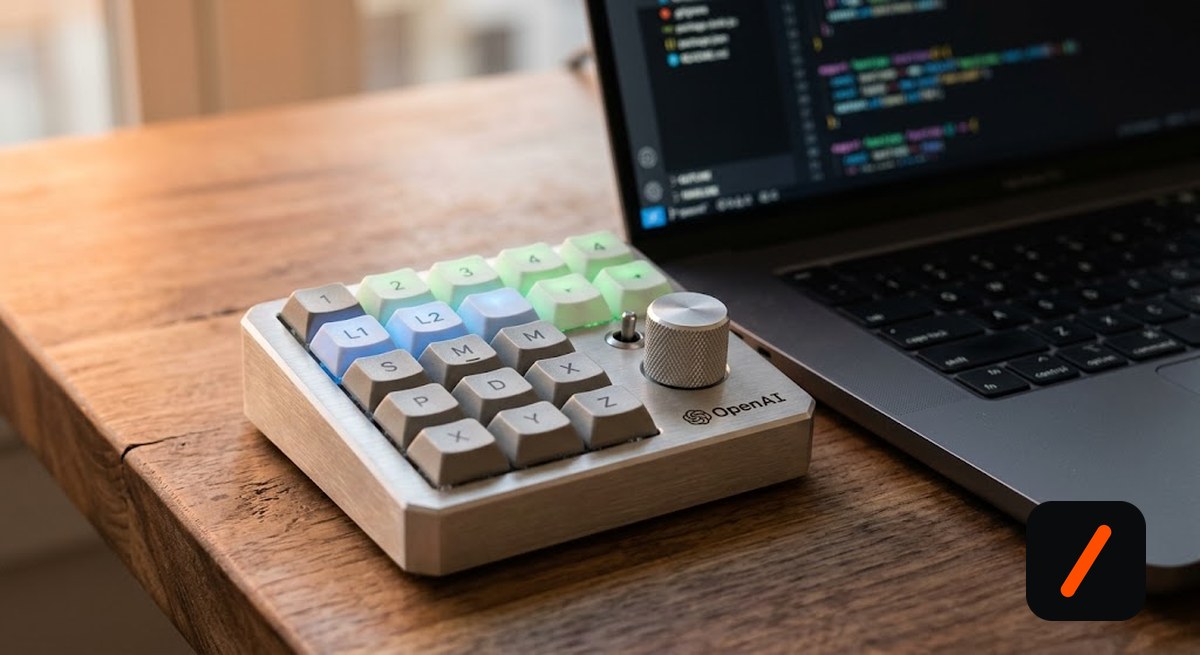
OpenAI shipped its first branded piece of hardware this morning, and it is not the device anyone was waiting for. Called the Codex Micro, it is a $230 limited-edition macro pad: a small square controller that sits beside your keyboard and gives Codex, OpenAI's AI coding agent, a set of physical buttons, a joystick, and a dial. Built with Montreal keyboard maker Work Louder and sold while supplies last, it is a niche accessory. It is also the clearest signal yet that OpenAI wants agentic coding to live on your desk, not just in a chat window.
- What it is: a $230 programmable macro pad for Codex power users, made with Work Louder, sold in a limited run while supplies last.
- The headline feature: six shine-through "Agent Keys" that glow white, blue, green, or red to show at a glance whether each background agent is idle, thinking, finished, or errored.
- Not the big one: this is not the Jony Ive consumer device from OpenAI's $6.5B io acquisition, nor the reported screenless smart speaker, both still expected later in 2026.
- The tell: OpenAI merged Codex into the ChatGPT desktop app last week and says Codex plus ChatGPT Work now has 8 million active users, so a hardware controller is a bet on that momentum.
What exactly did OpenAI ship?
The Codex Micro is built on Work Louder's Creator Micro 2 chassis: a CNC-machined aluminum square with 13 low-profile mechanical switches, a rotary encoder, a 2D analog joystick, and a capacitive touch sensor for cycling through programmable layers. Buyers choose clicky or silent switches. Every control is remapped through the ChatGPT desktop app, so the same pad can drive push-to-talk, send a prompt, accept or reject a code change, trigger a saved workflow from the joystick, or dial an agent's reasoning level up and down with the encoder.
RelatedOpenAI's Astra for Law Brings GPT-6 to Am Law 200 Firms
Work Louder is not new to this. The startup has shipped the same idea with Figma and Framer, supplying the hardware while the partner brings the branding and default key map. OpenAI's contribution is the Codex integration and the six lights on top.
What do the color-coded Agent Keys actually do?
This is the part most coverage skips, and it is the whole point. The six top keys have shine-through keycaps wired to the live state of your Codex agents. White means idle, blue means the agent is thinking, green means it finished, and red means it hit an error. A single tap selects the agent tied to that key; a double tap pulls it to the foreground. When you are running several agents at once, that turns agent status into ambient information you glance at, instead of a stack of browser tabs you keep alt-tabbing through.
Why build a keypad instead of shipping more software?
Agentic coding broke an assumption the terminal was built on: that you drive one task at a time. With Codex spawning multiple long-running agents, the bottleneck moved from typing to supervising, approving, and context-switching. A macro pad is a cheap, low-risk way to test whether developers want a dedicated control surface for that, the same way video editors reach for a jog wheel and streamers reach for a Stream Deck. It also keeps OpenAI's brand physically on the desk of its most engaged users while the real hardware bets stay behind closed doors.
| OpenAI hardware | Codex Micro | io consumer device | Smart speaker |
|---|---|---|---|
| What | Macro pad for Codex | Pocket AI companion | Screenless home hub |
| Partner | Work Louder | Jony Ive / io | In-house (reported) |
| Audience | Developers | Consumers | Consumers |
| Status | Shipping now, $230 | Due H2 2026 | Reported for 2027 |
How does this fit OpenAI's hardware ambitions?
Uneasily, and that is what makes the timing interesting. OpenAI's serious hardware push runs through io Products, the Jony Ive startup it bought for about $6.5 billion in May 2025, which is building a consumer AI device for later this year. That effort is now shadowed by an Apple lawsuit accusing OpenAI of taking hardware trade secrets, a fight that could complicate the launch window. Against that backdrop, a $230 developer accessory made by an outside keyboard shop is the safest possible way to start shipping physical product: no supply chain of its own, no consumer support burden, and no legal exposure.
RelatedCognition's SWE-2 Nearly Matches GPT-6 Astra for a Quarter the Price
- May 2025OpenAI acquires Jony Ive's io Products ~$6.5B, all-stock
- Jul 2026Codex merges into the ChatGPT desktop app last week
- Jul 15, 2026Codex Micro ships at $230 first branded hardware
- H2 2026io consumer device expected amid the Apple suit
What does it mean for the market?
The direct revenue here is a rounding error; a limited run of $230 pads will not move Microsoft-backed OpenAI's numbers. The signal for investors sits elsewhere. First, Work Louder, a small Montreal maker, just became the reference manufacturer for "AI-agent hardware accessories," a category that did not exist a week ago and that rivals like Anthropic, Google, or Cursor could copy. Second, it validates the Stream-Deck playbook for developer tools, which is a tailwind for peripheral makers such as Elgato eyeing the AI-coding wave. The read is not that hardware is OpenAI's business; it is that OpenAI now treats the developer desk as a surface worth owning, and every coding-tool competitor should assume a physical control layer is coming.
- Sell-through. "While supplies last" is a demand test; a fast sellout tells OpenAI developers want physical controls.
- Copycats. Watch for Anthropic, Cursor, or GitHub answering with their own agent controllers or Stream Deck plugins.
- The real device. The io consumer product and the Apple lawsuit, not this pad, decide whether OpenAI becomes a hardware company.
Our take
The Codex Micro is a toy with a serious idea inside it. The six status lights quietly admit that running a swarm of coding agents has an attention problem, and that the fix might be physical, not another panel in the app. As a product it is minor. As a statement of where OpenAI thinks agentic coding is heading, off the screen and onto the desk, it is worth more than its $230 price.
- OfficialOpenAI Supply Co. x Work Louder the Codex Micro product page
- ReferenceAxios: Codex Micro is a physical keyboard for AI agents launch details and specs
- ReferenceThe New Stack: OpenAI's first gadget is the $230 Codex Micro Agent Keys behavior
Original analysis by GenZTech. Reporting via TechCrunch.