
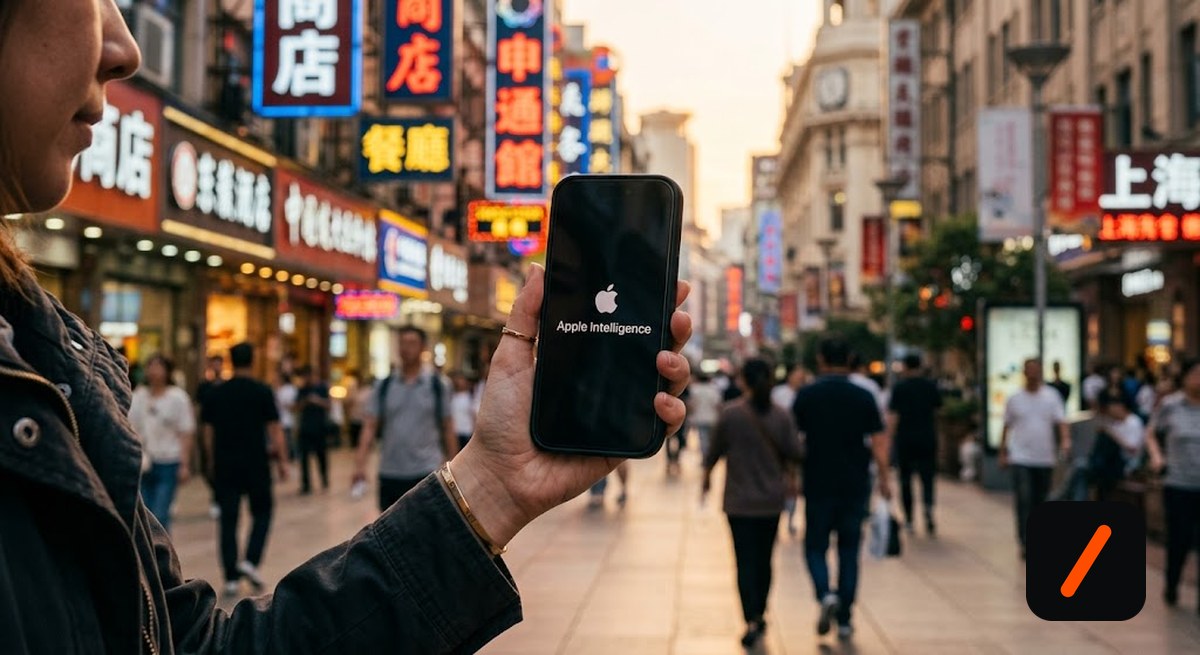
Apple Intelligence has been cleared for launch in mainland China, and the approval landed within the past hour: China's Cyberspace Administration (CAC) registered Apple's on-device generative AI service this week, and Alibaba confirmed to Reuters that its Qwen model will power the features locally. It is the regulatory unlock Apple has chased since Apple Intelligence debuted in the United States in 2024, and it comes with a twist, ChatGPT is out in China and homegrown models are in.
- China's CAC registered Apple Intelligence this week, the mandatory step before any generative AI service can ship to the public in the country.
- Alibaba's Qwen will handle text and image generation across iOS, iPadOS, macOS and visionOS in China, with Baidu reportedly contributing on a smaller scale.
- The local partnership replaces ChatGPT, which Apple uses elsewhere, satisfying China's rule that generative AI run on approved domestic models.
- Markets moved fast: Alibaba's US shares jumped about 4% to 7% on the news, while Apple rose roughly 2%. No China launch date is set yet.
What did China actually approve?
The concrete event is a registration, not a marketing launch. China requires any company to register large language models and generative AI services with the CAC before offering them publicly, and this week the regulator added Apple's on-device generative service to its list of cleared providers, alongside homegrown systems from Chinese phone makers. That registration is the gate. Without it, Apple Intelligence could not legally ship a single generative feature in the country, which is why the features have been dark in China for the roughly 20 months since they launched in the US. The CAC did not announce a public launch date, but approval typically precedes rollout by only a few months, which points to a China debut roughly in line with Apple's usual autumn software cycle.
RelatedQwen3.8-Omni-Flash: 1M Context, Audio Cheaper Than Gemini Flash
| By region | Rest of world | Mainland China |
|---|---|---|
| On-device layer | Apple's own models | Apple's own models |
| External partner | OpenAI (ChatGPT) | Alibaba (Qwen) + Baidu |
| Text generation | Apple + ChatGPT | Apple + Qwen |
| Image generation | Apple + ChatGPT | Apple + Qwen |
| Regulatory gate | None equivalent | CAC registration (done) |
| Status | Live | Approved, no date yet |
Why did Apple need a Chinese partner at all?
Because the model Apple leans on elsewhere is not allowed in. Apple Intelligence pairs its own on-device models with an external system for heavier, world-knowledge queries, and outside China that system is OpenAI's ChatGPT. OpenAI's models are not approved for public consumer use in mainland China, so Apple had no legal path to ship the full experience there without a domestic partner running a registered model. Alibaba said its Qwen family will fill that role across iPhone, iPad, Mac and Vision Pro, covering both text and image generation, with Baidu contributing a smaller share. For scale context, consumer-facing Qwen passed 295 million monthly active users across platforms as of March 2026, so this is not a fringe model, it is one of China's largest.
- Jun 2024Apple Intelligence unveiled at WWDC US-first, no China plan disclosed
- Late 2025Chinese-user feedback form appears on Apple's site early signal of a China push
- Mar 2026Features briefly switched on for some China users months ahead of approval
- Jul 2026CAC registers Apple Intelligence; Alibaba confirms Qwen the regulatory unlock
- Autumn 2026Expected consumer rollout in China no official date yet
What does it mean for the market?
The signal for investors is that Apple just handed Alibaba a very large distribution win. Being the AI layer inside the iPhone in Apple's single most important hardware market is a strategic prize, and the tape agreed immediately: Alibaba's US-listed shares rose about 4% to 7% on the reports, while Apple gained roughly 2%. Watch Alibaba (BABA) as the clearest beneficiary, its cloud and AI narrative gets a marquee reference customer, and Baidu (BIDU) as a secondary winner. For Apple (AAPL), the read is defensive but real: China is its biggest AI-feature gap, and closing it removes a competitive disadvantage against Huawei and other local phones that already ship on-device AI. The counterweight is OpenAI, which is locked out of the world's largest smartphone market by regulation, not by product. This is factual analysis, not investment advice: the takeaway is that AI features are becoming a per-market negotiation, and in China the leverage sits with approved domestic model makers.
Why does this matter beyond Apple?
It is a template for how Western AI ships into China. The pattern is now explicit: keep your on-device layer, but hand the cloud-scale reasoning to a CAC-registered domestic model. Any US company that wants generative features on Chinese consumer hardware faces the same fork Apple did, partner with an approved local model or stay dark. That entrenches a two-track AI world, where the same device runs different models depending on which side of the border it sells in, and it hands durable leverage to the handful of Chinese labs (Alibaba, Baidu, and a few others) whose models clear regulatory review. For Apple, the near-term upside is simpler: an iPhone in China that finally matches the AI features Huawei and Samsung already advertise there, which matters in a market where Apple has been losing ground.
RelatedGPT-6.1 Sol: OpenAI's Cheap Model Nears Astra's Power
Our take
This is a pragmatic win dressed as a partnership. Apple did not choose Qwen because it out-benchmarked ChatGPT, it chose Qwen because ChatGPT cannot legally ship in China and Qwen can. That is the honest read, and it is why the market rewarded Alibaba, not Apple: the scarce, regulated asset here is an approved Chinese model, and Alibaba owns one of the best. Expect the fall iPhone cycle in China to lean on this hard, and expect every other Western AI product eyeing China to study the blueprint. The interesting question is not whether the features work, it is how much of the AI experience quietly diverges between a Chinese iPhone and a US one over the next few years.
- The launch date. Approval is done; the tell now is when Apple actually ships the features in China. Watch for a fall software update.
- Feature parity. Does the Qwen-powered China experience match the ChatGPT-powered one elsewhere, or quietly differ in capability and guardrails?
- Alibaba's cloud narrative. Being inside the iPhone is a reference win. Watch whether it converts into enterprise and cloud momentum for BABA.
- The next Western entrant. Watch which other US AI products follow the same CAC-plus-local-model playbook to reach Chinese consumers.
- ReportingTechCrunch — Apple Intelligence approved for China with Alibaba's Qwen the approval and partnership
- ReportingMacRumors — Apple Intelligence cleared to launch in China CAC registration detail
- OfficialApple Intelligence product overview and architecture
Original analysis by GenZTech. Details current as of July 2026. Reporting via Reuters.