
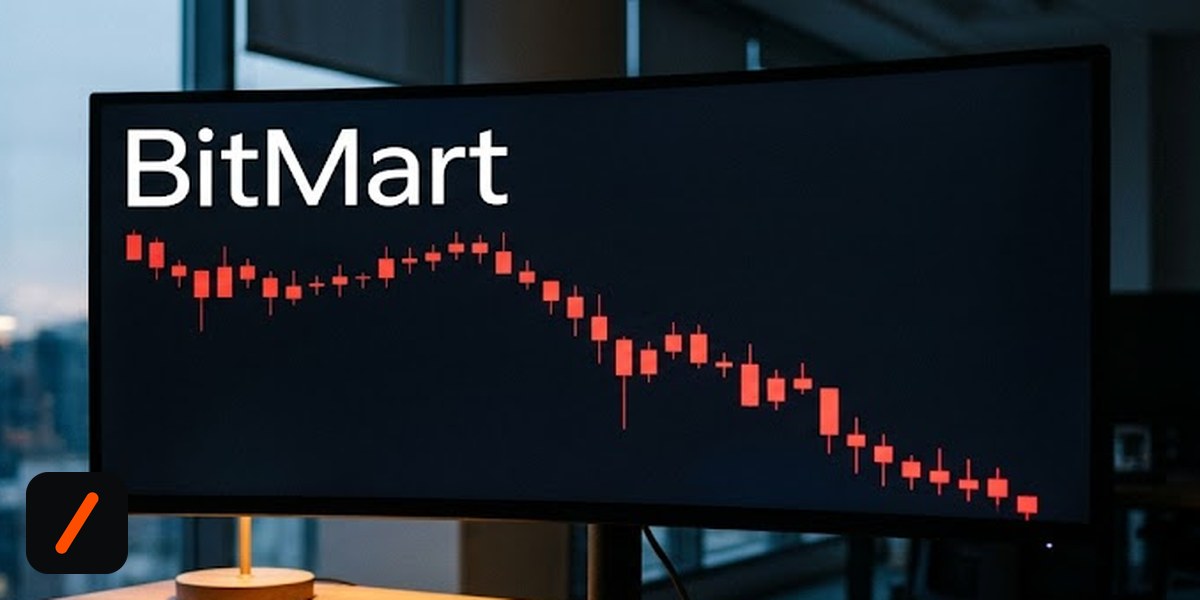
BitMart is closing. The exchange published the notice early this morning and stopped accepting new registrations, deposits and orders at 01:30 UTC. All spot and futures trading ends at 01:00 UTC on August 26. The platform shuts down entirely at 15:59 UTC on January 31, 2027. Its exchange token, BMX, lost 57.7 percent of its value inside 24 hours and now trades near 8 cents. There was no hack, no enforcement action, no insolvency filing. BitMart says it reviewed its operations, the market environment and its future strategic direction, which is the corporate way of saying the business stopped paying for itself.
This is the second exchange in four days to reach that conclusion. BitMEX told users on July 23 that it is winding down after eleven years, and then got hit with a 623 BTC class action the following day. Two closures in one week is not a coincidence, and the reason shows up in both sets of numbers.
RelatedBitcoin Hits a 652-Day Low as ETF Money Flees
- Trading stops August 26 at 01:00 UTC. Withdrawal requests have to be submitted by 05:00 UTC the same day, so the real deadline for users is four hours after the market closes, not January.
- The platform goes dark January 31, 2027 at 15:59 UTC. Deposits, new orders and new accounts already stopped on July 26 at 01:30 UTC, and futures accounts flipped to reduce-only.
- BMX is down 57.7 percent in a day to $0.0805, which puts the token's market value at $27.3 million and its rank at 667. It is 87 percent below its June 2024 peak.
- Withdrawals stay open, with friction. BitMart added identity verification, device and IP checks, address screening, source-of-funds questions and sanctions review, and warns of delays when everyone withdraws at once.
What did BitMart actually say?
The notice is short and gives no single cause. BitMart said it made "the difficult decision to commence an orderly wind-down of its trading platform operations" and pointed only to its operating conditions, the market environment and its future strategic direction. Nothing in it mentions a shortfall in customer assets, a regulator, or a security incident. That distinction matters, because the last time BitMart made news at this scale it was the December 2021 hot-wallet breach that drained about $196 million, and the exchange covered customer losses itself at the time.
The volume figures make the timing look stranger, not clearer. BitMart traded roughly $1.6 billion in the 24 hours around the announcement, up 51 percent, with bitcoin accounting for close to half of it. That is not a dead venue. It is a venue whose owners looked at what that volume earns after fees, licensing, market making and compliance headcount, and decided the arithmetic no longer works.
The token was already falling six days before the notice
We pulled BMX's own price history rather than take the 58 percent headline at face value, and the interesting part is what happened before this morning. BMX is down 74.3 percent over seven days but only 57.7 percent over 24 hours. Work backwards from the current $0.0805 and the token was near $0.313 a week ago and near $0.190 yesterday. Roughly 39 percent of the fall happened in the six days before any announcement existed, while withdrawal-delay chatter was circulating around July 24. The 30-day number, down 74.7 percent, is barely worse than the 7-day number, which means the token sat flat for three weeks and then broke.
Read that in order: the market priced BitMart's distress before BitMart confirmed it. People pulling funds and dumping the exchange token in the same week is what a slow-motion bank run looks like on a venue that has not yet said anything.
Why are mid-tier exchanges closing now?
A centralized exchange makes money on spread and fees, and pays for matching infrastructure, market makers, listings, custody, licensing and a compliance department that grows every year. For the top few venues that trade is still comfortable. For everyone in the middle it has been squeezed from both directions at once.
From below, fees have collapsed. Zero-fee bitcoin pairs are now normal on the majors, and perpetuals volume that used to live on venues like BitMEX moved to on-chain order books where the exchange is a contract instead of a company. From above, the cost of being legitimate keeps rising. Europe's MiCA regime went fully live on July 1 and immediately started forcing delistings of non-compliant assets; every jurisdiction that follows adds another licence, another audit, another local entity. A venue with billion-dollar daily volume can still fail that math if its take rate is a fraction of a basis point and its fixed costs are not.
| BitMart | BitMEX | |
|---|---|---|
| Launched | 2017 | 2014 |
| Closure announced | Jul 26, 2026 | Jul 23, 2026 |
| Trading ends | Aug 26, 2026 | Sep 23, 2026 |
| Platform closes | Jan 31, 2027 | Sep 23, 2026 |
| Core business | Spot and futures, long tail listings | Perpetual swaps |
| Exchange token | BMX, down 57.7% on the news | None |
| Reason given | Operating conditions and strategy | Strategic review |
| Prior incident | $196M hot-wallet hack, Dec 2021 | 623 BTC class action, Jul 24, 2026 |
- Dec 2021BitMart loses about $196 million in a hot-wallet breach covers customer losses itself
- Jun 4, 2024BMX peaks at $0.619 the token is 87% below this today
- Jul 23, 2026BitMEX announces it is closing after eleven years
- Jul 24, 2026Withdrawal-delay chatter spreads, BMX slides about 39% lost before any notice
- Jul 26, 01:30 UTCWind-down announced, deposits and new orders stop
- Aug 26, 01:00 UTCAll trading ends, withdrawal requests due by 05:00 UTC
- Jan 31, 2027Platform ceases operations at 15:59 UTC
What should users on BitMart do today?
Withdraw now, and do not treat January 2027 as the deadline. The date that actually binds is 05:00 UTC on August 26, four hours after trading stops, because that is when withdrawal requests close. Anything sitting on the platform after that depends on a wind-down process rather than a button.
Finish identity verification first, since the new screening steps mean an unverified account will stall exactly when the queue is longest. Close futures positions rather than waiting for reduce-only mode to unwind them at whatever the book looks like in August. Move assets to self-custody or a venue you already use, and expect phishing: every exchange shutdown produces a wave of fake "withdrawal assistance" messages within days, and the only address worth trusting is the one you reached by typing the domain yourself.
RelatedEurope's Crypto Rulebook Hits July 1, and Binance Has Days to Comply
What it means for the market
The direct casualty is BMX itself. An exchange token is a claim on an exchange's fee flow and discount schedule, so when the exchange stops trading the token stops having a mechanism. At $27.3 million of market value against a fully diluted $51.5 million, most of what is left is the hope of some wind-down consideration rather than any ongoing business. The same structural question hangs over every other venue token whose exchange is not clearly profitable.
The other read is consolidation. Volume leaving second-tier venues does not evaporate, it lands on the majors and on on-chain perpetuals, which is a tailwind for the listed exchange proxies and for the largest offshore books. The signal for investors is that exchange revenue is concentrating, not shrinking, and that the next closures will look like this one: no scandal, just a spreadsheet. Watch which mid-tier venues quietly stop paying market makers before they announce anything.
- Withdrawal throughput in the next two weeks. If processing slows materially before August 26, the orderly part of "orderly wind-down" is the claim to check.
- A third closure. Two in four days is a pattern. The candidates are venues with real volume, thin take rates and an exchange token doing nothing.
- BMX after trading stops. A token whose only utility was fee discounts on a closed venue is the cleanest test of what these assets were ever worth.
- Whether any regulator speaks. Nothing suggests enforcement here, but a wind-down with customer assets in it usually attracts at least one supervisory statement.
Our take
The instinct after any exchange announcement is to look for the hidden hole, and so far there is nothing pointing at one: withdrawals are open, the notice reads like a business decision, and the 2021 breach was made whole years ago. What makes this worth paying attention to is how ordinary it is. Crypto's failure mode used to be spectacular, with a halt at midnight and a bankruptcy filing a week later. BitMart and BitMEX are failing the boring way, by announcing a schedule and running it down, which is closer to how a broker exits any regulated market.
That is progress and a warning at the same time. Orderly exits are better than collapses, and they still leave users with a one-month window to move funds off a platform they may not check weekly. The token chart is the part to remember: it broke six days before the announcement, which means the people closest to the venue were already leaving while everyone else was reading nothing at all.
- OfficialBitMart support portal wind-down notice, July 26, 2026, 01:30 UTC
- DataCoinGecko: BMX market data price, market cap and 24h/7d/30d changes read 08:03 UTC
- ReferenceCoinDesk: BitMart to shut down after nine years volume figures and closure timeline
- ContextOur coverage: BitMEX shutdown and the 623 BTC lawsuit the other closure this week
Original analysis by GenZTech. Price history pulled from the CoinGecko API at 08:03 UTC on July 26, 2026. Reporting on the closure timeline via CoinDesk.