
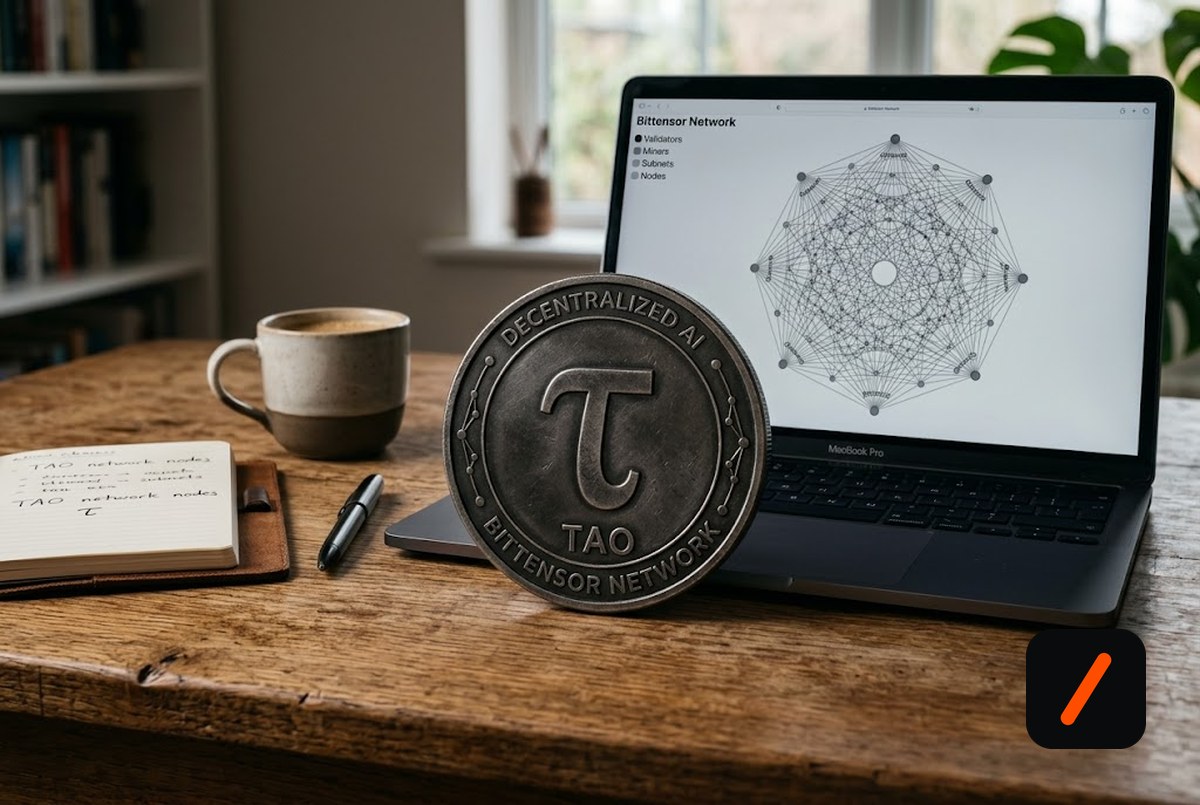
The largest token in the DePIN sector is no longer a storage or mapping network. It is Bittensor, whose TAO token sits around $3.4 billion in market value, ahead of names like Filecoin, Render, and Helium. That is a notable shift, because most decentralized physical infrastructure networks pay people to provide something tangible: disk space, GPU time, wireless coverage, map data. Bittensor's product is more abstract and more ambitious. It pays a marketplace of specialized subnets to produce machine intelligence itself, then rewards the ones that do it best. It is DePIN pointed at the most valuable commodity of the AI era.
- Bittensor (TAO) is the largest DePIN token by market cap, roughly $3.4B, above storage and compute rivals.
- Its structure is a set of subnets, specialized markets that compete to produce a specific kind of machine intelligence.
- It rewards useful output: miners are paid in TAO based on the quality of the intelligence they contribute, judged by validators.
- It reframes DePIN from renting physical resources to coordinating and pricing intelligence as a commodity.
What is DePIN, and why is Bittensor a stretch of the definition?
DePIN, decentralized physical infrastructure networks, use token incentives to get people to provide real-world resources: Filecoin pays for storage, Render and Aethir for GPU compute, Helium for wireless coverage, Hivemapper for map data. The pattern is always contribute a physical resource, earn tokens. Bittensor stretches that idea. The resource its participants contribute is machine intelligence, produced by running models and computation, which sits on physical hardware but is valued for its output, not its raw capacity. Whether that counts as physical infrastructure is a fair debate, but the market has answered by making TAO the sector's largest token, betting that coordinating intelligence is the most valuable thing crypto incentives can point at right now.
RelatedDePIN's real revenue hits $150M a month on-chain
How do the subnets actually work?
Bittensor is not one monolithic network but a collection of subnets, each a specialized market for a specific kind of intelligence, from text generation to prediction to data tasks. Within a subnet, miners compete to produce the best output, validators evaluate and score that output, and the network pays TAO rewards weighted toward the highest-quality contributors. The elegant part is the incentive: you are not paid for merely participating, you are paid for being useful, as judged by validators whose own rewards depend on scoring accurately. It is an attempt to build a self-organizing marketplace where competition drives quality up, using token emissions as the coordinating price signal.
| Network | Bittensor (TAO) | Filecoin | Render | Helium |
|---|---|---|---|---|
| Resource | Machine intelligence | Storage | GPU compute | Wireless |
| Paid for | Quality of output | Data stored | Render jobs | Coverage |
| Rough market cap | ~$3.4B | ~$0.6B | ~$0.9B | Top tier |
| Demand driver | AI intelligence | Archival storage | AI + rendering | Mobile / IoT |
Is the market cap justified?
That is the real question, and it is unresolved. The bull case is straightforward: intelligence is the defining commodity of the AI era, and a decentralized market that prices and rewards it could be enormously valuable, far more than one that rents disk space. The bear case is equally clear: token market caps in crypto often front-run real, fee-paying demand, and the sector as a whole has learned to separate networks that generate genuine revenue from those that mainly emit tokens. Bittensor has to show that its subnets produce intelligence people actually pay for, not just intelligence that earns emissions. Its position at the top of DePIN reflects a bet on the former; the coming year will test whether the demand is real.
- Real fee revenue. The whole thesis rests on subnets producing intelligence buyers pay for, not just token emissions. Follow the fees.
- Subnet quality. Watch which subnets attract serious miners and validators versus which are speculative shells.
- Emissions versus demand. The healthy signal is demand growing faster than token issuance, as some DePIN peers now show.
- AI-compute competition. Render, Aethir, and io.net chase overlapping demand. Bittensor's edge is coordinating output, not just supplying hardware.
Our take
Bittensor topping the DePIN charts is the single most interesting development in the sector, because it marks a conceptual leap from renting physical resources to coordinating intelligence as a commodity. The design is genuinely elegant: a market that pays for useful output rather than mere participation, with validators aligned to judge quality honestly, is a real answer to the hard problem of decentralizing AI. That said, an elegant mechanism and a large market cap are not the same as proven, fee-paying demand, and crypto has a long history of valuations that run ahead of usage. The mature reading of 2026's DePIN sector is that revenue resilience beats speculation, and by that yardstick Bittensor's ranking is a promise, not a verdict. If its subnets can show real buyers paying for real intelligence, TAO's position makes sense and points at where DePIN is heading. If they cannot, the market cap is a story the sector has told before. Watch the fees.
- OfficialBittensor the network and subnet documentation
- ReferenceCoinGecko, Bittensor (TAO) live market cap and price
- ReferenceWhat is DePIN sector overview and rankings
Original analysis by GenZTech. Figures current as of July 2026. Source: Bittensor.