
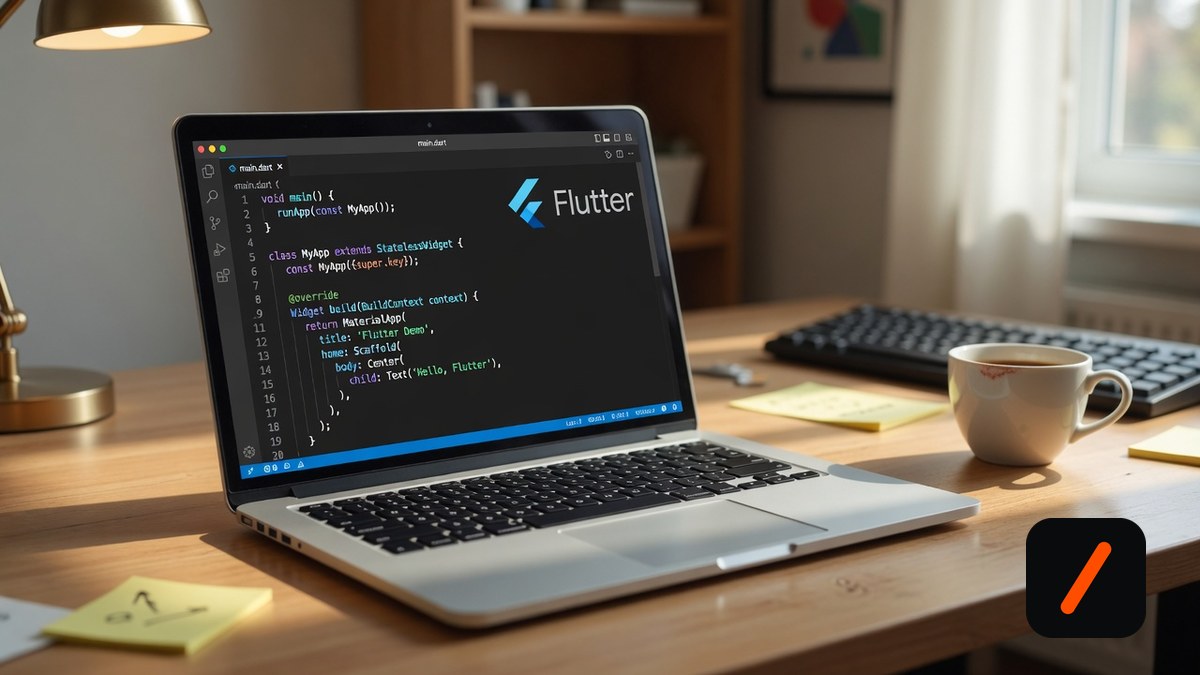
Flutter 3.44, released at Google I/O 2026 alongside Dart 3.12, is not a routine quarterly bump. It rewires the framework for a world where coding agents write UI: a new Model Context Protocol server finds your running app and triggers hot reload automatically after an agent edits your code, and a GenUI SDK lets an AI agent compose real Flutter widgets on the fly. Under the hood, Material and Cupertino are being pulled out of the core SDK, Swift Package Manager becomes the iOS default, and Impeller's Vulkan renderer finally becomes standard on modern Android.
- Agentic hot reload. The Flutter MCP server detects your running app and hot-reloads it after an agent's edit, cutting the manual copy-paste step out of the loop.
- GenUI SDK. Built on the open A2UI protocol, it lets an agent generate fully interactive Flutter screens dynamically instead of shipping fixed layouts.
- Material and Cupertino decouple. They move from the flutter/flutter repo into standalone
material_uiandcupertino_uipackages, off the 3-month SDK clock. - Plumbing upgrades. SwiftPM is now the default on iOS/macOS, Impeller Vulkan is default on modern Android, and Dart 3.12 adds private named parameters and experimental primary constructors.
Why agentic hot reload matters
Hot reload has always been Flutter's best party trick, but until now a coding agent editing your files still left a human to alt-tab to the terminal and press the reload key. The 3.44 MCP server removes that seam. It locates the running app and reloads it the moment an agent finishes an edit, so the loop from "agent writes a widget" to "you see it on screen" collapses from minutes to seconds. That is the difference between AI assistance that feels like a chat window and assistance that feels like pair programming on a live canvas.
RelatedNext.js 16.3 Is Built for AI Agents, Not Just Developers
What is GenUI, really?
GenUI is the more forward-looking bet. Built on the open Agent-to-UI (A2UI) protocol, the GenUI SDK lets an AI agent assemble real, interactive Flutter widgets at runtime based on what the user is trying to do, rather than a developer pre-building every screen. Instead of shipping a new app-store build to add a flow, an agent can compose the flow live. It is early and it will invite legitimate questions about consistency and testing, but it points at a UI that is generated to fit the task instead of frozen at compile time.
The quiet structural change: Material leaves core
The least flashy item may matter most for maintenance. Material and Cupertino are being frozen inside the core SDK and moved into independent material_ui and cupertino_ui packages on pub.dev. Decoupling them from the three-month SDK release cadence means Material 3 features and Cupertino fixes can ship when they are ready, not when the next Flutter release train leaves the station. It is the kind of plumbing decision that pays off slowly and steadily.
| Area | Flutter 3.44 | Before |
|---|---|---|
| Agent workflow | MCP auto hot-reload | Manual reload after edits |
| Dynamic UI | GenUI SDK (A2UI) | Pre-defined layouts only |
| iOS packages | SwiftPM default | SwiftPM opt-in |
| Android render | Impeller Vulkan default | Mixed / shader jank |
| Material/Cupertino | Standalone packages | Bundled in core SDK |
Anything that will break my build?
Yes, one migration to plan for. You need to update your Android build files to remove the separate Kotlin Gradle plugin. If a Flutter plugin you depend on still applies KGP, your build fails, and only that plugin's author can fix it, so the practical step is to check your dependencies and file issues upstream early rather than discovering it in CI. Everything else in 3.44 is additive, and Impeller Vulkan becoming default should mean fewer first-frame shader stutters, not more.
RelatedMinitap Accuses Google's Artemis of Copying Its Agent Code
- GenUI in production. Whether teams trust agent-composed UI for real flows, or keep it to prototypes and internal tools.
- Package cadence. How fast Material 3 features arrive now that
material_uiis off the SDK release clock. - MCP ecosystem. Which coding agents wire into the Flutter MCP server cleanly, and how reliable the auto-reload is at scale.
- KGP fallout. How quickly popular plugins ship the Kotlin Gradle plugin fix.
Our take
Flutter 3.44 is the clearest statement yet that Google sees cross-platform UI as something agents will increasingly write, and it is building the framework to make that loop tight instead of bolting AI on as an afterthought. Agentic hot reload is the feature you will feel every day, GenUI is the bet that could age well or awkwardly, and the Material decoupling is the boring change that keeps the platform healthy. With more than 1.5 million monthly developers and Flutter now powering everything from the 2026 Toyota RAV4's dashboard to webOS, this is a mature platform making a deliberate turn toward an agent-first workflow. It is worth the upgrade, just budget an afternoon for the Gradle migration.
- OfficialWhat's new in Flutter 3.44 the release blog
- DocsFlutter release notes migration details incl. KGP
- ReferenceVery Good Ventures Google I/O 2026 recap
Original analysis by GenZTech. Reporting via Flutter.