
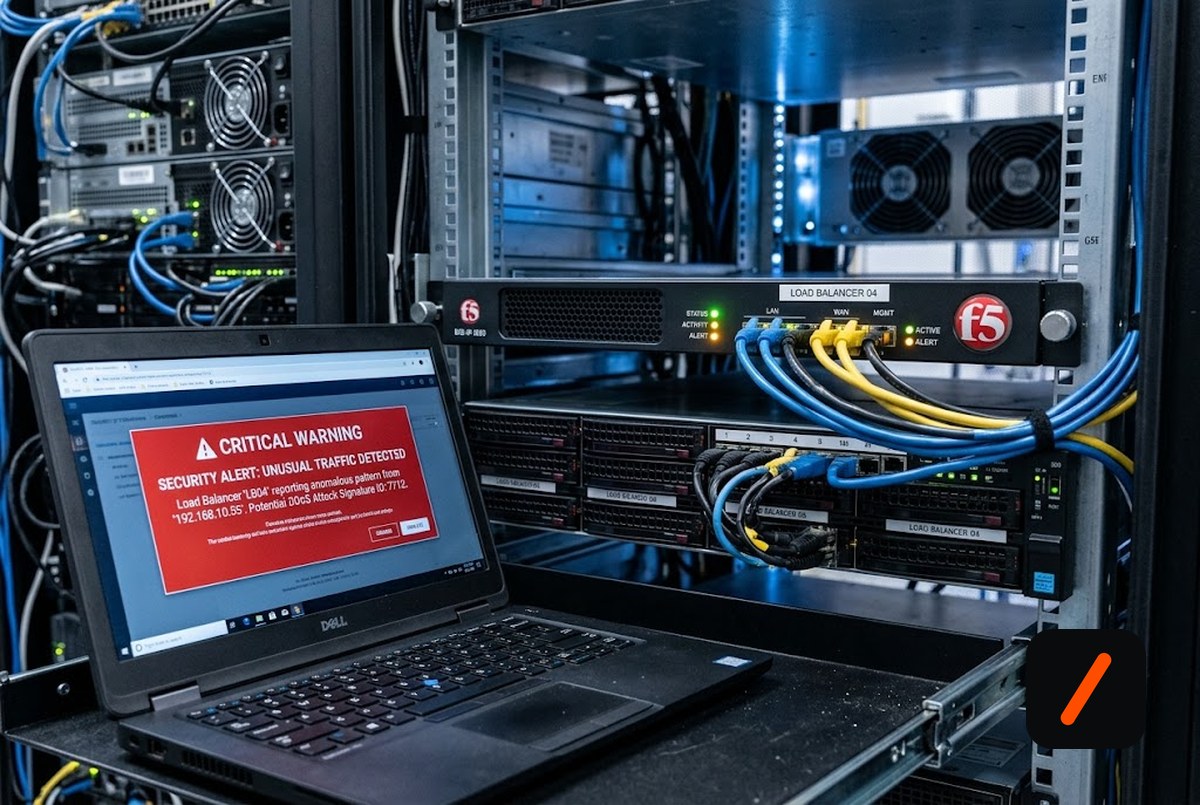
Attackers are actively exploiting a critical flaw in Progress Kemp LoadMaster, CVE-2026-8037, a CVSS 9.6 operating-system command-injection bug that lets them run arbitrary commands on the load balancer. Because a LoadMaster sits in front of and can see traffic to critical applications, a compromise here is not a single server falling over: it is an attacker gaining a foothold at one of the most sensitive chokepoints on the network.
- CVE-2026-8037 is an OS command-injection flaw scoring 9.6 on CVSS, enabling arbitrary code execution on affected LoadMaster devices.
- Exploitation attempts were observed starting June 29, 2026, so this is being attacked in the wild, not just theorized.
- A load balancer is a high-value target: it terminates TLS, routes traffic and often has deep network reach, making it a launchpad for wider intrusion.
- The window between disclosure and mass exploitation keeps shrinking, so patch-and-restrict windows are measured in hours, not weeks.
What is the flaw?
CVE-2026-8037 is an operating-system command-injection vulnerability in Progress Kemp LoadMaster, the widely deployed application delivery controller and load balancer. Command injection means the device fails to properly sanitize input that eventually reaches a system shell, so an attacker can smuggle their own commands into a request and have the appliance execute them. With a CVSS score of 9.6, it sits near the top of the severity scale, reflecting that it can be exploited to achieve arbitrary code execution on susceptible devices with low complexity and high impact.
RelatedZimbra RCE Flaw Under Active Attack, CISA Gives Feds 3 Days
Why is a load balancer such a prized target?
LoadMaster is not an obscure box in the corner. It terminates encrypted connections, distributes traffic to back-end servers, and typically has privileged reach across the network segments it serves. Compromising it gives an attacker a vantage point most malware never reaches: the ability to inspect or redirect traffic, harvest credentials as they pass through, and pivot toward internal systems from a device that is trusted by design. That is why edge appliances, VPNs and load balancers have become favorite targets. They are exposed to the internet by necessity and they sit at the intersection of everything important.
How fast is exploitation moving?
Attacks against CVE-2026-8037 were observed beginning June 29, 2026, and the pattern fits a trend that defenders now treat as the baseline. In a separate case this summer, the PraisonAI authentication-bypass flaw saw its first exploitation attempts less than four hours after public disclosure. Researchers are blunt about the cause: AI-assisted tooling is letting attackers turn an advisory into a working exploit in timeframes that did not exist before. The practical consequence is that the safety margin between a vulnerability becoming public and being weaponized has collapsed, and any organization still treating patch cycles as a monthly ritual is exposed by default.
- DisclosureCVE-2026-8037 published, CVSS 9.6. OS command injection, arbitrary code execution on LoadMaster.
- Jun 29 2026Active exploitation observed. Attack attempts against exposed devices begin in the wild.
- NowPatch and restrict. Apply the vendor fix, remove management interfaces from the public internet.
Who is affected and what should they do?
Any organization running an internet-reachable Kemp LoadMaster should treat this as an emergency. The immediate steps are the familiar ones that actually work: apply the vendor's fixed firmware as soon as it is validated in your environment, and remove the management interface from public exposure so it is reachable only over a trusted network or VPN. Beyond patching, assume that an exposed device may already have been probed and review logs for anomalous commands or outbound connections from the appliance. Given the exploitation timeline, waiting for a convenient maintenance window is the wrong call. It is also worth checking whether the appliance has network reach it does not need: a LoadMaster that can only talk to the specific back-end servers it balances is far less useful to an attacker than one with a flat path into the rest of the estate. Segmenting the device and enforcing least-privilege egress limits the blast radius even if a compromise slips through before the patch lands.
RelatedA CVSS 10 UniFi flaw exposes 100,000 gateways to takeover
- Public exposure. The single biggest risk factor is a management interface reachable from the open internet. Close it.
- KEV additions. If CISA adds this to its Known Exploited Vulnerabilities catalog, federal remediation deadlines follow and urgency rises.
- Post-exploitation. Watch for persistence and lateral movement, not just the initial injection. A patched box that was already hit is still compromised.
Our take
Edge appliance flaws have quietly become the most reliable way into enterprise networks, and CVE-2026-8037 is a textbook example: maximum-severity code execution on a device that is exposed by design and trusted by everything behind it. The story here is less about one CVE and more about tempo. Exploitation now begins within days or even hours of disclosure, and the old assumption that you have weeks to patch is simply false. If you run LoadMaster, the correct posture is to patch immediately, pull the management plane off the internet, and hunt for signs you were already hit. Speed is the only defense that scales to the speed of the attack.
- AdvisoryProgress security center LoadMaster advisories and fixed firmware
- ReferenceCISA Known Exploited Vulnerabilities tracks actively exploited CVEs
- ReportingSecurityWeek exploitation timeline coverage
Original analysis by GenZTech. Apply the vendor's guidance for your specific firmware version. Current as of July 2026.