
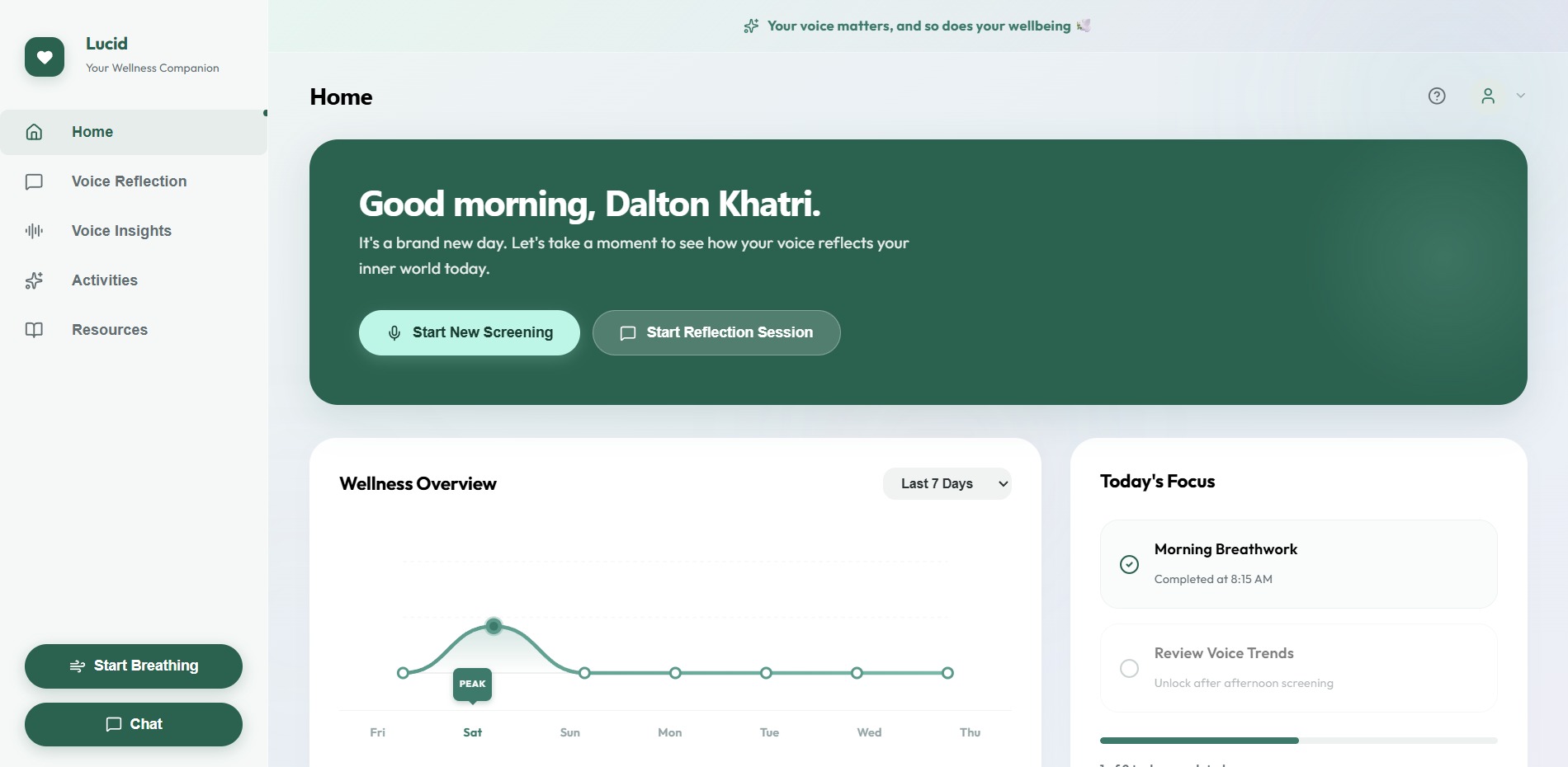
Most mental-health apps ask you to fill out a questionnaire and score the answers. A team of four Computer Engineering students at Kathmandu University built something that skips the form entirely: Lucid listens to a short voice recording, both the words and the tone, and flags stress, emotional triggers, and depression risk from that alone. The project started life under the working name SerenityScreen and has since been renamed.
What Lucid actually does
"Lucid is a private wellness tool that listens to both the words you say and the tone of your voice to help you track stress, emotional triggers, and depression risk," Dalton Khatri told us. In practice that means a reflection session: you talk, the app transcribes and analyzes it, and it returns a wellness overview alongside a specific identified trigger, in one example we saw, "jobs and careers" flagged as the primary cause with a 26 percent confidence score, plotted against five other candidate categories rather than presented as a single verdict.
RelatedGoogle's HEIR Compiler Runs AI On Encrypted Data
Built to bypass the stigma of a questionnaire
"We built Lucid to bridge the gap in clinical mental health access by providing a private, objective screening tool that detects early distress signals directly from voice recordings, bypassing the subjectivity and stigma of traditional questionnaires," Dalton said. The harder engineering problem was underneath, not on the surface: "The hardest part was implementing the late-fusion pipeline to successfully combine voice tone and word patterns on a very small clinical dataset without the models overfitting." Small clinical datasets are exactly where machine learning models tend to memorize instead of generalize, which makes that overfitting fight the real story behind the calm dashboard.
How it's different from a typical screening questionnaire
| Trait | Lucid | Typical screening questionnaire |
|---|---|---|
| Input | Your actual voice: words and tone together | Self-reported multiple choice answers |
| Method | Late-fusion of MentalBERT text and Wav2Vec2 audio embeddings | A scored form, no modeling involved |
| What you get back | A likely cause plus a confidence score, not just a verdict | One number, no explanation |
| Training data | A small clinical interview dataset, deliberately guarded against overfitting | Not applicable |
The team behind it
Lucid is a group project built by four Computer Engineering students at Kathmandu University in Dhulikhel, Nepal: Dalton Khatri, Sahaj Wagle, Saksham Dallakoti, and Abhyudaya Pokhrel, supervised by Dr. Prakash Paudyal, Assistant Professor in the Department of Computer Science and Engineering. The team also credited the DAIC-WOZ dataset, a clinical interview corpus researchers use for exactly this kind of distress-detection work, as the training data underpinning the model.
Our take
The interesting decision here isn't the voice-analysis pitch, plenty of hackathon projects promise that. It's that the team pointed their hardest engineering effort at the least glamorous part of the problem: keeping a model honest on a dataset too small to hide behind. A late-fusion architecture that deliberately keeps text and audio on separate branches until the last layer is a real design choice against overfitting, not a buzzword. Worth being clear about scope too: this is a student research prototype built to screen for risk signals, not a diagnostic tool, and the team's own framing as a "private, objective screening tool" rather than a clinical instrument is the right way to talk about it.
RelatedGemini 3.5 Flash Makes Computer Use a Native Tool
Lucid was built by Dalton Khatri, Sahaj Wagle, Saksham Dallakoti, and Abhyudaya Pokhrel at Kathmandu University, supervised by Dr. Prakash Paudyal. The project is open: GitHub.
- Built something? Doesn't need to be finished or fancy: a side project, a hackathon build, or a class project you're proud of counts.
- Email hello@genztech.blog with what you built, why you built it, a link, and your name plus college.
- See every spotlight so far at genztech.blog/campus-radar.
Reporting based on a direct interview with Dalton Khatri on behalf of the Lucid team. GenZTech has not independently audited the model's clinical accuracy or its performance on the DAIC-WOZ dataset.