
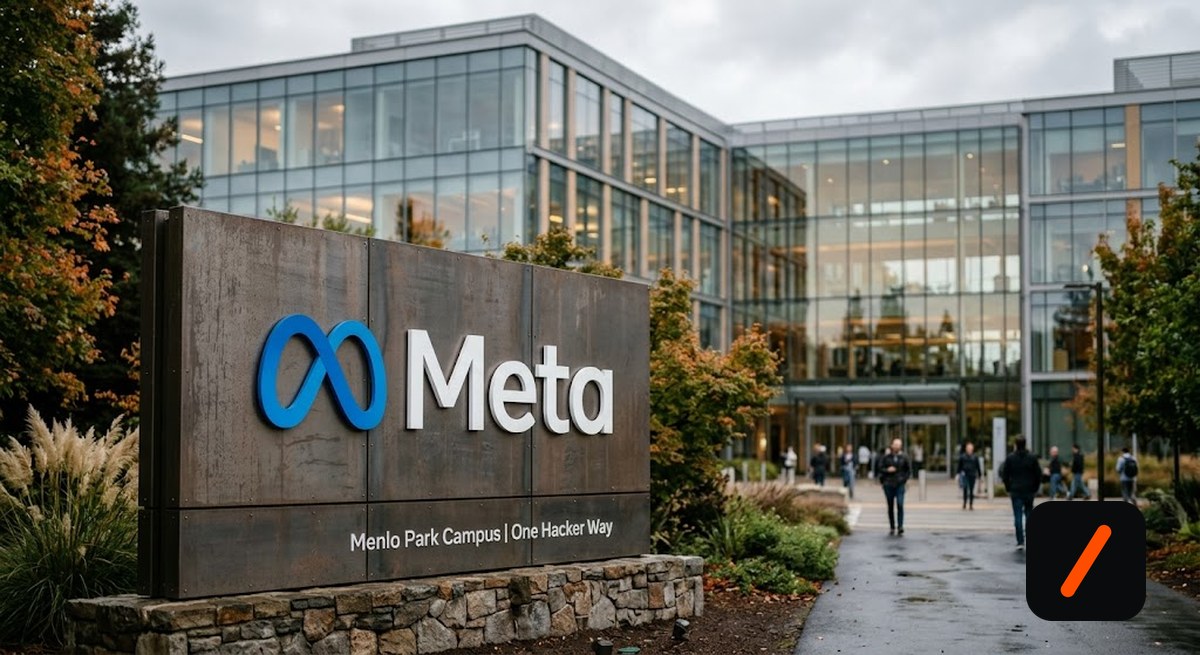
Meta has begun laying off about 8,000 employees, roughly 10% of its workforce, while reassigning around 7,000 more onto AI-focused teams, the company confirmed in mid-July 2026. This is not a retreat from growth. It is Mark Zuckerberg's clearest bet yet that Meta's future headcount should be concentrated behind AI and its superintelligence effort, not spread thin across legacy org charts built for a social-network company.
- The cut: about 8,000 roles eliminated, near 10% of the company, the largest single reduction since Meta's 2022-2023 "year of efficiency".
- The reshuffle: roughly 7,000 employees moved onto AI teams, so total internal churn is far larger than the net headcount change suggests.
- The why: compute and elite AI talent now command the budget, and Meta is trading breadth of headcount for depth of AI investment.
- The pattern: another big-tech "AI restructuring" that removes people even as capital spending on data centers and chips keeps climbing.
What exactly did Meta announce?
Meta has started notifying staff of about 8,000 job cuts, a reduction close to 10% of the company, and paired it with a large internal transfer that moves roughly 7,000 employees onto AI-focused teams. The framing matters. A pure layoff shrinks a company; this is a restructuring that shrinks some divisions while pouring people into others. The teams gaining headcount sit under Meta's AI and superintelligence umbrella, the effort Zuckerberg has publicly made his top priority. The teams losing headcount are the slower-growing corners of a two-decade-old company: overlapping middle-management layers, legacy product groups, and functions Meta believes AI tooling can now do with fewer people. The net headcount falls, but the composition changes far more than the total.
RelatedCognition's SWE-2 Nearly Matches GPT-6 Astra for a Quarter the Price
Why cut 8,000 while hiring for AI?
Because the two moves are the same decision. Frontier AI is astonishingly expensive in exactly two inputs: compute and a small number of extremely sought-after researchers. Meta has been paying record packages to poach top talent and committing tens of billions in capital expenditure to data centers and accelerators. That money has to come from somewhere, and in a company this size the largest controllable line item is people. Cutting 8,000 roles funds the compute and the talent war without denting the AI budget. It also reflects a genuine belief inside Meta that its own AI tools now raise the output of the remaining engineers enough that the company can do more with a leaner base. Whether that productivity claim holds is the real bet under the numbers.
| Company | Meta | Microsoft | Amazon | Alphabet |
|---|---|---|---|---|
| Recent workforce move | ~8,000 cut, ~7,000 reassigned to AI | Multiple 2025-26 rounds tied to AI focus | Corporate and devices trims | Targeted cuts, AI reinvestment |
| Stated rationale | AI / superintelligence priority | AI and cloud realignment | Efficiency plus AI | Durable cost base for AI |
| Capex direction | Rising sharply | Rising sharply | Rising | Rising |
| Signal | Headcount down, AI depth up | Same trade | Same trade | Same trade |
How is this different from the 2023 layoffs?
Meta's 2022-2023 cuts were about undoing pandemic-era overhiring and pleasing markets worried about metaverse spending. The message then was efficiency and discipline. This round is offensive, not defensive. The company is profitable, the stock has been strong, and revenue is growing, so these cuts are not a survival measure. They are a reallocation of a healthy company's resources toward a single strategic bet. That is a meaningfully different posture: in 2023 Meta shrank because it had to, and in 2026 it is reshaping because it has chosen a destination and wants every dollar and every seat pointed at it.
What it means for the market
For investors in Meta Platforms (META), the read is cost discipline colliding with an enormous AI spending cycle. Cutting 8,000 roles is a margin tailwind that partially offsets soaring capital expenditure on chips and data centers, which is the number that has spooked the market in recent quarters. The signal to watch is not the layoff itself but the combination: does operating margin hold or expand while capex keeps rising? If Meta can fund a superintelligence-scale buildout partly by trimming headcount and still grow ad revenue, the efficiency story supports the multiple. The risk is that heavy reassignment disrupts the ad and app teams that actually pay the bills. This is analysis, not investment advice; the tell will be capex guidance and Reality Labs losses on the next earnings call.
RelatedOpenAI Ships ChatGPT Images 2.5 With Sharper, Faster Generation
Who is most exposed inside Meta?
The employees most at risk are in layers the company thinks it can flatten: redundant management, slower legacy product lines, and support functions where AI tooling is already changing the work. The employees most protected are those who can plausibly be pointed at models, infrastructure, and the superintelligence roadmap. For the broader tech labor market, the message is stark. Even at a profitable, growing company, being adjacent to the AI thesis increasingly determines whether a role is funded, and being outside it increasingly does not. That reality, more than the raw 8,000 figure, is what will echo across the industry.
- Margins vs capex. The bull case needs operating margin to hold while AI spending climbs; the next earnings call is the test.
- Ad-team disruption. If reassigning 7,000 people slows the core ads and apps engine, the cost savings could be a false economy.
- Talent retention. Watch whether the reshuffle triggers voluntary exits among the very AI researchers Meta paid so much to attract.
- Copycats. Expect more big-tech "AI restructurings" framed the same way: fewer people, more compute.
Our take
The 8,000 number will dominate headlines, but the reassignment of 7,000 is the more important fact. Meta is not simply cutting costs; it is rebuilding itself as an AI company that happens to own the world's largest social apps, and it is willing to churn a tenth of its staff to do it. That is a defensible bet from a position of strength, and it is also a warning shot for the industry: the AI era is redistributing headcount, not just adding it. The open question is whether the productivity gains Meta is counting on are real enough to justify pointing an entire company at superintelligence while thinning the teams that fund the dream. We will know in the margins.
- OfficialMeta Investor Relations financials, headcount and capital-expenditure disclosures
- ReferenceMeta Newsroom company announcements and organizational updates
- ContextMeta AI Meta's AI and superintelligence research programs
Original analysis by GenZTech. Figures reflect reporting as of July 2026 and Meta's disclosed workforce changes.