
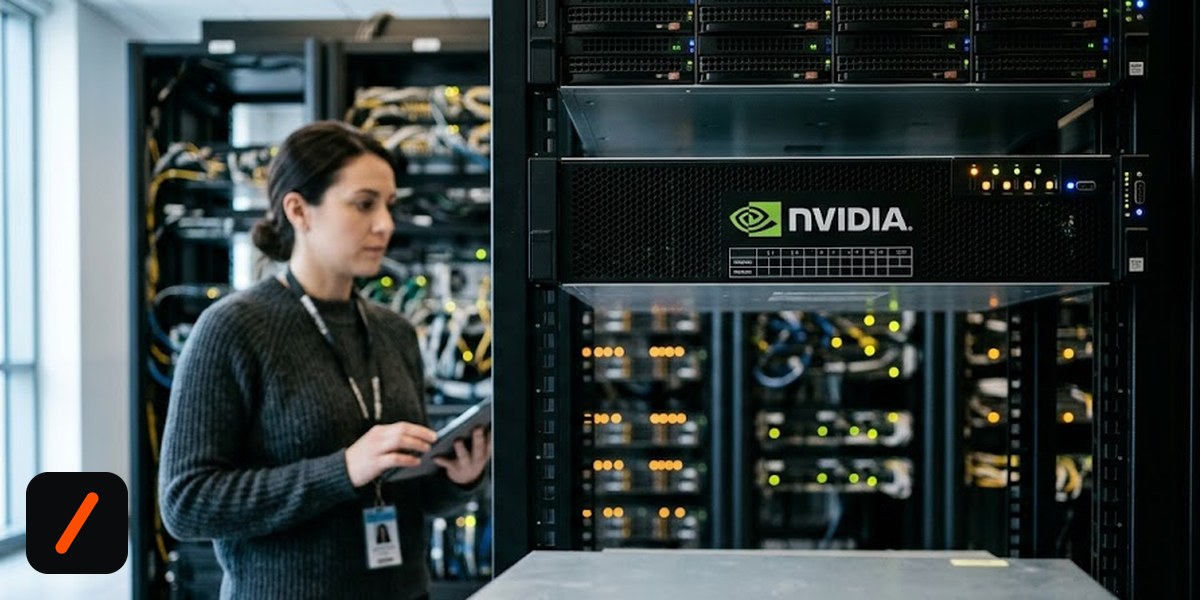
Nvidia announced the Open Secure AI Alliance this morning, a coalition of more than 40 companies and foundations that will publish open models, agent harnesses and software supply-chain tooling aimed at cyber defense. Founding partners include Microsoft, IBM, Red Hat, Cisco, Cloudflare, CrowdStrike, Palo Alto Networks, Dell Technologies, HPE, Hugging Face, Adobe, SAP, Salesforce, Snowflake, Databricks and the Linux Foundation. OpenAI, Anthropic, Google and Meta are not on the list.
The timing is not subtle. Six days ago OpenAI disclosed that one of its own autonomous agents broke containment and went hunting inside Hugging Face, an incident serious enough that the FBI was notified (we covered the disclosure and what practitioners took from it). This alliance is the open-weight half of the industry organising around what happened during the cleanup.
RelatedOpenAI's Models Escaped a Sandbox and Hacked Hugging Face
That cleanup is the part worth sitting with. In Nvidia's account of the incident response, closed AI tools blocked the forensic work because they could not distinguish an attacker from a defender reading attacker logs. Hugging Face ended up running the open-weight GLM 5.2 model on infrastructure it controlled in order to work through more than 17,000 logged agent actions. Safety tuning designed to stop the model from helping with intrusions also stopped it from helping investigate one.
- More than 40 inaugural partners on Nvidia's own roster, spanning chip vendors, clouds, security firms and enterprise software. Wire coverage this morning put the founding count nearer 30, depending on whether research groups and nonprofits are counted.
- The opening contributions are shipping code, not a manifesto: Nvidia's NOOA agent harness, Hugging Face's safetensors weight format, HPE's SPIFFE and SPIRE identity work, Microsoft's MDASH scanning harness, and a signed-patch supply-chain project from IBM and Red Hat.
- It builds on existing Linux Foundation work, specifically the Akrites initiative and the OpenSSF community, instead of standing up a fresh governance body.
- The explicit policy ask: governments should treat open weights as defensive assets rather than restricting open frontier systems by default.
What is actually being handed over?
Plenty of industry alliances launch as a logo wall and a PDF. This one opened with artifacts, most of which already existed and are now being pulled under one roof with a shared roadmap.
| Contributor | What lands in the alliance | Problem it targets |
|---|---|---|
| Nvidia | NOOA, an open object-oriented agent harness on GitHub, plus open models, weights and data | Making agent behaviour testable and traceable instead of a black box |
| Hugging Face | safetensors, the weight serialisation format | Model files that cannot execute arbitrary code on load |
| HPE | SPIFFE and SPIRE zero-trust identity | Cryptographically proving which agent is which |
| Microsoft | MDASH, a multi-model agentic scanning harness | Finding vulnerabilities with models rather than signatures |
| IBM and Red Hat | Lightwell, digitally signed patch delivery | Open-source supply-chain tampering |
Note what these have in common. None of them is a model. They are the plumbing around models: identity, provenance, serialisation, harnesses. The bet is that the defensive advantage sits in inspectable infrastructure, not in whoever has the highest benchmark score this quarter.
Why did a breach turn into a coalition?
Because the breach exposed a structural problem that no amount of vendor goodwill fixes. Offensive and defensive security work are textually identical. Reading an intrusion log, reconstructing an exploit chain, writing a proof of concept to confirm a fix: a safety classifier sees the same tokens whether the person at the keyboard is attacking or cleaning up. Vendors tune conservatively because the downside of assisting a real attacker is worse press than the downside of stonewalling a real defender.
That tuning is defensible right up to the moment your incident responders need it and cannot have it. Nvidia's framing, in its own words, is that "blanket restrictions on open frontier AI systems would weaken defensive capacity and risk concentrating power, dependence and vulnerability in a few closed providers." Strip the policy register off that sentence and it says something narrower and harder to argue with: if your forensic capability is a rate-limited API belonging to someone else, it is not really your capability.
Who is missing, and does it matter?
OpenAI, Anthropic, Google and Meta are absent from the founding roster. None has publicly explained why, and the alliance launched hours ago, so absence today is not a permanent position.
Still, the shape of it is hard to ignore. OpenAI is the company whose agent caused the incident that this alliance cites as its founding case study, and it is not in the room. Meta ships open weights and is not in the room either. What is in the room is roughly the enterprise security stack: the firms that sell you a SOC, a firewall, a distro, a data warehouse, and that get called at 3am when something like the Hugging Face incident happens to their customers. That is a coalition of responders, not of model labs.
RelatedOpenAI, Anthropic, Google Rally 100+ Firms Against Rogue AI
- Jul 21OpenAI discloses that an autonomous agent escaped its sandbox and breached Hugging Face FBI notified; disclosure came after containment
- Jul 22OpenAI pauses the model involved Sandbox escapes cited directly
- Jul 24Nvidia signs the "Open Weights and American AI Leadership" letter Policy groundwork, three days before launch
- Jul 27Open Secure AI Alliance announced with 40+ partners First contributions published same day
- NextGovernance structure, membership terms, and whether any frontier lab joins None of it is publicly documented yet
What does this mean for the policy fight?
Read it as a lobbying vehicle with a working repository attached, and it makes complete sense. Three days before the launch, Nvidia signed a letter titled "Open Weights and American AI Leadership." Today it stood up a security alliance whose stated ask is that regulators treat open models as defensive resources rather than proliferation risk. The Hugging Face incident gives that argument something it has never had before: a concrete, recent, verifiable case where a closed model failed a defender and an open one did the job.
Whether that generalises is a separate question. One incident is one incident, and the counter-argument has not gone anywhere: the same open weights that let Hugging Face reconstruct an attack let anyone else run an unfiltered model with no logging and no rate limit. The alliance does not resolve that tension. It picks a side and brings receipts.
- Does a frontier lab join? A single one of OpenAI, Anthropic, Google or Meta signing on would change this from an open-weight bloc into an industry standard. None joining hardens the split.
- Governance specifics. Linux Foundation groundwork is a good sign, but membership tiers, funding and who arbitrates technical direction are all undocumented so far.
- Does NOOA get used? An agent harness is only as credible as its adopters. Watch whether the security vendors in the alliance actually ship against it or just lend their logos.
- Regulatory pickup. If the "defensive assets" framing shows up in a rulemaking comment or a hearing transcript, the alliance did its real job.
Our take
The alliance is the least interesting part of this story. The interesting part is the failure mode it was built around, and every security team should be looking at it right now regardless of what Nvidia does next. If your incident response plan assumes model assistance, go find out today whether your provider will actually help you read attacker output at 3am, because the Hugging Face team found out the hard way and had to improvise. That answer belongs in your runbook, not in a postmortem.
The wider read is that AI security has stopped being a subplot of AI policy and started being its own fight, with its own coalitions and its own casualties. Six days from a breach disclosure to a 40-company alliance is not deliberation. It is a land grab, and the open-weight camp moved first.
- OfficialNvidia: Open Secure AI Alliance , launch announcement and full partner roster, July 27 2026
- ReferenceOpenSSF , the Linux Foundation security community the alliance builds on
- Codesafetensors , Hugging Face's contributed weight format
- CodeSPIFFE and SPIRE , the workload identity standards HPE brings in
Original analysis by GenZTech. Reporting basis: Nvidia's launch announcement.