
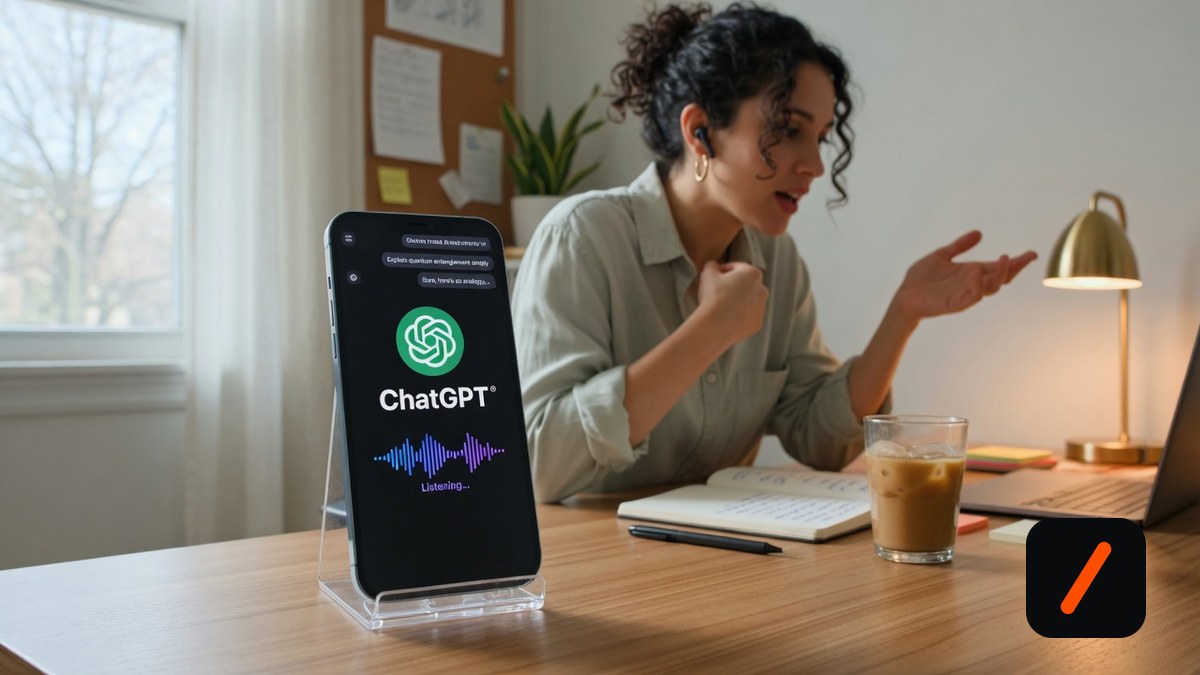
OpenAI released GPT-Live, a new generation of voice models that can listen and speak simultaneously, ending the walkie-talkie rhythm that has defined talking to ChatGPT until now. Two versions, GPT-Live-1 and a cheaper GPT-Live-1 mini, are rolling out globally inside ChatGPT alongside the July 9 GPT-5.6 launch. The pitch is simple and the demo is convincing: you can cut the model off mid-sentence, and it hears you, stops, and adjusts, the way a person on a phone call does.
- GPT-Live is full-duplex: it processes incoming audio while it is still talking, so interruptions and back-channels ("mm-hm", "wait, no") work naturally.
- Two tiers ship at once, GPT-Live-1 for quality and GPT-Live-1 mini for cost and latency, both available in ChatGPT and via the API.
- It collapses the old three-step voice stack (speech-to-text, then a text model, then text-to-speech) into one speech-native model, cutting the lag that made prior voice modes feel robotic.
- It lands the same day as GPT-5.6, giving OpenAI a paired text and voice release aimed squarely at agents and hands-free workflows.
What actually shipped?
GPT-Live is a speech-native model, meaning it takes audio in and produces audio out without round-tripping through text in the middle. That is the whole trick. Earlier "Advanced Voice" modes stitched together three separate systems: a transcriber that turned your words into text, a language model that read the text and wrote a reply, and a text-to-speech engine that read that reply aloud. Every hop added delay and threw away information, which is why the old voice mode could not really be interrupted and never caught tone, laughter, or a half-finished thought. Folding all of that into one model removes the seams, and the result feels less like issuing commands and more like a conversation.
RelatedClaude Cowork vs ChatGPT Work: the agent app war goes mobile
Why does full-duplex matter so much?
Human conversation is not turn-based. We interrupt, we agree while the other person is still talking, we trail off and expect to be understood. A half-duplex assistant breaks all of those habits, and that mismatch is the single biggest reason voice AI has felt like a gimmick rather than a tool. Full-duplex fixes the mechanics of the exchange. You can say "no, the other one" the instant the model starts down the wrong path, and it stops. For anything hands-free, cooking, driving, walking, accessibility use, or a support agent handling a live caller, that responsiveness is the difference between usable and abandoned.
| Capability | GPT-Live | Advanced Voice (old) | Typical assistant |
|---|---|---|---|
| Architecture | Single speech-native model | STT + LLM + TTS chain | STT + LLM + TTS chain |
| Interrupt mid-reply | Yes, natural | Limited | Rare |
| Listens while speaking | Yes | No | No |
| Perceived latency | Low | Noticeable | High |
| Budget tier | GPT-Live-1 mini | None | Varies |
Who is this really for?
The consumer story is the headline, but the developer story is the point. Shipping GPT-Live in the API on the same day as ChatGPT means builders can drop realtime voice into their own apps: phone-based customer support, language tutors that talk back, in-car assistants, voice-first agents that book, cancel, and confirm out loud. The mini tier is the tell. Realtime voice is expensive to run, and a cheaper, lower-latency model is what makes always-on voice affordable at scale rather than a premium demo. OpenAI is not just improving ChatGPT's microphone; it is trying to own the voice layer that other products get built on.
What it means for the market
Voice is the surface where OpenAI, Google, and Amazon collide most directly. Google has been pushing Gemini into Assistant and Android, and Amazon rebuilt Alexa around a large model. A genuinely conversational OpenAI voice model raises the bar for all of them and pressures the standalone voice-AI startups (think real-time speech vendors) whose entire product is the pipeline GPT-Live just collapsed into one call. For investors, the signal is that the voice interface is consolidating into the same handful of frontier labs that already dominate text, and that the moat is latency and cost, not just quality. Watch API pricing on the mini tier: that number decides how many companies can build voice-first products without going broke on inference.
RelatedOpenAI Dots: Always-On Agents With Their Own Computers
Our take
Voice has been the most oversold and underwhelming part of consumer AI for years, so skepticism is fair. But full-duplex is a real architectural change, not a marketing label, and it targets the exact thing that made previous voice modes feel fake. If GPT-Live delivers the low-lag, interruptible experience OpenAI is showing, it will quietly become one of the most-used features of ChatGPT, precisely because it stops feeling like a feature. The open question is reliability under messy real-world audio, background noise, accents, crosstalk, where demos always look better than daily use. That, not the demo, is the test worth waiting for.
- Mini-tier pricing. The per-minute cost of GPT-Live-1 mini decides whether voice-first startups are viable.
- Noise robustness. Full-duplex only wins if it holds up in cars, kitchens, and call centers, not just quiet demos.
- Google's answer. Expect a Gemini realtime-voice response fast; this is now a two-horse race for the voice layer.
- OfficialOpenAI announcements GPT-Live and GPT-5.6 launch posts
- ReportingCNBC GPT-5.6 public release and new voice models
- ReferenceLLM-Stats news tracker July 2026 model timeline
Original analysis by GenZTech. Figures current as of July 2026.