
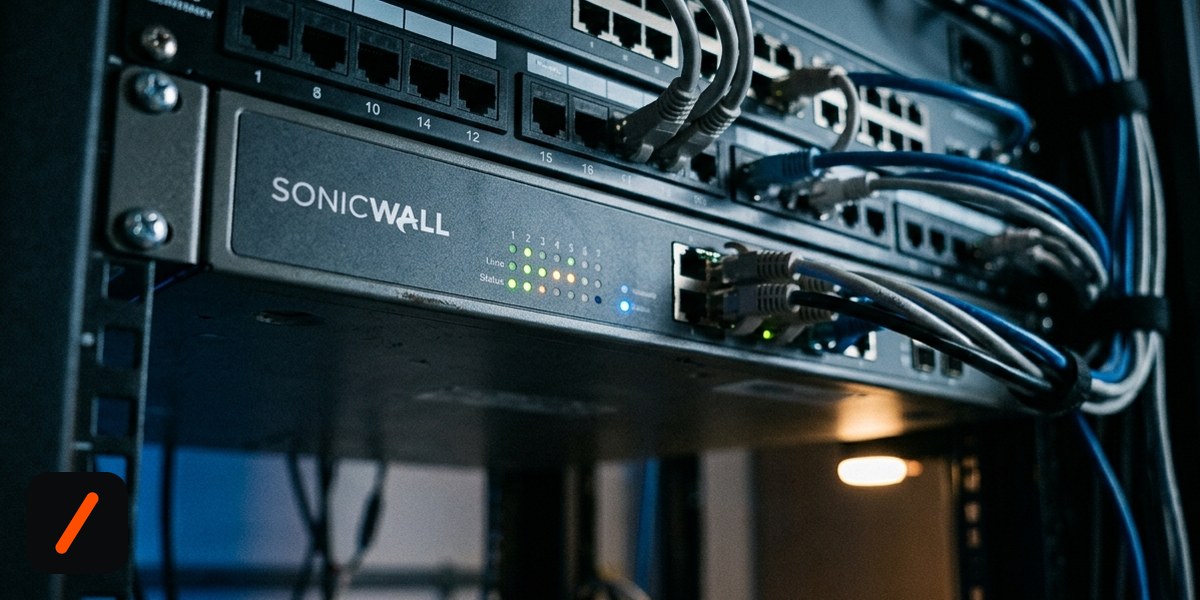
SonicWall disclosed and patched two zero-day vulnerabilities in its SMA 1000 series secure remote access appliances on September 1, 2026, after both were already being exploited in the wild. Chained together, they let an attacker with zero credentials reach full remote code execution on the exact box enterprises deploy to gatekeep VPN access. It's the third distinct attack chain against this product line in under a year, and the worst part isn't the bugs themselves: researchers found that MFA seeds stolen before the patch keep working after it, meaning a patched appliance can still hand an attacker a valid second factor.
- CVE-2026-83548 is a pre-authentication SSRF flaw in the Appliance Work Place interface, rated a maximum CVSS 10.0, exploitable remotely with no login required at all.
- CVE-2026-83549 is OS command injection in the Appliance Management Console (AMC), CVSS 7.8, and normally needs an authenticated admin session, but attackers chain it through the SSRF to skip authentication entirely.
- Chained, the two bugs produce unauthenticated remote code execution on affected SMA 1000 models 6210, 7210, and 8200v.
- Most critical finding: stolen MFA seeds from earlier compromise activity remain valid even after organizations apply the September patches, so patching alone does not remove an attacker who already grabbed a seed.
Affected firmware runs 12.4.3-03453/12.5.0-02835 (platform-hotfix) and older. SonicWall's fix landed in 12.4.3-03526/12.5.0-02952 (platform-hotfix) and later, released the same day the vulnerabilities were disclosed. CISA, Rapid7, and researchers with ties to Google confirmed active exploitation before the advisory even went public, which is the pattern that should worry defenders most: this wasn't caught by SonicWall first.
RelatedCitrix NetScaler Zero-Days CVE-2026-88771/88772: Patch Now
How do the two SonicWall flaws chain into full RCE?
The Appliance Work Place interface, the portal remote users hit to authenticate into the VPN, has a server-side request forgery hole that requires no credentials whatsoever. On its own, SSRF lets an attacker coerce the appliance into making requests it shouldn't, typically against internal services the appliance can reach but the attacker normally can't. In this case, that internal reach extends to the Appliance Management Console, the administrative component that's supposed to sit behind an authenticated admin session.
The AMC has its own bug, an OS command injection flaw. Command injection in an admin console is bad but contained, assuming only trusted admins can reach it. The SSRF breaks that assumption. An attacker forges a request through the public-facing Work Place interface, lands inside the AMC's request path, and fires the command injection without ever presenting a password, a certificate, or an MFA token. The result is code execution as the appliance itself, on a box that sits at the network edge specifically to broker remote access into everything behind it.
Why doesn't patching alone fix this?
This is the detail that separates a routine "patch by Friday" advisory from something IT teams need to escalate. Researchers investigating the September attacks found that attacker access to stolen MFA seeds predates the fixes, and critically, those stolen seeds kept working on appliances after the patches were applied. Firmware updates close the SSRF and command injection holes, but they don't invalidate a seed an attacker already copied off the box or intercepted earlier in the year.
MFA seeds are the shared secret behind time-based one-time codes. If an attacker has the seed, they can generate valid codes indefinitely, the same as the legitimate user's authenticator app, until that seed is revoked and reissued. Patching the appliance stops new exploitation of these two CVEs. It does nothing to a second factor an attacker was handed months ago. Any organization treating "we applied the hotfix" as case closed is leaving a standing door open for exactly the kind of access that outlives a patch cycle.
The practical fix has two parts, not one: update to 12.4.3-03526 or 12.5.0-02952 (or later), and separately rotate or reissue MFA seeds and tokens for every SMA 1000 user. Skipping the second step means an attacker who compromised credentials before September 1 can walk back in after the patch with a still-valid one-time code.
RelatedMagento Zero-Day StyleSmuggler Hit Stores Before Adobe Patched
Who is actually at risk right now?
Any organization running SMA 1000 models 6210, 7210, or 8200v on firmware at or below 12.4.3-03453/12.5.0-02835 was exposed prior to the fix, and given confirmed in-the-wild exploitation ahead of disclosure, "was exposed" should be read as "may already be compromised" rather than "might get hit later." Enterprises using SMA 1000 gateways for remote workforce VPN access are the direct target, since a compromised appliance sits between the internet and everything the appliance is trusted to reach internally.
- Jul 22, 2026UTA0533 exploits SMA 1000 first tracked incident against this product line this year
- Sep 1, 2026CVE-2026-83548 & CVE-2026-83549 disclosed already under active exploitation, patched same day
- Sep 2026 onwardstolen MFA seeds remain valid patched appliances still accept old seeds until rotated
- Scrutiny on SonicWall. A third distinct incident against the same appliance line in under a year will draw harder questions from enterprise security teams about SMA 1000's architecture, not just its patch cadence.
- Migration pressure. Expect at least some large SMA 1000 customers to evaluate alternative remote access gateways rather than wait for a fourth incident.
- MFA rotation becomes standard advisory language. This incident sets a precedent: future vendor advisories for edge devices will likely start pairing "patch now" with "rotate secrets separately" as a default recommendation.
- CISA follow-up. Given confirmed active exploitation ahead of disclosure, a KEV catalog addition and possible federal mandate for MFA seed rotation, not just patching, is a reasonable near-term expectation.
Our take
Edge remote-access appliances keep getting hit for the same structural reason every time: they're internet-facing by design, trusted by everything behind them, and often patched on a slower cadence than the software running inside the network they protect. SonicWall's SMA line has now absorbed three separate attack chains in about twelve months, which stops looking like bad luck and starts looking like a pattern worth an architecture review, not just another hotfix.
The MFA seed finding is the part that should reshape how security teams think about "patched" as a status. A CVSS 10.0 SSRF chained into RCE is the kind of bug that gets headlines and same-day fixes. Stolen secrets that quietly survive the fix are the kind of finding that gets missed in the rush to close the ticket. Treating patch and credential rotation as one atomic response, rather than two separate to-do items with different urgency, is the actual lesson here. Anyone still validating the second factor from before September 1 is trusting a lock they never actually changed.
- ReferenceHelp Net Security on the SMA 1000 zero-day attacks : vulnerability details and disclosure timeline
- ReferenceSecurityWeek on SonicWall's two SMA1000 zero-days : vendor warning and exploitation confirmation
- ReferenceRapid7 emerging threat response : technical breakdown of the chained exploit
- ReferenceThe Hacker News on the SonicWall SMA exploitation : active exploitation coverage
- ReferenceTech Times on the third SMA1000 incident and MFA seed persistence : the MFA seed survival finding
- ReferenceThe Register on SMA1000 boxes under active attack again : context on the repeated targeting of this product line
Original analysis by GenZTech. Sources: SecurityWeek.