
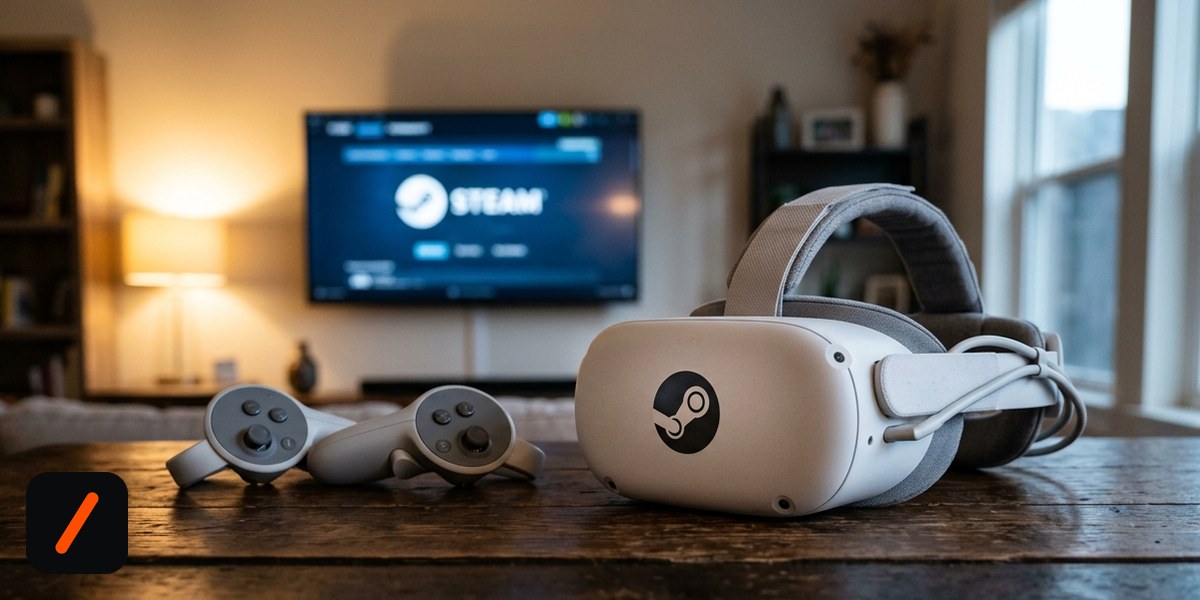
Valve priced its long-delayed Steam Frame VR headset at $1,059 for the 256GB model and $1,299 for 1TB, and opened reservations this morning, nearly ten months after first showing the hardware off. Every unit ships with both controllers and a full, rebuilt copy of Half-Life: Alyx built to run natively on the headset's own chip, no PC required.
The reservation window itself is oddly structured and worth getting right if you actually want one. Sign-ups are open now through September 17 at 10am Pacific, at which point Valve randomizes the queue rather than running first-come-first-served, and purchase invitations start going out September 18. Anyone not picked in the first pass lands on a waitlist rather than being turned away outright.
RelatedAustralia's Age Law Kicks In, Steam Accepts Only Credit Cards
What exactly did Valve announce on September 14?
Pricing, storage tiers, and a firm reservation process, closing out a headset Valve first showed alongside the Steam Machine console and a redesigned Steam Controller back on November 12, 2025. That original reveal targeted an early-2026 launch; instead the hardware spent most of the year in near-silence before today's pricing post. Valve hasn't said why the slip happened, though the timing lines up with an industry-wide memory squeeze that's been pushing up the cost of RAM and flash storage across the board.
Both storage tiers include the headset, two controllers, and a USB dongle for PC streaming. A microSD slot lets 256GB buyers add their own storage rather than paying Valve's premium for the 1TB unit outright.
What's actually inside the $1,059 headset?
A Qualcomm Snapdragon 8 Gen 3, the same tier of mobile chip Android flagships used a couple of generations back, paired with 16GB of LPDDR5X RAM, double what a Meta Quest 3 carries. Each eye gets its own 2160x2160 LCD panel running up to 120Hz, with an experimental 144Hz mode Valve is clearly still tuning. Tracking is entirely inside-out, four grayscale cameras handle positional tracking with no base stations to set up, two of those cameras double as color passthrough, and eye tracking feeds the foveated rendering and foveated streaming that keep both local games and streamed PC games looking sharp without melting the wireless connection. The whole thing weighs 185 grams bare, climbing to around 440 grams once the battery, head strap, and facial interface are attached, a number Valve needs to defend against a Quest 3 that undercuts it on weight as well as price.
| Steam Frame (256GB) | Meta Quest 3 (512GB) | PSVR2 | |
|---|---|---|---|
| Price | $1,059 | $349 | ~$549 |
| Chip | Snapdragon 8 Gen 3 | Snapdragon XR2 Gen 2 | Custom (tethered to PS5) |
| RAM | 16GB | 8GB | Shares PS5's 16GB |
| Tracking | Inside-out, eye tracking | Inside-out, eye tracking | Inside-out, eye tracking |
| PC play | Native SteamOS + wireless streaming | Wired/wireless Steam Link app | Wired to PS5 only |
| Bundled game | Half-Life: Alyx | None standard | Varies by bundle |
Why does this cost three times what a Quest 3 does?
Because Meta subsidizes Quest hardware with its advertising and software business, and Valve, by its own long-standing policy, does not. Valve has said plainly that it prices Steam hardware to cover its costs rather than lose money on the box to sell more software later, the same logic that made the Steam Deck a harder sell against a subsidized Nintendo Switch on paper even when reviewers preferred it. Layer on top of that a genuine component problem: memory manufacturers including Samsung and SK Hynix have been signing exclusive, large-volume supply deals with AI companies buying up DRAM and NAND for data centers, which has tightened supply and pushed prices up for everyone else building consumer electronics in 2026. Meta has quietly raised some Quest prices this year for the same reason. Valve just isn't in a position to absorb it the way a company running billions in ad revenue can.
- Nov 12, 2025Valve unveils Steam Frame shown alongside the Steam Machine console and a new Steam Controller, targeting early 2026
- Jul 6, 2026Steam Machine priced at $1,049 Valve's living-room console ships first, reservations open
- Sep 14, 2026Steam Frame pricing revealed $1,059 / $1,299, reservations open with Half-Life: Alyx bundled
- Sep 17, 2026, 10am PTReservation queue randomizes sign-ups after this point join a waitlist
- Sep 18, 2026 onwardPurchase invitations begin selected buyers get their checkout window
What happens if Half-Life: Alyx doesn't ship day one?
It probably won't, and Valve has said as much. The rebuilt Alyx, a native 64-bit ARM build using foveated rendering and eye tracking to run on mobile silicon instead of a gaming PC, is described as "intended to ship to customers soon" rather than at launch, redeemed later as a Steam voucher. That's a real gap between the marketing headline and what actually arrives in the box, and it matters more than it would for a lesser game: Alyx is still the single best argument for owning a headset at all nearly six years after it shipped on PC, and Valve is leaning on it hard to justify the price. Buyers paying $1,059 up front on the promise of a game that arrives on an unspecified later date are extending Valve a fair amount of trust.
RelatedValheim Hits 1.0: Deep North, PS5 and Switch 2 Launch
Who should actually reserve one?
People already invested in Steam's library who want it untethered from a desk, and anyone who never got to play Alyx because they didn't own PC VR gear in 2020. It's a harder sell for someone shopping purely on price or casual use, where a $349 Quest 3 does most of the same job for a third of the cost and a much bigger existing app catalog. The 130-plus titles Valve says run natively at launch, with roughly 70 already carrying the new "Steam Frame Verified" compatibility tag, is a real number but still a fraction of Quest's install base after three hardware generations. Developers get their own angle: Steam Partner accounts can already request dev kits, which is usually the more reliable early signal of how seriously a platform is being taken internally than the marketing copy around it.
- Whether Alyx actually ships before the returns window closes. A voucher redeemed months late is a very different customer experience than the bundle Valve is advertising today.
- Real-world battery life. A 21.6Wh cell in a 440-gram headset is a tight budget for anything demanding; independent runtime tests will tell the real story fast.
- Whether the memory shortage gets worse before Steam Frame actually ships to the first buyers, which could push accessory and future restock pricing higher still.
Our take
Valve is charging a premium and being unusually upfront about why: no ad business to subsidize the box, and a component market working against it. That honesty is worth something, but it doesn't change the math for most buyers stacking Steam Frame against a Quest 3 that costs a third as much and already has the bigger library. What could actually move Steam Frame is the thing no competitor can copy: a from-scratch, hand-rebuilt Half-Life: Alyx that only exists on this hardware, at least until Valve inevitably ports it elsewhere. Whether that's worth $1,059 to a given buyer is a much narrower question than "is this good VR hardware," and Valve seems to know it.
- ReferenceUploadVR: Steam Frame Is $1,059, Reservations Opened, Alyx Included pricing, accessories, reservation timeline, and hardware specifics
- ReferenceEngadget: Valve's Steam Frame VR headset starts at $1,059 and ships with Half-Life: Alyx launch-title count and Alyx's voucher-redemption detail
- ReferenceGame Developer: Valve's Steam Frame will retail for $1,059 memory-shortage pricing context and Valve's no-subsidy stance
- ReferenceRoad to VR: Valve unveils Steam Frame VR headset original November 2025 reveal and chipset/display specs
Original analysis by GenZTech Team. Sources linked above. Read UploadVR's original coverage.