
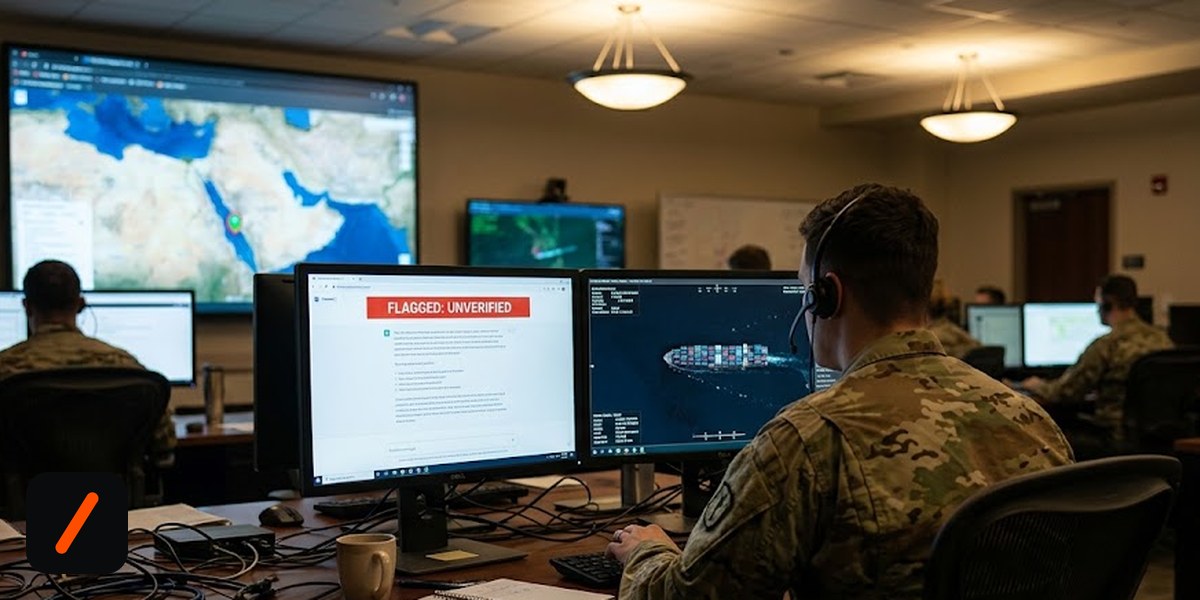
A US military intelligence analyst asked an AI chatbot to review a ship's manifest this spring, and the answer it gave nearly triggered an armed interception of a Chinese vessel in the Middle East. CNN reported Thursday, citing four sources, that the chatbot had fused open-source shipping data with classified signals intelligence and concluded, wrongly, that the vessel was carrying components for a nuclear weapons program. Military aircraft were already in the air and a boarding team was staged before a last review caught the error and the operation was called off.
- The false report surfaced this spring during the US war with Iran, when a Special Operations Command Pacific analyst queried a chatbot about a Chinese ship's cargo.
- The tool blended open-source intelligence with classified signals intelligence and produced a fabricated conclusion: that the ship carried nuclear weapons program materials.
- Armed personnel were preparing to board the vessel and aircraft were airborne before a final review flagged the report as AI-generated and false.
- One source told CNN the episode "almost started a war"; the Pentagon and Special Operations Command Pacific did not respond to requests for comment.
What did the chatbot actually get wrong?
The specifics CNN's sources describe are narrower than "an AI made something up out of thin air," which is what makes the failure worth taking seriously. An analyst fed the chatbot real material: a ship's manifest and surrounding intelligence. The tool then did exactly what these systems are built to do, synthesizing scattered inputs, in this case open-source shipping records alongside classified signals intelligence, into a single readable assessment. Somewhere in that synthesis it inferred cargo that wasn't there and stated it as fact, with no visible hedge distinguishing an inference from a confirmed finding. Read by someone under time pressure, a report like that looks like any other finished intelligence product.
RelatedGemini 3.8 Flash Model Card Leaks Ahead of Google Launch
That is the mechanism behind almost every well-known AI hallucination, from fabricated legal citations to invented API methods. The model has no internal flag for "I am guessing." It produces a fluent sentence whether the underlying evidence supports it or not, and the sentence carries exactly the same confident tone either way. In a chatbot answering trivia, that produces an embarrassing correction. Fed into a targeting pipeline with armed personnel already moving, it produces a much narrower margin for someone to notice before it's too late.
Why was this even close to happening?
Because the Pentagon spent this year explicitly pushing its workforce toward exactly this kind of use. In January, Defense Secretary Pete Hegseth's office released an "Artificial Intelligence Acceleration Strategy" built around three pillars: warfighting, intelligence, and enterprise operations, with one of its named projects aimed at speeding up "the conversion of intelligence into weapons." Hegseth's own language at the rollout was blunt: "We will unleash experimentation, eliminate bureaucratic barriers, focus our investments and demonstrate the execution approach needed to ensure we lead in military AI." Giving analysts fast, broad access to generative tools was the stated goal, not a side effect.
Speed and verification pull in opposite directions, though, and this incident sits exactly at that seam. An analyst under pressure to move fast now has a tool that will always give them an answer, confidently phrased, regardless of whether the underlying evidence actually supports it. Nothing in the public reporting suggests the chatbot was a specialized, vetted intelligence system rather than something closer to an off-the-shelf assistant repurposed for a classified workflow. When speed is the explicit mandate, a fabricated answer looks, at a glance, exactly like a fast one.
Who's actually accountable when this goes wrong?
Nobody with a clear answer yet, which is the uncomfortable part. CNN's sourcing describes a defense and intelligence community with no unified standard for verifying AI-generated material before it's acted on: different commands apply different checks, and there's no single gate a report has to clear regardless of which unit produced it. Formal sign-off on lethal action nominally still sits with a human, but that distinction gets thinner every time the underlying analysis, the part that actually decides what a target is, comes from a model instead of a person who did the legwork.
RelatedKimi K3 Shipped Early. The Real Barrier Isn't the Repo.
This case worked out because a final review caught the fabrication before boots hit the deck. That's a real safeguard functioning as intended, and it deserves credit. But "someone happened to double-check in time" is a thin margin to be running on when the process being reviewed is explicitly being accelerated. A near-miss with a Chinese vessel during an active war with Iran is the kind of story that, told one beat later, is a very different headline.
- Whether the Pentagon names the tool. Neither CNN's sources nor the Pentagon's non-response identify which chatbot generated the report. Knowing whether it was a commercial model, a government-built system, or something in between changes who's actually responsible for fixing it.
- A unified verification standard, or the lack of one. The Acceleration Strategy talks about speed; it says far less about a mandatory human check on AI-generated intelligence before action. Whether that gets written down now, after a near-miss, is the real test of the strategy's seriousness.
- The next story like this that isn't caught in time. Hallucination rates on frontier models have not gone to zero, and the military's own strategy calls for putting more of them into exactly this kind of pipeline, faster.
Our take
The story that will get written is "AI almost started a war," and that's fair as a headline but it undersells what actually failed. This wasn't a rogue system acting on its own. It was a normal chatbot doing what chatbots do: answering a question fluently, without flagging where its confidence ran out. The failure sat entirely in the workflow around it, in the absence of a mandatory check before a fabricated claim could move armed personnel. Every organization racing to bolt AI onto a decision pipeline should read this as the concrete version of a risk that's usually discussed in the abstract. The tool doesn't need to be malicious or even unusually bad to cause real harm. It just needs to be trusted a little more than it deserves, at the one moment nobody has time to double-check.
- ReportingCNN: US military had close call after using AI for false intelligence report — the original reporting, citing four sources
- OfficialDepartment of War: Artificial Intelligence Acceleration Strategy (PDF) — the January 2026 strategy document setting the push for faster military AI adoption
- OfficialDoW Research & Engineering: Release of the AI Acceleration Strategy — the official rollout summary and named "pace-setting projects"
Original analysis by GenZTech Team, based on CNN's reporting.