
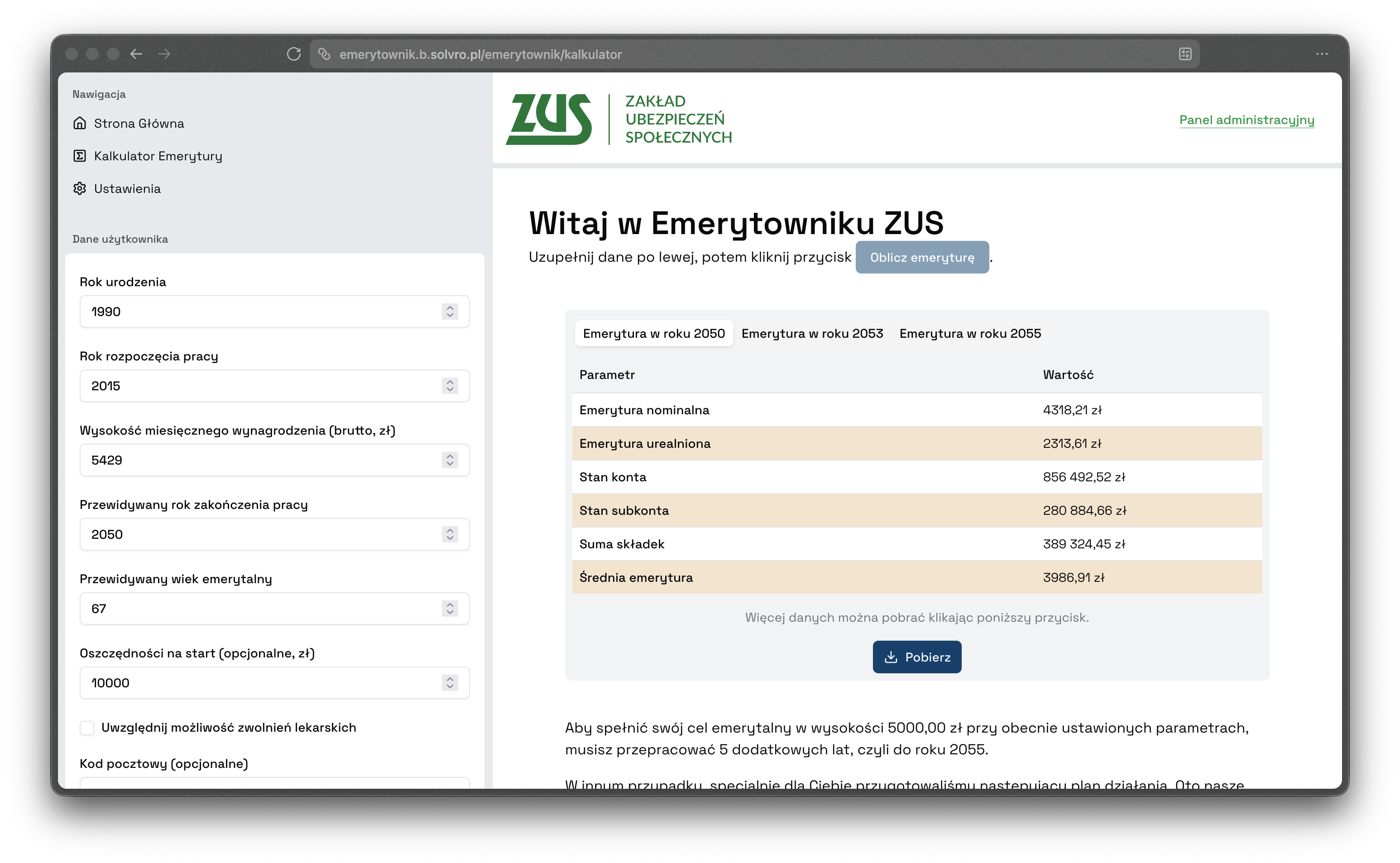
Most retirement calculators give you one number and leave you to figure out what to do with it. A team of students at Wroclaw University of Science and Technology built something different at HackYeah 2025, Poland's largest hackathon: a pension calculator that tells you exactly what to change if the number it gives you isn't good enough. This is Campus Radar, GenZTech's weekly spotlight on real student projects, and this week it's a team build, not a solo one.
What Emerytownik actually does
"Emerytownik allows users to predict and plan their retirement savings based on their current and historical salary, wages, age, and data from the Polish Social Insurance Institution," Konrad Guzek, one of the builders, told us. That institution, ZUS (Zaklad Ubezpieczen Spolecznych), posed the challenge themselves: a real government agency wanted a tool that would get young adults thinking seriously about retirement planning, not just a nice-looking form.
RelatedSovereign AI Has a Price Tag. Does It Have a Plan?
Under the calculator UI sits a genuine machine learning pipeline. An MLP classifier, trained with PyTorch Lightning directly on ZUS's own actuarial tables, predicts a pension outcome from a user's career inputs. Most tools would stop there and hand back a number. Emerytownik adds a second stage: a PPCEF module, short for probabilistically plausible counterfactual explanation, that works backward from a target pension and tells the user what would actually need to change (working longer, earning more, saving differently) to get there. The site itself is live and fully functional, not a mockup: enter a birth year, a starting salary, and a target retirement income, and it returns the gap, the plan to close it, and a set of national pension statistics for context.
Built for a government challenge, not a demo
"This was the solution to a challenge posed by the Social Insurance Institution in order to promote sensible retirement planning in young adults," Konrad said. "It was created in under 24 hours during the HackYeah 2025 hackathon in Krakow by members of KN Solvro, a student software house operating at Wroclaw Tech." KN Solvro isn't a one-off hackathon team either: it's an ongoing student organization that builds production software actually used by the university and student groups, which shows in how complete Emerytownik feels for something built in a single overnight sprint.
How it's different from a typical retirement calculator
| Trait | Emerytownik | Typical retirement calculator |
|---|---|---|
| Data source | Official ZUS actuarial tables (Parametry-III) | Generic assumed growth rates |
| Prediction method | Trained MLP classifier, PyTorch Lightning | A fixed formula or linear projection |
| The answer you get | A counterfactual: what to change to hit your target | One projected number, no next step |
| Context | National pension statistics by gender and income | Rarely shown at all |
The hardest part wasn't the model
"The biggest problem with Emerytownik was balancing utility, automation, insightfulness, and ease of use as an all-rounded tool aimed to be available to both those who are well-versed in the use of technology and those who are not," Konrad said. That's a real product problem, not just an engineering one: a trained model and a counterfactual explanation layer are only useful if a non-technical user can actually get a straight answer out of them in under a minute, which the finished calculator does.
RelatedThe AI Talent War Just Hit a New High With Noam Shazeer's Jump to OpenAI
Our take
Most hackathon finance tools stop at a chart. Emerytownik's team took a genuinely fiddly research method, counterfactual explanation, and pointed it at a mundane, universal problem instead of a flashy one, then shipped it in a form a government agency could plausibly put in front of actual citizens. That combination (real actuarial data in, a real explainability method in the middle, a plain-language answer out) is the kind of scoping discipline that's rarer at hackathons than the ML itself. It also helps that KN Solvro isn't a team that formed for one weekend: they build production tools for their university year-round, and it shows in how finished this one feels.
Emerytownik was built by Konrad Guzek, Marcel Musialek, Julia Farganus, and other KN Solvro members. The project is live and open: GitHub · live demo · KN Solvro.
- Built something? Doesn't need to be finished or fancy: a side project, a hackathon build, or a class project you're proud of counts.
- Email hello@genztech.blog with what you built, why you built it, a link, and your name plus college.
- See every spotlight so far at genztech.blog/campus-radar.
Reporting based on a direct interview with Konrad Guzek. Project details, stack, and team credit as described by the builder; GenZTech has not independently audited Emerytownik's ML claims.