
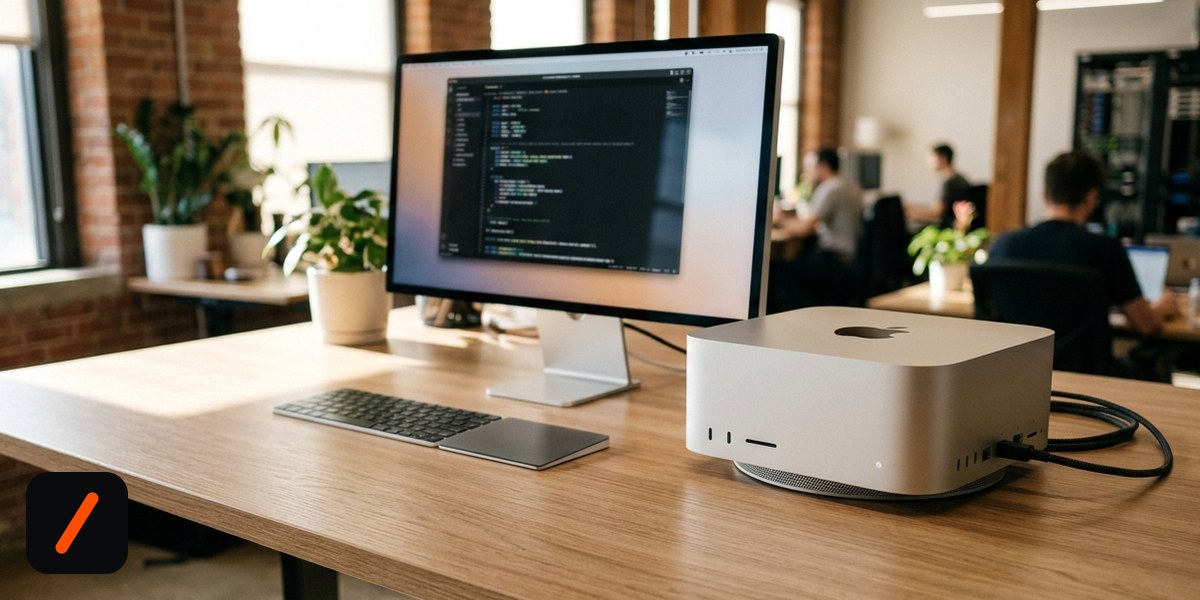
Apple pushed out new Mac Studio and Mac mini models roughly two months earlier than its usual October-November refresh, and the reason wasn't a leak-forced scramble. According to a report from The Information published this morning, the company was blindsided by how many businesses wanted Apple silicon specifically to run AI models locally, and rushed the launch to catch demand it hadn't planned for.
The new machines went up for order August 25: a Mac Studio starting at $2,499 with the M5 Max chip or $5,499 with the new M5 Ultra, and a Mac mini starting at $899 with Apple's first 2-nanometer chip, the M6. Both got quietly reframed around a use case Apple has never marketed this hard before, clustering several Mac Studios together to run large frontier AI models, a pitch aimed squarely at developers and IT buyers rather than the video editors and musicians the Studio was built for.
RelatedGoogle's AX Rebuilds Its Agent Orchestrator on Redis Streams
What actually changed in this announcement?
The headline spec is memory. The M5 Ultra Mac Studio can be configured with up to 512GB of unified memory, a pool the CPU and GPU share directly instead of splitting into separate system RAM and video RAM. That number matters more to someone trying to fit a 400-billion-parameter language model in memory than it does to anyone editing 8K video, and Apple knows it: the fully loaded 512GB configuration won't actually ship until late October, weeks after the base models, because Apple didn't build enough supply for it. The M5 Max Studio tops out at 128GB, and the new Mac mini, despite its 2nm chip and dual 16-core Neural Engine, still caps at 64GB.
Why were enterprises suddenly buying Mac minis and Studios?
Running a large language model locally instead of through an API comes down to one constraint: does the box have enough memory to hold the model's weights. A high-end consumer GPU like Nvidia's RTX 5090 tops out around 32GB of VRAM, which rules out most modern open-weight models above 30 billion parameters unless you shard across several cards. Apple's unified memory sidesteps that by letting a single machine address hundreds of gigabytes as one pool, at a fraction of the cost of stacking enterprise GPUs. For a startup or an internal engineering team that wants to fine-tune, test, or serve an open model without sending data to a third-party API, a maxed-out Mac Studio started looking less like a workstation and more like private inference infrastructure. Apple apparently did not see that shift coming at the scale it happened.
What gap inside Apple did this expose?
The more revealing part of The Information's report isn't the sales numbers, it's what Apple didn't have in place to handle them. The company reportedly has no engineering team dedicated to business customers, no staff focused on developer relations for this use case, and no formal enterprise AI strategy heading into this launch. Businesses that asked Apple for access to its own Private Cloud Compute infrastructure, the system Apple built to run heavier AI tasks off-device for consumer features, were turned down outright. That's an odd position for a company that just built the hardware those same businesses want to buy: Apple has the silicon enterprises are chasing, but not yet the sales motion, support structure, or cloud access policy to go with it.
Why is it hard to actually buy one right now?
Demand alone wouldn't explain months-long backorders. The timing collided with a separate, unrelated problem: a global memory shortage that has been squeezing DRAM and NAND supply across the entire electronics industry through 2026. Apple's unified-memory chips are unusually memory-intensive to build, packing far more RAM per unit than a typical laptop or desktop, so a company already fighting AI-driven demand for its highest-memory configurations ran straight into a supply chain that couldn't produce enough chips to fill orders. The result is a stack of overlapping shortages:
- Configuration scarcity. Apple isn't even taking pre-orders yet for every Mac Studio memory tier, and the 512GB M5 Ultra option is delayed to late October on its own.
- Component competition. Apple is now bidding for the same memory chips that AI data centers, phone makers, and every other PC vendor also need more of.
- An unplanned buyer segment. Enterprise AI buyers weren't in Apple's original forecast for these SKUs, so the shortage isn't just bad luck, it's a demand-planning miss on top of a supply crunch.
Some enterprise buyers who couldn't get a Mac Studio in a reasonable timeframe reportedly turned to Nvidia's DGX Spark instead, even though it's a very different machine at a similar price point.
RelatedSpaceX will run xAI's unpermitted turbines until July 2027
| Spec | Mac Studio M5 Ultra | Mac mini M6 | Nvidia DGX Spark |
|---|---|---|---|
| Starting price | $5,499 | $899 | $4,699 |
| Max unified memory | 512GB (Oct) | 64GB | 128GB (fixed) |
| Chip | Apple M5 Ultra, 36-core CPU | Apple M6, 2nm, 12-core CPU | Nvidia GB10 Grace Blackwell |
| Software stack | macOS, MLX/Metal | macOS, MLX/Metal | Linux, full CUDA |
| Best fit | Large local models, clustering | Light inference, dev boxes | CUDA-native training/fine-tuning |
The Mac's advantage is memory headroom and price-per-gigabyte; the DGX Spark's advantage is that it runs the actual CUDA stack most AI research code is written against, and it isn't sitting in an Apple backorder queue.
What does this mean for the market?
For Apple, this is a demand signal worth taking seriously heading into fiscal Q4: enterprise AI buyers are a Mac segment the company wasn't forecasting or staffing for, and if it builds out real enterprise sales and support around it, that's incremental high-margin hardware revenue on top of the consumer base. The near-term risk is reputational rather than financial. Missing supply on a hyped launch, with the flagship 512GB configuration pushed a full two months out, is the kind of stockout that sends buyers who need the machine now toward Nvidia instead, and some of that share doesn't come back once a team has already built its workflow around CUDA. For Nvidia, DGX Spark's role as the fallback option for stranded Apple demand is a small but real tailwind, on top of a machine that was already selling on its own merits. And for memory suppliers like SK Hynix, Samsung, and Micron, this is one more buyer competing for the same constrained DRAM capacity that's already driving component prices up across the entire PC and phone industry.
- Aug 25Apple launches new Mac Studio and Mac mini roughly two months ahead of its normal fall refresh
- Aug 25512GB M5 Ultra configuration delayed to "late October" while base configs ship sooner
- Aug 30The Information reports Apple was caught off guard by enterprise AI demand driving the early launch
- Sep 22Mac mini M6 begins general shipping after pre-orders opened August 25
- Late Oct512GB Mac Studio configurations ship the tier enterprise AI buyers are waiting on
- Whether Apple builds an enterprise AI sales motion. A dedicated business team and a real Private Cloud Compute access policy would signal Apple is treating this as a strategy, not a one-time surprise.
- Memory supply through Q4. If the DRAM shortage doesn't ease, expect the 512GB Studio and other high-memory SKUs to stay backordered well past October.
- Whether the enterprise demand holds after supply catches up. A surge driven partly by scarcity and hype can cool once the machines are actually available; a surge driven by genuine workload fit won't.
Our take
The interesting story here isn't that businesses want fast, cheap local AI hardware. Of course they do, sending proprietary data to a third-party API is a real cost for a lot of companies, and 512GB of memory for $18,299 undercuts equivalent Nvidia enterprise gear by a wide margin. The interesting part is that Apple, a company famous for forecasting demand down to the unit, got surprised by its own product. That's a tell about how fast the local-AI-hardware category has moved this year: it grew from a niche hobbyist interest into enough real enterprise dollars to force an unplanned early launch, and Apple's internal org chart hadn't caught up to that shift yet. Expect the next few quarters to be less about chip specs and more about whether Apple can build the enterprise-facing muscle, sales, support, cloud access, that this launch just proved it's missing.
- OfficialApple introduces new Mac Studio with M5 Max and M5 Ultra Apple Newsroom
- ReportApple Caught Off Guard by AI Demand for Mac Mini and Mac Studio MacRumors, citing The Information
- PricingApple isn't taking pre-orders for every Mac Studio configuration AppleInsider, on the delayed 512GB tier and $18,299 pricing
- ReferenceNvidia DGX Spark product page Nvidia
Original analysis by GenZTech, built from Apple's own product pages and the reporting cited above. Source: MacRumors.