
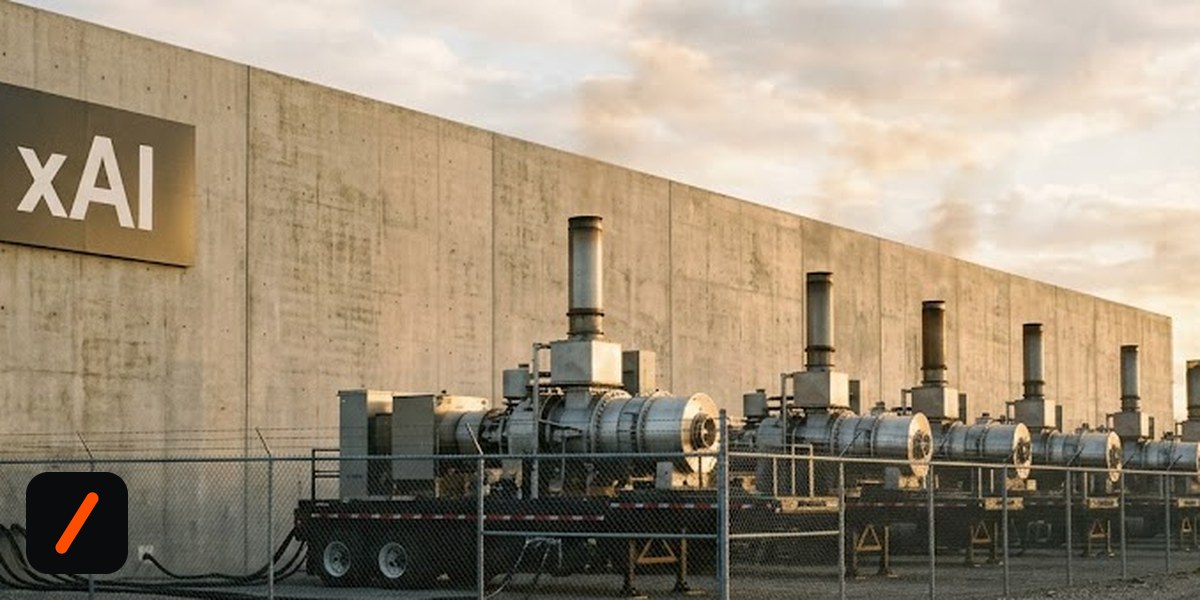
SpaceX said this morning it will remove all 69 trailer-mounted gas turbines powering its Colossus 2 data center in Southaven, Mississippi, with the first units leaving as early as August and the last gone by July 2027. The announcement is landing as a cleanup story. The calendar says something narrower: turbines that a federal lawsuit calls illegal keep running for most of another year, and they vanish by being swapped for 41 permanent turbines Mississippi regulators approved back in March.
The commitment came through an agreement with the Mississippi Department of Environmental Quality, the same agency that issued the Clean Air Act permit for the replacement plant. That plant is rated at 1.2 gigawatts and built from 41 units ranging between 16.48 and 50 megawatts. The fleet powering Colossus 2 does not shrink. It gets a permit.
RelatedSpaceX's Turbines Aren't Being Retired. They're Being Redeployed.
The numbers worth holding onto:
- 69 turbines currently run at the Southaven campus with no air permit. The NAACP complaint filed in April counted 27, so the unpermitted fleet more than doubled while the case was pending.
- Removal starts as early as August 2026 and ends by July 2027, under the agreement with Mississippi DEQ.
- 41 permanent turbines totaling 1.2 GW were permitted in March 2026 and are under construction now.
- SpaceX's IPO filing shows roughly $2.8 billion of turbine spending planned across three years, which makes on-site generation a permanent line item rather than a bridge.
Why were 69 turbines running without a permit at all?
The company's position has been that the turbines sit on shipping trailers, which makes them mobile equipment rather than a stationary source, and stationary sources are what Clean Air Act construction permits cover. Roll them in, roll them out, no permit required. Utilities have leaned on that reading for real emergencies: hurricane recovery, a failed substation, a brutal demand week.
Powering a gigawatt-class training cluster for two years is none of those things. EPA narrowed the gap in January 2026 by revising the New Source Performance Standard so that large methane gas turbines need permits even for temporary operation. Elon Musk's earlier purchase of APR Energy, a temporary-power company, is what made assembling a fleet this size possible in the first place, and it is why the same playbook is now available to anyone else racing to energize a campus faster than a utility interconnect allows.
What does the Justice Department have to do with an air permit?
This is the part most coverage skips. In April, the national NAACP and its Mississippi State Conference sued over the Southaven turbines, represented by the Southern Environmental Law Center and Earthjustice, after a notice of intent filed on February 13. Their core claim is straightforward: 27 large methane turbines running continuously without a construction permit violate the Clean Air Act, and together they are likely the single largest industrial source of nitrogen oxides in the greater Memphis area. Reported permitting estimates for the site put potential NOx emissions above 2,000 tons a year, which is smog-forming pollution in a metro that already struggles with it.
On June 15 the Justice Department moved to intervene and asked the court to dismiss the case with prejudice. The 33-page filing did not dispute that the turbines emit what plaintiffs say they emit. It argued instead that shutting off power to the site would threaten national, economic and energy security, and it invoked the Department of War's reliance on AI. Six weeks later, on July 27, EPA issued guidance exempting islanded AI data center power plants from Acid Rain Program caps, a change that touches close to 60 off-grid fossil-fuel facilities.
Put those together and today's removal pledge reads differently. The federal posture has been moving toward the company for two months. Committing to a removal schedule that ends in July 2027, on turbines you were going to retire anyway once the permitted plant energizes, costs very little from that position.
Does removing the turbines settle the lawsuit?
Not by itself. A Clean Air Act citizen suit is about whether operation without a permit was lawful, and future removal does not answer a question about the past. Courts can still find violations, assess penalties, and order injunctive relief for conduct that has already stopped, which is exactly why defendants prefer consent decrees: a decree converts a voluntary schedule into an enforceable one with consequences attached. An agreement with a state agency is a weaker instrument. If a removal date slips because the permanent plant energizes late, and grid-scale construction slips routinely, the recourse is negotiation rather than contempt.
RelatedMicrosoft and Oracle Are Betting the House on AI Data Centers
There is also a jurisdictional split worth keeping straight. The 69 turbines are in DeSoto County, Mississippi, regulated by MDEQ. The original Memphis Colossus site sits across the state line in Shelby County, Tennessee, where the county health department permitted 15 permanent turbines in a decision the NAACP and others appealed. Two sites, two regulators, one company, and headlines that keep merging them.
- Feb 2026SpaceX completes its acquisition of xAI Colossus becomes a SpaceX asset
- Feb 13, 2026Notice of intent to sue filed over Southaven turbines NAACP, SELC, Earthjustice
- Mar 2026Mississippi DEQ permits 41 permanent turbines, 1.2 GW the replacement plant
- Apr 15, 2026NAACP sues over 27 unpermitted turbines Clean Air Act citizen suit
- Jun 15, 2026DOJ moves to intervene, seeks dismissal with prejudice cites national and energy security
- Jul 27, 2026EPA exempts islanded AI data center plants from Acid Rain caps roughly 60 facilities
- Jul 31, 2026SpaceX commits to removing all 69 temporary turbines agreement with Mississippi DEQ
- Aug 2026First trailer-mounted units leave the site earliest start
- Jul 2027Last unpermitted turbine off site the deadline that matters
| Temporary fleet (today) | Permanent plant (by 2027) | |
|---|---|---|
| Units | 69, trailer-mounted | 41, fixed |
| Permit | None claimed necessary | Clean Air Act permit, MDEQ |
| Legal exposure | Active citizen suit | Permitted, appealable |
| Capacity | Not publicly itemized | 1.2 GW, units 16.48 to 50 MW |
| Controls | Retrofits, sound walls, silencers | Designed-in, permit conditions |
| Status | Removal Aug 2026 to Jul 2027 | Under construction |
What it means for the next AI campus
The interesting signal here is not environmental, it is operational. Every hyperscale AI buildout now faces the same wall: interconnect queues measured in years against training schedules measured in months. Southaven is the clearest demonstration yet that a company can bridge that gap with rented mobile generation, absorb the legal risk, and convert to permitted permanent capacity later, with federal agencies arriving mid-dispute to widen the lane.
For investors the read is about where the cost lands, not about a single quarter. On-site generation is becoming a permitted, capital-heavy asset class rather than a rental line: $2.8 billion of planned turbine spend over three years, plus sound walls, silencers and quieter next-generation units the company says it is funding around the site. That spend accrues to turbine manufacturers and EPC contractors, and it sets a floor on what a frontier training campus costs beyond the GPUs. Watch permitting timelines as a schedule risk in any AI infrastructure story, because that is where the compute plans actually slip.
- Whether the schedule becomes enforceable. A state agreement is not a consent decree. If plaintiffs get one, the July 2027 date grows teeth.
- Whether the court rules on the past. Removal does not moot the question of whether two years of unpermitted operation broke the law.
- Whether the EPA memo is challenged. The July 27 Acid Rain exemption for islanded AI plants is the broader precedent, well beyond one campus.
- Whether the playbook spreads. If mobile turbines keep working as a bridge, expect the next gigawatt campus to open the same way.
Our take
Calling this a reversal gives it too much credit, and calling it meaningless gives it too little. A dated, public commitment to remove all 69 units is more than the company offered six months ago, and community groups pushing on this deserve the credit for producing it. But the substance is a transition already under construction. The turbines leave when the permitted plant is ready, which was always the plan, and the announcement mostly buys goodwill for a year of continued unpermitted operation while a court decides whether that operation was legal at all. The number to remember is not 69. It is July 2027.
- OfficialSpaceXAI Memphis site updates company statements on turbines and removal
- LegalNAACP: suit over data center power plant pollution the April complaint and its claims
- FilingNotice of intent to sue, Southaven (PDF) Feb 13, 2026, with exhibit
- StatementNAACP on the DOJ motion to intervene plaintiffs' response to the June 15 filing
- ReferenceSELC: inside the Memphis fight over xAI background and emissions analysis
Original analysis by GenZTech. Announcement first reported by TechCrunch.