
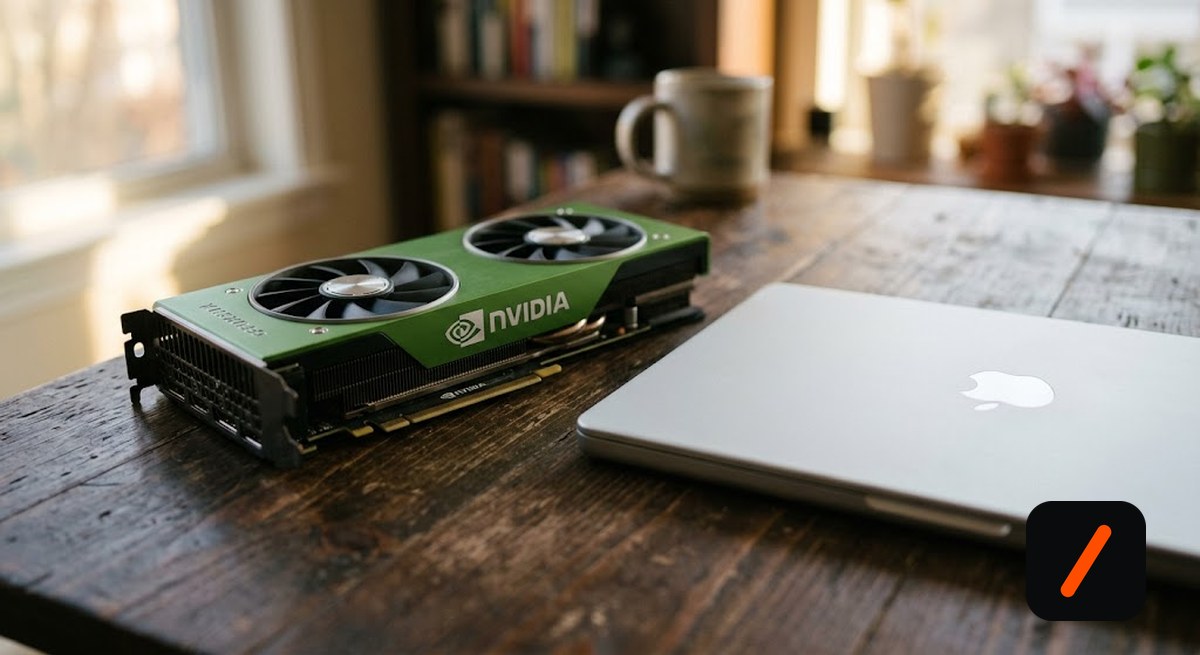
Apple briefly overtook Nvidia as the world's most valuable company on Friday July 17, 2026, ending a run Nvidia had held since May 2025. It did not last. Nvidia closed down 2.2% at just over $4.92 trillion, edging Apple by roughly $6 billion. The reason this near-miss is worth your attention is not the scoreboard. It is that the market spent two years punishing Apple for underspending on AI and has now started paying it for exactly the same behaviour.
- Nvidia fell as much as 4.6% in the first thirty minutes of trading, briefly pushing its market cap below $4.8 trillion while Apple touched about $4.9 trillion.
- The Philadelphia Semiconductor Index is down almost 19% from its all-time high, heading for its worst week in over a year.
- Apple is up nearly 23% year to date; Nvidia has managed 7.3%.
- Apple's fiscal 2025 capex was roughly $12.7 billion, against hundreds of billions committed by the hyperscalers.
What actually happened on Friday?
Nvidia opened sharply lower and Apple drifted up. For part of the session Apple was the largest company in the world by market capitalisation. By the closing bell Nvidia had recovered enough to hold the title by about $6 billion, which at this scale is a rounding error. Wire services filed intraday stories saying Apple had taken the crown, which is why you will see contradictory headlines about the same day.
RelatedSamsung Hiked Foundry Prices After Losing a Third of Share
The move was not Apple-specific news. There was no product launch and no earnings. It was a rotation: money leaving the most obvious AI beneficiaries and looking for somewhere else to sit.
| Apple | Nvidia | |
|---|---|---|
| 2026 YTD share move | +23% | +7.3% |
| Market cap, Jul 17 close | ~$4.91T | ~$4.92T |
| Recent annual capex | ~$12.7B (FY25) | Asset-light, TSMC-fabbed |
| AI revenue exposure | Indirect, via devices | Direct, majority of revenue |
| Main risk | Falling behind on models | Customers cannot recoup spend |
Why is the market rewarding Apple for spending less?
For two years the consensus was that Apple had missed AI. It shipped no frontier model, bought no gigawatt data centers, and spent about $12.7 billion in fiscal 2025 while hyperscaler capex ran an order of magnitude higher. That read has inverted. The question the market is now asking is not who spent the most, it is who can earn it back.
Nvidia's revenue depends on customers continuing to buy accelerators. Those customers need AI products that generate enough revenue to justify the next purchase order. Every quarter that adoption lags the buildout, the recoupment question gets louder. Apple sits outside that loop. It sells hardware to consumers, and AI features are a reason to upgrade a phone rather than a line item it has to earn back.
Is this the AI trade breaking?
Not on this evidence, and be careful with anyone who tells you it is. The Street is genuinely split. Barclays' trading desk characterised the selloff as active position rotation rather than panic liquidation, which is a meaningful distinction: rotation means money moving between sectors, liquidation means money leaving. Deutsche Bank strategists made the harder point, that semiconductors drove the bulk of index gains and investors carrying that concentration need to reassess it deliberately.
A 19% drawdown in the SOX is significant but not unprecedented for a sector that had run as far as it did. What makes this week notable is the pairing: chips falling while the least AI-exposed megacap rises. That is a rotation with a thesis attached, not indiscriminate selling.
What it means for the market
The signal for investors is not which logo sits at number one on a given Friday. It is that the market has started separating AI infrastructure spend from AI infrastructure returns, and pricing them differently. Watch three things. First, hyperscaler capex guidance at the next round of earnings, because any moderation validates the recoupment worry. Second, Nvidia's data center revenue mix and whether growth is still broad or narrowing to a few very large buyers. Third, whether Apple's gain holds through its own earnings, since a 23% run without an AI story needs the device cycle to deliver.
RelatedNVIDIA and SK Group Unveil $500B Korea AI Buildout
This is analysis, not investment advice. The two companies are close enough that the ranking may change hands several more times before the question is settled.
- Hyperscaler capex guidance. Any trimming is the strongest available evidence for the recoupment thesis.
- Nvidia customer concentration. Narrowing demand is a bigger risk than a slower headline growth rate.
- Whether the crown changes again. A $6 billion gap on a $4.9 trillion base is noise, and it will move.
- Apple's device cycle. The capex-discipline story only holds if iPhone upgrades actually come through.
Our take
The most useful thing about Friday is what it reveals about how quickly a narrative can invert without a single new fact. Apple did not change strategy. It kept doing what it has done since 2023, which is decline to build a frontier lab. What changed is that the market got nervous about whether the enormous AI buildout pays for itself, and in that mood, not having spent the money becomes an asset.
We would not read this as a verdict on AI. Nvidia still closed as the most valuable company on earth, and a 19% drawdown after the run semiconductors had is a correction, not a collapse. But the questions have shifted from how fast can you build to how do you get paid, and that shift is durable even if this week's price action is not.
The company to watch is not either of these two. It is whichever hyperscaler blinks first on capex guidance, because that is the moment the recoupment debate stops being a debate.
- ReportingCNBC: Apple, Nvidia vie for title of world's most valuable company , intraday and closing figures
- ReportingBloomberg: Apple briefly tops Nvidia as world's largest company , rotation context and analyst commentary
- ReportingForbes: Apple briefly unseats Nvidia as world's largest company , market cap detail
Original analysis by GenZTech. Market data as reported by CNBC and Bloomberg on July 17, 2026.