
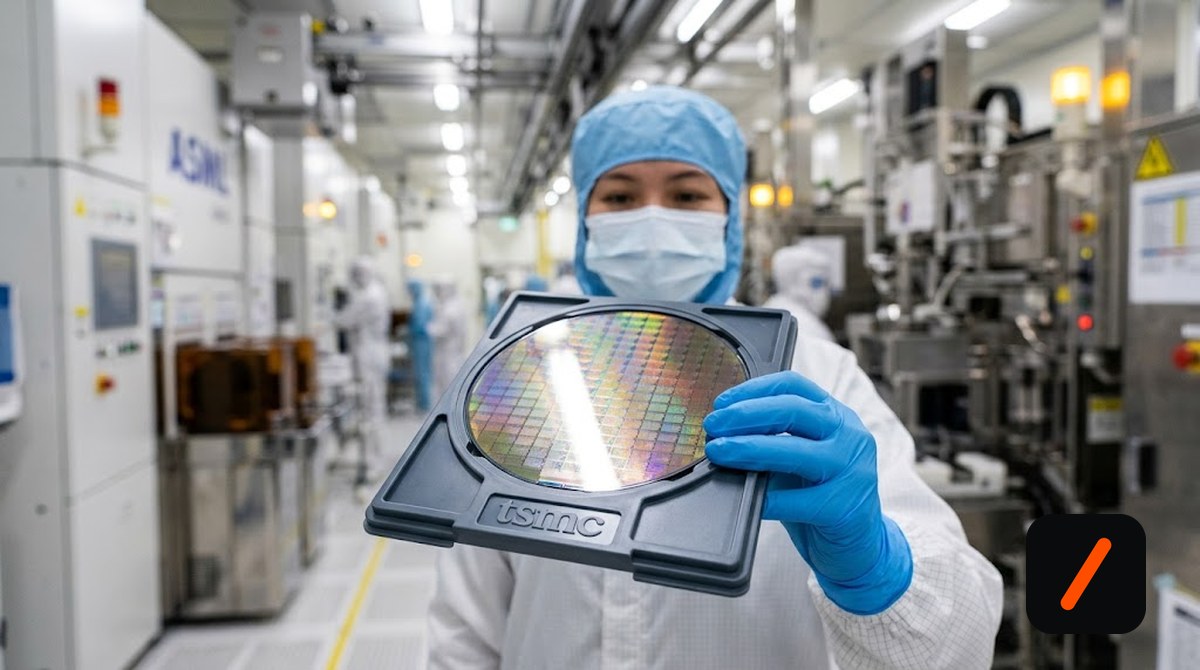
TSMC has stopped asking and started dictating. Ahead of its July earnings report, the world's dominant chipmaker is raising prices on its most advanced manufacturing: about 15% on 3nm wafers before year-end, and 5 to 10% across all leading-edge processes at 7nm and below, which account for roughly three-quarters of its revenue. With an estimated 72% of the global foundry market, TSMC can push those increases downstream almost at will, and everyone from Nvidia to Apple pays. This is what a quasi-monopoly on the physical substrate of AI looks like in practice.
- The hike. Roughly 15% on 3nm and 5 to 10% across 7nm-and-below nodes, the processes that make up about 75% of TSMC's revenue.
- The leverage. An estimated 72% foundry market share means customers have nowhere comparable to go for leading-edge silicon.
- The demand. 2nm and next-gen A16 output is projected to grow around 70% annually through 2028 on AI and HPC demand.
- The pass-through. Higher wafer costs flow into GPUs, phones, and laptops, which is inflation baked into the AI buildout itself.
What exactly is changing?
Two things at once: price and mix. On price, TSMC is lifting 3nm wafers by roughly 15% before the end of the year and raising 5 to 10% across the rest of its leading-edge portfolio, meaning 7nm, 5nm, and 3nm all cost more per wafer heading into 2027. On mix, the company is pouring capacity into its newest nodes, with 2nm and the next-generation A16 process projected to grow at around a 70% compound annual rate between 2026 and 2028. It is also building an unusually large number of new fab and advanced-packaging phases this year. The combination is deliberate: raise the price of what everyone needs today while scaling the capacity for what they will need tomorrow.
RelatedSamsung Hiked Foundry Prices After Losing a Third of Share
Why can TSMC simply raise prices?
Because at the leading edge there is no real alternative. Samsung's foundry has struggled with yield on its most advanced nodes, Intel's foundry ambitions are still ramping, and no one else is close on 3nm and below. When a single supplier makes the chips that power nearly every AI accelerator, flagship phone, and premium laptop, and holds roughly 72% of the market, its customers cannot credibly threaten to leave. Nvidia cannot ship a Rubin GPU without TSMC. Apple cannot ship an A-series or M-series chip without TSMC. That structural dependence converts directly into pricing power, which is why analysts describe the increases as passing rising costs almost at will.
What does it mean for the market?
The signal for investors is that TSMC (ticker TSM) is monetizing scarcity, and the increases should show up as expanding gross margins in the July earnings report, which is why analyst price targets have been climbing. But the second-order effect matters more: higher wafer prices are a cost input for TSMC's biggest customers. Nvidia and AMD either absorb the hit on margin or pass it into accelerator pricing, and Apple faces the same choice on iPhones and Macs. In an environment where DRAM and HBM are already surging, a leading-edge logic price hike compounds the squeeze, effectively baking hardware inflation into the AI buildout. Watch whether Nvidia's next-gen pricing rises, whether Apple holds device prices flat by eating the cost, and whether Intel's foundry gains any credibility as a second source, which is the only thing that would ever loosen TSMC's grip.
Who feels it first?
Data-center buyers feel it fastest because leading-edge is where AI accelerators live, and those are the wafers rising most. Consumers feel it on a lag, through the next cycle of phones and laptops built on 3nm and 2nm parts. Smaller fabless chip designers feel it hardest of all, because they lack the volume to negotiate and cannot absorb margin compression the way a Nvidia or Apple can. The uncomfortable through-line is that the AI boom has made the one company that manufactures its silicon more essential and less contestable than at any point in the industry's history.
RelatedQualcomm Hikes Chip Prices by Double Digits From September 1
- Margin proof. Whether the July earnings report shows the hikes flowing straight into gross margin.
- Customer pass-through. If Nvidia and AMD raise accelerator prices in response, or eat the cost.
- 2nm ramp. How fast A16 and 2nm capacity comes online at the projected ~70% CAGR.
- A second source. Any sign Intel or Samsung foundry becomes credible enough to cap TSMC's pricing.
Our take
TSMC raising prices is not a story about greed, it is a story about structure. When one company controls the leading edge and demand for AI silicon is close to insatiable, higher prices are the market clearing itself. The real lesson is how fragile the rest of the industry's economics are underneath the AI boom: every impressive GPU and every thin flagship phone rests on wafers from a single supplier that can now set the terms. That concentration is a strategic risk far beyond any one price hike. Until a genuine second source exists at 3nm and below, the entire hardware world is a price-taker, and TSMC's quarterly decisions will keep rippling into the cost of everything from your next phone to the next trillion-parameter training run.
- OfficialTSMC newsroom earnings and capacity disclosures
- ReportingYahoo Finance on the foundry price hikes
- ReferenceTSMC overview foundry share and process nodes
Original analysis by GenZTech. Reporting via Yahoo Finance.