
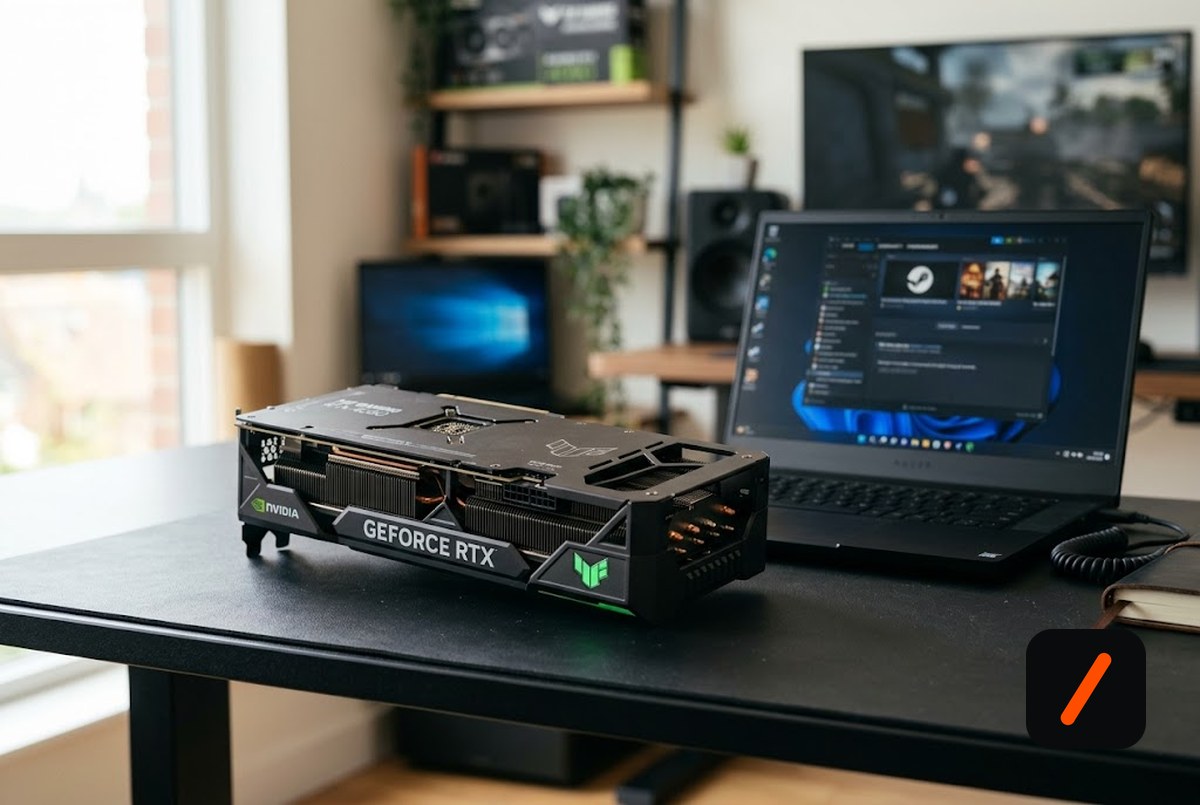
Nvidia has unveiled the RTX Spark Superchip, a full processor for Windows laptops, marking its move from graphics supplier to the heart of the PC and putting it in direct competition with Intel, AMD, Qualcomm and Apple for the first time. Announced around Computex, the chip is Jensen Huang's bid to own every layer of the AI stack, from the datacenter down to the machine on your desk, and Wall Street read it as a real threat: shares of the incumbent PC-chip makers fell on the news.
- The RTX Spark Superchip is a laptop-class processor for Windows machines that fuses Nvidia CPU and GPU silicon, not just a discrete graphics card.
- It lands Nvidia in the PC processor market against Intel, AMD, Qualcomm and Apple, a business it has never directly contested.
- Analysts expect Spark to appear first in premium laptops with AI features from partners like Microsoft and Adobe, then trickle down to cheaper tiers.
- Shares of AMD, Intel and Qualcomm fell when Nvidia signaled the move, reflecting how much of the premium PC market is suddenly contestable.
What is the RTX Spark Superchip?
It is a laptop processor, not a graphics card. Where Nvidia has spent decades selling GPUs that slot alongside an Intel or AMD CPU, Spark integrates Nvidia's own compute and graphics into a single Windows-class chip, the kind of part that defines a whole laptop rather than accelerating one. That distinction matters because the CPU socket is the piece of the PC Nvidia never controlled. Owning it means Nvidia can define the platform, tune the AI features, and capture margin that used to flow to Intel and AMD. Huang has framed it plainly as an attempt to reinvent the PC around AI, with Nvidia silicon at the center.
RelatedNvidia's RTX Spark Superchip Puts an AI PC in a Box
Why does this rattle Intel, AMD and Qualcomm?
Because the premium AI laptop is the most profitable slice of a shrinking PC market, and Nvidia arrives with the strongest brand in AI and deep ties to Microsoft, Adobe and the software that sells those machines. Qualcomm spent two years positioning its Arm chips as the AI-PC answer; Intel is mid-turnaround; AMD is riding a strong year but has no comparable AI-halo brand in consumer minds. A credible Nvidia laptop chip threatens all three at the high end at once, which is why their shares slipped when the plan surfaced. Nvidia-powered laptops could be the first machines in years to give Apple's MacBooks a real fight in the premium tier.
What it means for the market
The signal for investors is that Nvidia (NVDA) is widening its attack surface from datacenters into a consumer market worth tens of billions, and doing it from a position of brand strength rather than as an underdog. The exposed names are AMD (whose 2026 rally leans partly on client and AI momentum), Intel (INTC, whose comeback depends on holding premium laptop share), and Qualcomm (QCOM, whose Arm-PC thesis just got a bigger rival). The counterweight is timing and supply: with DRAM and memory tight across the industry, ramping a brand-new laptop platform into volume is hard, and Spark is expected to start in pricey machines before reaching mainstream prices. The read for investors is direction over speed: Nvidia is coming for the PC, but the share shift will play out over years, not one product cycle.
What to watch before Spark laptops ship
- Windows-on-Nvidia software. The platform lives or dies on driver maturity and app compatibility. Watch how cleanly Windows and pro apps run on the new silicon.
- OEM design wins. Which laptop makers commit flagship models to Spark decides whether this is a platform or a demo.
- Battery and thermals. Apple and Qualcomm win laptops on efficiency. Nvidia has to prove Spark is not just fast but all-day usable.
- Price ladder. The whole threat depends on Spark reaching mainstream prices, not staying a halo part. Watch the second wave.
Our take
Nvidia entering the PC processor market is the logical end of the AI boom: the company that owns datacenter compute now wants the device in your bag too, and it has the brand and software relationships to make the attempt serious. The incumbents are right to be nervous, because Spark targets exactly the premium, AI-branded laptops where margins live. But a first chip is not a franchise. Intel and AMD have decades of platform, OEM and driver relationships that Nvidia has to rebuild in a market where efficiency and compatibility, not raw AI horsepower, usually decide the sale. The likeliest outcome is not a wipeout but a genuine three-and-a-half-way fight at the high end, which is more competition than the PC has seen in a long time, and good for buyers.
- OfficialNVIDIA Newsroom product announcements and briefings
- ReferenceCNBC: Nvidia's PC chip play market reaction and strategy
- ContextNotebookcheck GPU and laptop roadmap reporting
Original analysis by GenZTech. Figures current as of July 2026.