
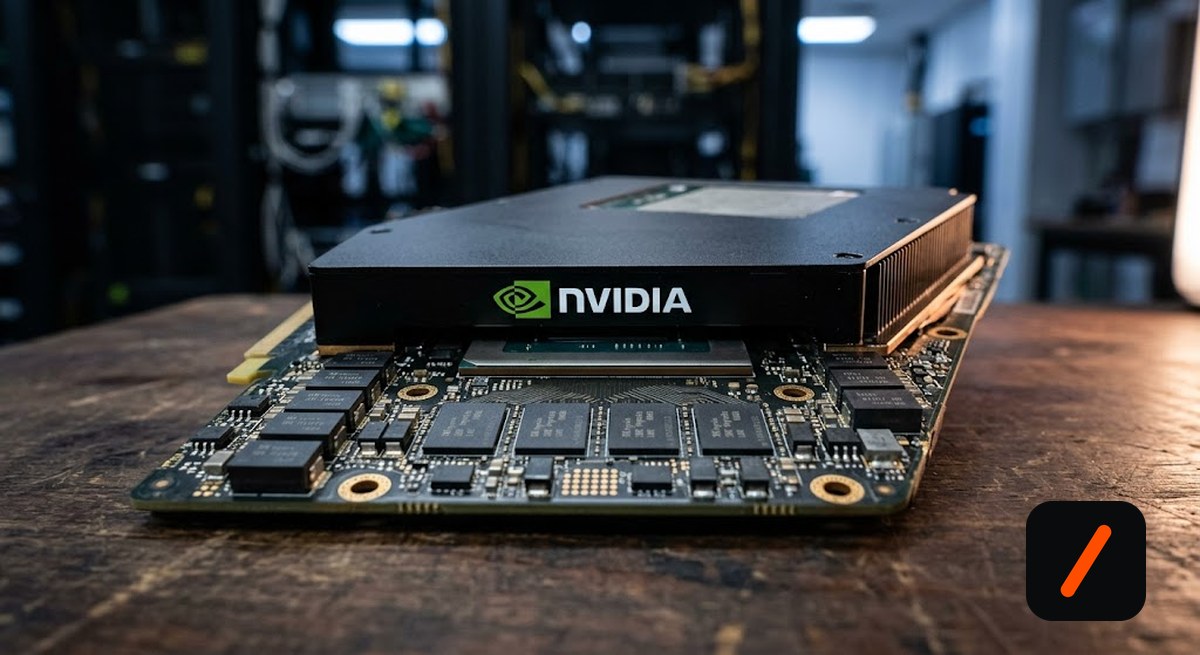
Nvidia used its GTC stage to announce a Language Processing Unit, a new chip class aimed squarely at LLM inference rather than training, and folded it into a data-center roadmap that now spans three hardware generations through 2028. Coming from the company that already owns training, the LPU is a tell: Nvidia expects the center of gravity in AI spending to shift from building models to serving them at volume, and it does not intend to let inference-specialist startups own that shift.
- The LPU targets inference specifically, where the workload is memory-bandwidth and latency bound rather than raw floating-point throughput.
- It slots alongside the Vera Rubin platform on Nvidia's roadmap, which pairs Vera CPUs with Rubin GPUs in the back half of the year.
- Nvidia is effectively attacking the pitch of Groq, Cerebras, and SambaNova, whose entire case is that inference deserves dedicated silicon.
- The strategy extends Nvidia's push to own every layer of the stack, from data-center training to the RTX Spark PC chip.
Why build a separate inference chip at all?
Training and inference stress hardware differently. Training is a compute-bound firehose of parallel matrix math that a GPU's thousands of cores devour. Inference is the opposite shape: generating tokens one after another, where the bottleneck is how fast weights and cache can be moved through memory, and where latency, the delay before the first token, is what users feel. A chip optimized for that regime can prioritize memory bandwidth, on-die SRAM, and deterministic low-latency dataflow over peak FLOPs. That is precisely the argument inference startups have made for years, and Nvidia building an LPU is the company conceding the argument has merit.
RelatedNvidia's Groq 3 LPU Bets Inference Isn't a GPU Problem
Who is this aimed at?
Directly, the inference-specialist camp. Groq, Cerebras, and SambaNova all sell the same core thesis: general-purpose GPUs waste silicon on inference, and dedicated architectures deliver more tokens per dollar and per watt. Their moat was that Nvidia was too busy owning training to bother. An Nvidia LPU collapses that moat, because it lets customers stay inside CUDA and Nvidia's networking while getting inference-tuned hardware, removing the main reason to adopt a risky startup platform. The startups' counter is that they still lead on raw latency, but they now compete against the incumbent's distribution rather than its indifference.
What does it mean for the market?
For Nvidia (NASDAQ: NVDA), the LPU defends the most valuable real estate in computing: as enterprises deploy agents that generate tokens continuously, inference becomes the larger, recurring line item, and a chip that captures it protects revenue that pure training hardware would eventually cede. The signal for investors is that Nvidia is playing defense on the exact market it created for challengers. For those challengers, and their backers, the read is harsher: their entire pitch just got an incumbent-branded answer. Publicly, this is the same land-grab logic behind Nvidia entering PC chips with RTX Spark, a move that already pressured AMD, Intel, and Qualcomm shares.
What is still unknown?
Nvidia has announced the class more than the full spec sheet, so the numbers that decide everything, tokens per second per watt, memory capacity, price, and availability, are the open variables. An inference chip lives or dies on cost per token against an H-class or Rubin GPU already sitting in the same rack. If the LPU only matches GPU economics, customers will not bother with a second SKU. If it meaningfully beats them, the specialist startups have a real problem. Until third parties benchmark it, treat the competitive impact as directional, not settled.
RelatedQualcomm bets $4B on Modular to own the AI software stack
- Tokens-per-watt disclosure. The single figure that determines whether the LPU threatens Groq and Cerebras or just rounds out Nvidia's catalog.
- Rubin timing. How the LPU is priced and positioned against Rubin GPUs signals whether Nvidia sees it as complement or replacement for inference.
- Startup response. Watch for Groq and Cerebras to counter on latency and open pricing, the two axes where an incumbent is slowest to move.
Our take
The LPU is less a product announcement than a strategic admission. For years the tidy story was that Nvidia owned training and left inference as the opening for a new generation of chip companies. By building an inference-first part, Nvidia is signaling it believes the inference market will be too big to leave on the table, and that it would rather cannibalize its own GPU inference sales than watch a startup do it. That is the behavior of a company that intends to be the toll booth on every token, not just every trained model.
Does the software moat still hold?
The quiet reason an Nvidia LPU is so dangerous to challengers is not the silicon, it is CUDA. Groq, Cerebras, and SambaNova each ask developers to leave a mature software ecosystem, port their stack, and trust an unproven toolchain to win on latency. An inference chip from Nvidia lets customers keep CUDA, keep their networking, and keep their operational muscle memory while gaining inference-tuned hardware. That removes the switching cost that made the specialists worth the risk. The startups still lead on raw efficiency in some cases, but they now have to beat not just a chip but a decade of accumulated developer lock-in.
- ReportNvidia updates data center roadmap following LPU launch at GTC 2026 DataCenterDynamics
- AnalysisGTC 2026: The Inference Kingdom Expands SemiAnalysis
Original analysis by GenZTech. Reporting via DataCenterDynamics.