
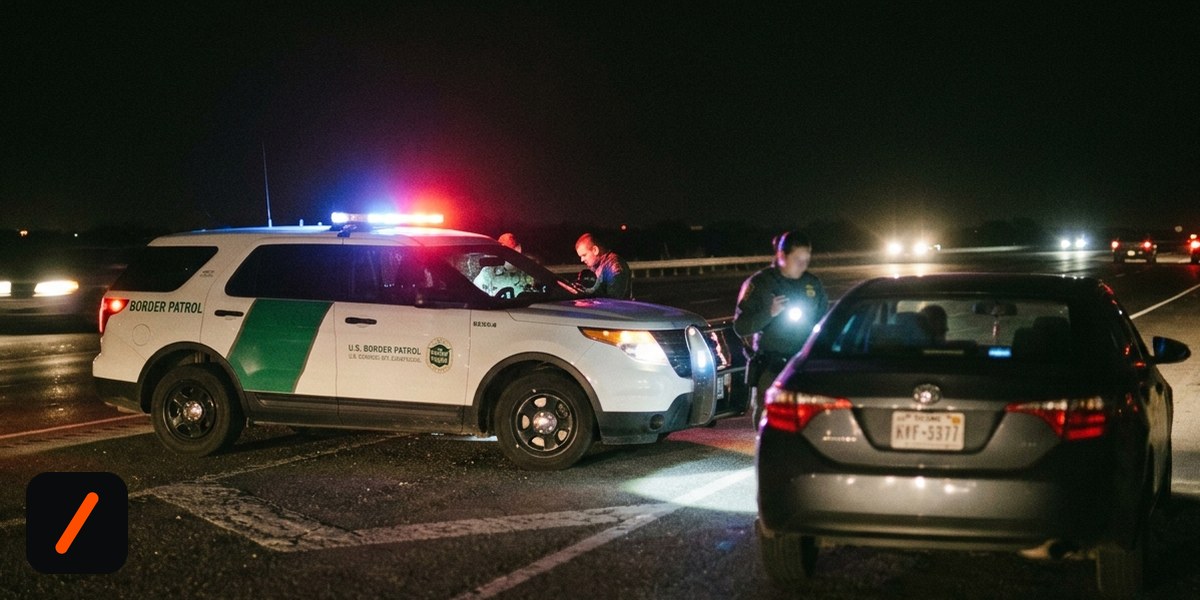
A Montana Highway Patrol sergeant told a driver named Kyle Olson his car was pulled over on Interstate 90 in May because its license plate was "a little bit obstructed." That was the stated reason. The real one, according to a Border Patrol document that surfaced through discovery in Olson's criminal case and published this morning by 404 Media, was that a federal agent had already flagged him based on "financial activity patterns commonly associated with illicit narcotics activity," pulled from what the agency calls law enforcement sensitive systems. The plate excuse came after the decision to stop him, not before it.
The unit behind that flag has a name: Predictive Intelligence Targeting Teams, or PITT. 404 Media, reporting from documents obtained by journalist Joseph Cox, confirmed PITTs operating in at least two of Border Patrol's 20 sectors, Spokane in Washington and Laredo in Texas, working the Canadian and Mexican borders respectively. Analysts there pull financial activity, automatic license plate reader hits, criminal history and location data into a single profile, then hand a tip to state or local police, who manufacture a separate, defensible reason to make the stop.
RelatedEFF: Cops Searched 19,000 Flock Cameras for 'LMAO'
What did Border Patrol actually do to Kyle Olson?
Agent Matthew Phelps, working the Spokane PITT, wrote that Olson's file showed financial patterns tied to narcotics trafficking, no further detail given in the document 404 Media obtained. That intelligence went to Montana Highway Patrol, whose Sergeant James Beck then stopped Olson and told him, on camera, that the obstruction was "our reason for stopping you." Olson was ultimately charged with DUI and drug possession, and it was his defense team's discovery request, not a leak or a FOIA release, that pulled the PITT document into daylight. CBP would not describe what financial data it draws on or whether the analysis required a warrant, telling 404 Media only that Border Patrol "uses intelligence-informed analysis and planning to support national security operations, allocate resources, and help identify potential threats."
Why does using financial data for this matter?
Ordinary traffic enforcement runs on things an officer can point to: speed, a broken taillight, a lane violation. PITT inverts that. The government picks a target first, using data the person never agreed to hand over and cannot see, and only afterward looks for a legal pretext to justify approaching them. Courts have generally allowed pretextual stops (an officer can stop you for a real infraction even if their true motive is something else), which is exactly the loophole this program is built around: as long as the plate really was a little dirty, the stop survives a challenge, and the financial flag that actually drove it stays buried in a system nobody outside DHS can query. Jake Laperruque of the Center for Democracy and Technology and Rob Frommer of the Institute for Justice, who separately represented a driver named Alek Schott in a 2022 Texas stop built on the same kind of tip, have both argued this converts routine traffic law into a backdoor around the warrant requirement that would normally apply to searching someone's financial records.
How new is this, really?
Not very, and that is part of the story. An Associated Press investigation reported in late 2025 had already documented a nationwide Border Patrol license-plate-reader dragnet feeding "suspicious travel pattern" tips to local police, with cameras disguised inside highway barrels and cones. What 404 Media adds is the financial layer: PITT does not just watch where a car goes, it appears to fold in information about the driver's money. That is a meaningfully different, and more invasive, category of surveillance than tracking a plate down a highway.
RelatedCities Ditch Flock Cameras, Then Buy Axon's Instead
- 2022Alek Schott is stopped near San Antonio. Bexar County deputies act on a Border Patrol tip about his overnight travel pattern; nothing is found. He later sues with the Institute for Justice.
- Nov 2025AP publishes its license-plate-reader investigation. Documents a national ALPR dragnet feeding "suspicious travel" tips from Border Patrol to local police.
- May 2026Kyle Olson is stopped on I-90 in Montana. Sergeant James Beck cites an obstructed plate; a Border Patrol financial-activity flag from Agent Matthew Phelps sits behind it.
- Sept 8, 2026404 Media publishes the PITT document. First public confirmation that Border Patrol's predictive program reaches into financial activity, not just travel and plate data.
Who else could this reach?
Montana's stop is the detail that should worry people who assume this is a border-only program. Interstate 90 through Montana is nowhere near an international boundary, yet a Border Patrol sector still generated the tip that put a trooper on Olson's tail. Border Patrol's statutory search authority extends across a 100-mile zone from any US border or coast, a strip that by the ACLU's count holds roughly two-thirds of the American population, and PITT-style tips travel well beyond even that zone once they reach a local police radio. Two confirmed sectors running this today, with 18 more Border Patrol sectors nationwide unaccounted for, means the honest answer to how many people have already been profiled this way is that nobody outside DHS knows.
- Olson's suppression motion. If a Montana court rules the financial-pattern flag tainted the stop, that precedent travels to every other PITT case built the same way.
- Which financial data, specifically. CBP has not said whether this touches bank suspicious-activity reports, payment processors, or something else; that answer determines which federal privacy statutes are even in play.
- The other 18 sectors. Watch for confirmation, through litigation discovery or further reporting, of PITTs beyond Spokane and Laredo.
- A Carpenter-style challenge. The Supreme Court already required a warrant for historical cell-site location records in Carpenter v. United States; expect defense attorneys to push the same argument onto financial-pattern policing.
Our take
The individual pieces here, financial monitoring, plate readers, predictive policing, aren't new by themselves. What makes PITT worth paying attention to is the stacking: a program that picks its targets from data a driver never consented to share, then deliberately manufactures an unrelated public reason for the stop so the real trigger never has to survive a courtroom. That is not a side effect of the system, it is the design. A financial-activity flag that never gets disclosed to the driver, the defense, or in most cases the public is a program built to avoid the scrutiny that would normally follow when the government decides to surveil someone's money. Two sectors are confirmed. The interesting number is the other eighteen.
- Investigation404 Media: the PITT document and the Olson case original reporting, published today
- InvestigationAP: Border Patrol's driver-monitoring dragnet the prior license-plate-reader investigation this builds on
- LitigationInstitute for Justice: Schott v. County of Bexar the earlier pretextual-stop case cited for pattern
- ReferenceACLU on the 100-mile border zone and ALPR dragnet context on Border Patrol's reach inland
Original analysis by GenZTech Team. Story developing.