
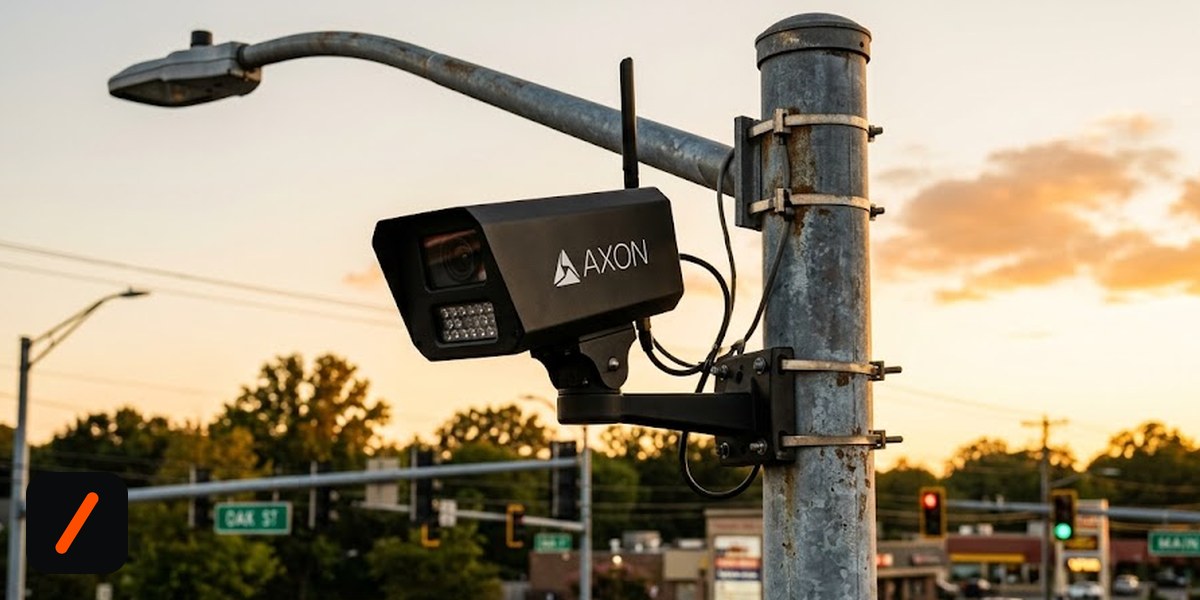
Roughly two dozen American cities have torn up their Flock Safety license plate reader contracts this year. A 404 Media report published this morning traces what happened after the vote in seven of them, and the answer complicates every headline about a surveillance backlash: the Flock cameras came down and Axon cameras went up, in some cases within weeks.
Axon is the company behind the Taser and most of the body cameras worn by American police. It sells fixed plate readers too. So a city council that voted to end automated plate surveillance mostly did not end automated plate surveillance. It changed which vendor holds the data and, more to the point, who else gets to search it.
RelatedHackers Cracked a Flock Camera, Copied 3 Weeks of Its Data
- Seven documented switches so far, starting with Ferndale, Michigan in December 2025 and running through Douglas County, Colorado in July 2026.
- Denver's replacement contract halved the camera count, from more than 100 Flock units to 50 Axon units, on a one year term.
- Douglas County went the other way, signing a $22.8 million Axon deal for 100 cameras plus drones, double its previous Flock footprint.
- The feature cities actually killed was the national lookup, Flock's cross agency search layer, not the cameras themselves.
Which cities actually made the switch?
The pattern shows up across four states and both parties' municipal politics, which is unusual for a privacy fight.
- Dec 2025Ferndale, Michigan switches to Axon Cited privacy concerns and Flock's failure to keep unauthorized agencies off the city's ALPR network
- Feb 2026Syracuse, New York approves Axon 7 to 1 Revoked Flock's permission to operate on city streets the following month
- Mar 2026Denver votes 7 to 6 to replace Flock 50 Axon cameras, 21 day retention, no vendor run national database, audit trail on every query
- Mar 2026Longmont, Colorado approves Axon unanimously Let its Flock agreement lapse rather than renew
- Jun 2026Grand Chute, Wisconsin drops Flock Cited repeated problems with the service
- Jul 2026Douglas County, Colorado signs $22.8M with Axon 100 cameras plus drones, twice its former 50 camera Flock deployment
Knoxville, Texas took a slightly different route, letting its Flock contract expire and folding plate readers into an existing Axon relationship through a $9.4 million amendment. Counts of the broader cancellation wave vary by who is tallying. The Washington Examiner put it at 23 localities across 23 states earlier this summer. Other trackers that count deactivations and rejected proposals alongside terminated contracts run considerably higher.
Why did Flock lose these contracts?
Not because plate readers stopped catching stolen cars. Flock lost on data governance, and the record is specific.
In Ventura County, California, the sheriff's office disabled Flock's National Lookup feature in June 2023 to comply with state law barring the sharing of plate data with out of state agencies. A vendor side configuration error silently switched nationwide querying back on, and more than 364,000 unauthorized accesses followed between February and March 2025. Mountain View found that over 250 agencies with no data sharing agreement had run roughly 600,000 queries against its cameras in a single year after a sharing toggle was flipped without the city's knowledge.
Then immigration enforcement turned it into a political problem. A May 2026 audit in Dayton found the city's camera data had been searched more than 7,100 times for immigration purposes, explicitly against Dayton's own policy. In Bend, Oregon, federal immigration officials ran 279 queries in the first three weeks of access.
The accuracy story arrived last. When the LAPD let its three year Flock contract expire in July 2026, a 98 page inspector general audit found that roughly one in three hot list alerts, the flags that tell an officer a passing car is stolen, were false.
What is Axon actually selling them?
Three products, one backend. Fleet 3 is the in car camera that reads plates as a patrol vehicle drives. Lightpost mounts on existing streetlights and is designed to disappear into the streetscape. Outpost is the pole mounted fixed unit that looks and behaves much like the Flock cameras it replaces, capturing plates plus vehicle descriptors.
All three feed Fusus, the real time crime center platform Axon bought in February 2024, which stitches a city's cameras together and lets officers query them from one place. Under Axon's sharing model, an outside agency searches into the owning department's own tenant under that department's retention policy. Nothing is replicated into a vendor operated national pool, which is the structural difference from Flock's design.
There is an awkward footnote. Axon was an investor in Flock, and the two products were tightly integrated: Axon in car cameras once piped plate reads straight into Flock's search platform. They split, and now they are competing for the same municipal contracts, one of them selling against the exact architecture it helped feed.
Does swapping vendors fix the privacy problem?
Partly, and only the part cities voted on.
| Property | Flock, as deployed | Axon, Denver terms |
|---|---|---|
| Plates scanned | All passing vehicles | All passing vehicles |
| Retention | 30 days | 21 days |
| Cross state search | National lookup network | None |
| Federal access | Occurred without city consent | Warrant plus public notice |
| Immigration use | Documented despite local bans | Contractually prohibited |
| Query logging | Audits found gaps | Mandatory audit trail |
Denver council member Kevin Flynn framed the win plainly: "No law enforcement officer in Texas, Ohio, New York, or California can log into our system. It's only Denver Police officers."
RelatedEFF: Cops Searched 19,000 Flock Cameras for 'LMAO'
That is a real change, and it is the change that mattered to the residents who showed up. But every row in the top half of that table is identical. The cameras still read every plate of every driver who passes, overwhelmingly people suspected of nothing. A shorter retention window and a contractual promise are governance improvements layered on top of the same collection.
Worth remembering that Flock's guarantees were contractual too. Ventura County had state law on its side and a disabled toggle, and the data still flowed for two months because of a configuration error nobody outside the vendor could see. A prohibition you cannot independently verify is a policy, not a control. Critics in Syracuse have been making exactly this argument since the switch, and they are not obviously wrong.
What it means for the market
Axon Enterprise trades on Nasdaq as AXON, and this is a clean tailwind on a business that already sells most of these departments their body cameras, their evidence storage and, via Fusus, their camera integration layer. Each Flock displacement is not a one product win; it pulls the department deeper into a stack it is already inside. Douglas County's $22.8 million contract bundling cameras with drones is the shape to watch, since drone as first responder is where the higher margin expansion sits.
Flock is private and venture backed, and it is not collapsing: it crossed 100,000 cameras this year while the cancellations mounted. The signal for investors is narrower than the headlines. Municipal ALPR spending is not shrinking. It is consolidating toward whichever vendor can credibly promise that a police department in another state cannot see the data. Whether Axon's promise survives the same federal pressure that broke Flock's is the open question, and nobody has tested it yet.
Our take
Read the cancellation wave for what it is. Residents did not turn against license plate readers. They turned against a single company's decision to build a national search layer on top of thousands of local deployments and then let it stay switched on when cities thought it was off. Fix that, and most councils will keep the cameras. Six of the seven cities here proved it within weeks.
The uncomfortable version, for anyone who campaigned on these votes: the surveillance infrastructure survived the referendum. What changed hands was the trust, and it went to a vendor whose main advantage is that it has not yet had its own Ventura County moment.
- Denver's one year term. Short contracts were the point. Whether Denver renews in 2027 is the first real test of whether the Axon terms held up.
- An Axon federal access request. The warrant plus public notice clause has not been stress tested. The first time a federal agency pushes on it, the value of the whole swap becomes measurable.
- Independent audits, not vendor dashboards. Ventura County's breach was invisible from the customer side. Cities that do not fund their own query audits are buying the same blind spot with a different logo.
- Flock's response. It can unbundle the national lookup and compete on the same governance terms. If it does, this stops being a vendor story and becomes an industry standard.
- Report404 Media: Cities Are Ditching Flock, Immediately Replacing It With Axon the reporting that documents the seven switches
- OfficialAxon Fusus ALPR sharing documentation how Axon's cross agency search works without a central pool
- ReferenceNPR: Why some cities are canceling Flock contracts the immigration enforcement thread that started the wave
- ReferenceACLU: How ALPR deployments work and how to challenge them the governance questions councils are now asking vendors
Original analysis by GenZTech. Reporting on the individual city switches: 404 Media.