
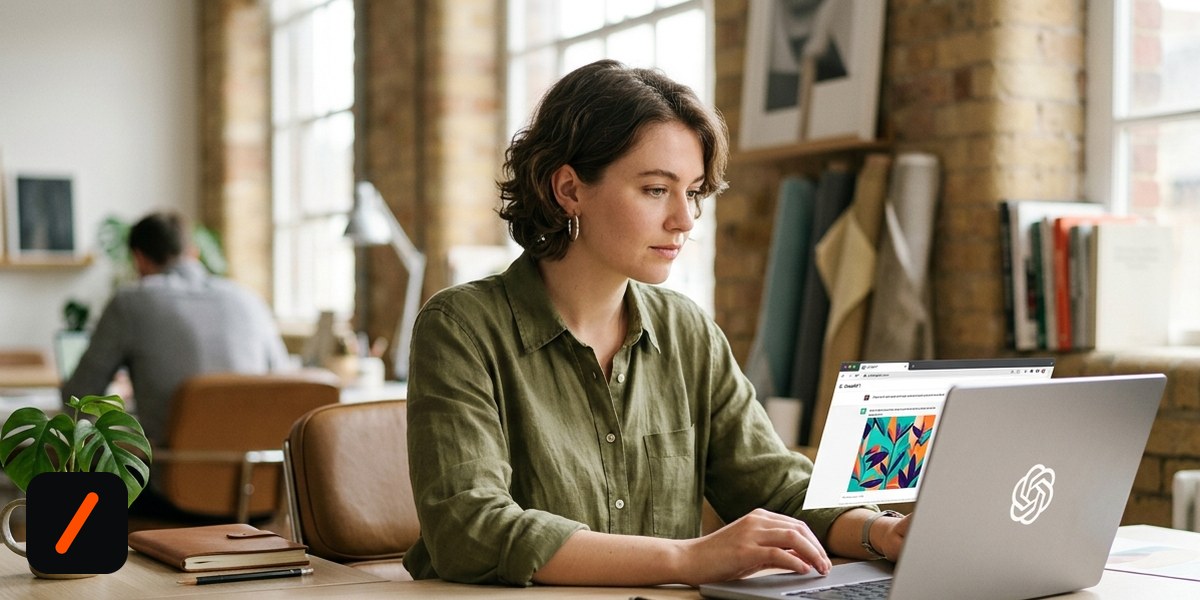
OpenAI shipped ChatGPT Images 2.5 this morning, cutting image generation latency in half versus the 2.0 model while adding sharper detail, more reliable multi-turn editing, and a new sketch-to-image tool. The update rolled out quietly to ChatGPT, ChatGPT Work, and Codex across desktop, mobile, and web, alongside two new API tiers for developers: GPT-Image-2.5 Flare for high-volume, low-latency generation, and GPT-Image-2.5 Sunburst for tighter creative control on production work. It is the kind of release that would barely register as news on its own. What makes it worth a second look is timing: Google's Nano Banana Pro has spent the last few months closing the photorealism gap that used to be OpenAI's clearest edge, and this is OpenAI's answer.
What actually changed in Images 2.5?
Three things, according to OpenAI's own announcement. Generation latency dropped by roughly 50% compared to Images 2.0, which matters more than it sounds: a two-second wait versus a four-second wait is the difference between a tool that feels conversational and one that feels like a batch job. Second, the model produces more natural lighting and richer textures, and does a noticeably better job preserving the actual subject in a reference photo instead of drifting toward a generic likeness after a couple of edits. Third, it follows multi-turn editing instructions more reliably, the "make the jacket blue, now add rain, now zoom out" kind of chained request that used to degrade fast after the second or third turn.
RelatedClaude Opus 5.5 Ships With Agent Benchmarks, Not SWE-bench
The new Sketch tool lets you draw a rough shape directly inside ChatGPT and use it as a compositional reference, which is a genuinely different interaction model from typing a paragraph of prompt and hoping the layout lands where you wanted it. OpenAI also added templates for common image formats and a prompt-sharing feature, so a workflow someone else built can be copied and reused rather than reverse-engineered from a finished image.
Why does Flare vs. Sunburst matter for developers?
The API split is the part most coverage is glossing over, and it is a real signal about how OpenAI expects the model to actually get used. Flare is the default: fast, cheaper per call, tuned for the volume use cases like social content, product listings, and generated marketing assets where a business is calling the API thousands of times a day and cannot afford Sunburst's slower, more careful pass. Sunburst trades speed for control, aimed at agencies and production teams doing campaign creative where a single image gets scrutinized by a client before it ships. Splitting a model family into a volume tier and a precision tier is the same move OpenAI made with its language models, and it tells you the image API has grown up enough to need the same segmentation.
| ChatGPT Images 2.5 | Google Nano Banana Pro | Midjourney | |
|---|---|---|---|
| Strongest at | Text rendering, conversational editing | Photorealism, controllable multi-image edits | Artistic composition, atmosphere |
| Editing across turns | Improved subject preservation | Strong character consistency | Limited, regenerate-heavy |
| Speed | ~50% faster than 2.0 | Fast, GPU-backed | Slower, queue-based |
| Best fit | Chat-native workflows, volume API | Production edits, 4K output | Concept art, mood boards |
Why is OpenAI pushing this out now?
Because the ground shifted under it. For most of 2026, ChatGPT's image tool won on raw output quality and lost on photorealism to Google's Nano Banana line, which built its reputation on believable skin tones, consistent characters across edits, and genuinely controllable multi-image composition. Reviewers who ran the two side by side kept landing on the same verdict: Midjourney for art, Nano Banana for production work, ChatGPT Images for the middle ground where speed and convenience matter more than pixel-level polish. A 50% latency cut plus better subject preservation is OpenAI closing exactly the gap reviewers kept naming, not a random feature bump.
RelatedOpenAI Ships gpt-realtime-2.1 With Lower Voice Latency
What does this mean for stock photography and creative tools?
The signal for the creative-software market keeps sharpening. Every time a foundation-model image tool gets faster and better at controlled editing, it eats a little more of the workflow that used to belong to stock photo libraries and template-based design tools. Getty Images and Shutterstock have already reoriented around licensing training data and selling their own AI generation add-ons rather than pretending the shift isn't happening, and Adobe has pushed Firefly hard into Photoshop and Express for the same reason: if a customer can describe an edit in plain English and get a usable result in two seconds, the reason to pay for a stock subscription or a manual retouching pass keeps shrinking. None of that is a reason to bet against Adobe, whose moat is the surrounding professional workflow, not raw generation quality. But a free-tier chatbot doing production-adjacent editing on a two-second latency budget is worth watching if you have exposure to the stock-content or template-marketplace side of the business.
- Google's response. Nano Banana Pro's photorealism lead was OpenAI's stated target here; expect a Google counter-release rather than silence.
- API adoption of Sunburst. If agencies actually pay the premium for the slower, higher-control tier, that validates the two-tier split as more than a pricing trick.
- Copyright and provenance fights. Faster, better subject-preserving edits make it easier to reproduce a real person's or brand's likeness convincingly, which keeps this squarely in regulators' and rights-holders' sights.
Our take
This is a competent, unglamorous release, and that is exactly why it matters. OpenAI isn't claiming a generational leap; it is closing a specific, publicly documented gap (photorealism and editing reliability) against a specific rival (Google) on a specific metric (latency) that reviewers had already called out. That is a company responding to a scoreboard it doesn't currently top, not one setting the pace. The Flare/Sunburst split is the more interesting long-term signal: treating image generation as a product with distinct speed and control tiers, the way OpenAI already treats its language models, suggests the company expects image APIs to become as embedded in ordinary software as text completion already is. Watch Google's next move more than OpenAI's next feature list.
- OfficialOpenAI, "Introducing ChatGPT Images 2.5" official announcement: latency, feature list, API model tiers
- Analysis9to5Mac, "OpenAI releases ChatGPT Images 2.5 with 'sharper details' and 'more precise editing'" breakdown of Flare vs. Sunburst API tiers and rollout scope
- ComparisonXDA Developers, ChatGPT Images 2.0 vs. Gemini Nano Banana comparison context on the photorealism gap this release targets
Original analysis by GenZTech Team. Source: OpenAI.