
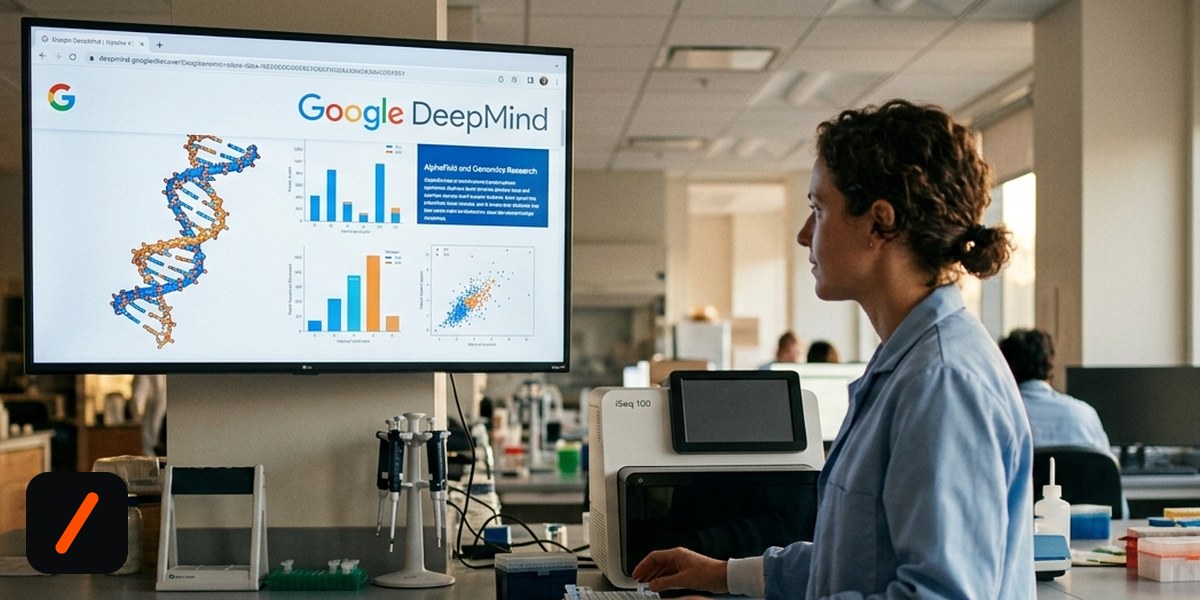
Google DeepMind switched on AlphaGenome Atlas earlier today, and it already has an answer for every possible single-letter mutation across the human genome, all 9 billion of them, sitting precomputed and searchable before a single researcher types a query. It's the lab's biggest genomics release since AlphaFold, and this time the target isn't protein shape. It's the 98% of your DNA that doesn't code for proteins at all.
- AlphaGenome Atlas covers all 9 billion possible single-nucleotide variants across the genome's roughly 3 billion base pairs, packaged as a dataset DeepMind puts at about 1 petabyte, more than 30 times the size of the AlphaFold Database.
- Every variant gets a single AlphaGenome Variant Impact (AVI) score that rolls up 11 separate prediction categories, gene expression, chromatin accessibility, splicing, and more, into one number researchers can sort and filter by.
- Access is free for non-commercial research through a no-code web portal, with an API and a skill inside Google Antigravity, DeepMind's agentic coding platform, for anyone who wants to query it programmatically.
- Outside genomicist Carl de Boer, who wasn't involved in the work, called the underlying model "the field's leading model" but warned the impact score "could be easily misinterpreted" and that running it from scratch stays "very slow and computationally intensive," which is exactly the gap Atlas exists to close.
What actually shipped today?
Atlas isn't a new AI model. It's the output of an old one, run exhaustively. AlphaGenome itself, the sequence-to-function model that reads up to a million base pairs of DNA and predicts how that stretch behaves, launched back in June 2025 and got its formal peer-reviewed writeup in Nature this past January. Until today, using it meant picking a variant, running it through the model, and waiting. DeepMind's team instead ran AlphaGenome against every single possible substitution at every position in the reference genome, three possible letter swaps per base pair times roughly 3 billion base pairs, and banked the results. What launched this morning is that finished lookup table: type in a genomic coordinate, get back the model's prediction instantly, no GPU queue required.
RelatedGoogle Pulls Earth's AI Image Tool One Day After Launch
How does the AVI score work, and why collapse everything into one number?
Raw AlphaGenome output is not simple. For a given variant, the model looks at roughly a million base pairs of surrounding sequence, compares the reference version against the mutated one, and predicts thousands of downstream effects across 11 categories: gene expression levels, DNA accessibility, histone modification patterns, transcription factor binding, splicing outcomes, and how the genome physically folds in three dimensions, among others. Almost none of that is useful to skim by eye. The AlphaGenome Variant Impact score exists to solve that specific problem: it's a single number that summarizes how disruptive a given change looks across all of it, so a researcher scanning thousands of candidate variants for a rare-disease patient can sort by AVI and focus attention where the model is most confident something is wrong, rather than opening 11 separate charts per variant.
How did DeepMind actually pull off 9 billion predictions?
Running a transformer-scale model against every position in the human genome, one variant at a time, was never going to finish in a reasonable window on the compute DeepMind had budgeted. Genomics lead Žiga Avsec said the team calculated it needed roughly an 80-fold speedup over naive execution to make the project land, and got there through model distillation, hand-tuned GPU kernels, and stripping out redundant calculations that don't change between overlapping variants. "There was a lot of thought and engineering that we had to do to make this happen at this scale," Avsec said. VP of Science Pushmeet Kohli framed the bigger ambition behind it more simply: "Understanding this language of life can unlock so many things."
| Resource | What it predicts | Scale | Launched |
|---|---|---|---|
| AlphaGenome Atlas | Regulatory / non-coding DNA effects, whole genome | 9 billion variants, ~1 petabyte | Sep 8, 2026 |
| AlphaMissense | Pathogenicity of protein-coding mutations | 71 million variants | 2023 |
| AlphaFold Database | 3D protein structure from amino acid sequence | Over 200 million structures | 2021, expanded with EMBL-EBI |
Who benefits, and what can't it do yet?
The clearest early use case is rare disease research, where clinicians already sequence a patient's genome but have no fast way to know which of thousands of unusual variants actually matters. DeepMind's own examples lean on a UK Biobank study of more than 54,000 participants, where applying AlphaGenome-style analysis surfaced a 22% increase in detected non-coding genetic associations and identified 19 distinct genomic regions linked to body mass index. That's the pitch in miniature: most disease-relevant variation sits outside the roughly 2% of the genome that codes for proteins, in regulatory regions that control when and how much a gene turns on, and this atlas is built specifically to search that space.
It has real limits, and DeepMind isn't hiding them. The model examines a fixed million-base-pair window around each variant, so an enhancer that regulates a gene from further away simply falls outside its field of view. It also doesn't attempt to model diseases driven by combinations of variants interacting with each other, which describes most common conditions, not the rare monogenic ones it's best suited for. De Boer's caution about the AVI score being "easily misinterpreted" is worth taking seriously too: a single number is convenient exactly because it hides the complexity underneath, and a high or low score is a lead worth investigating in the lab, not a diagnosis on its own.
RelatedGemini Robotics 2 gives humanoids whole-body control
- 2021AlphaFold Database launches with EMBL-EBI predicted structures for ~350,000 proteins, later expanded past 200 million
- 2023AlphaMissense ships pathogenicity scores for 71 million protein-coding variants
- Jun 25, 2025AlphaGenome model launches sequence-to-function predictions across 1M base pairs of context
- Jan 2026AlphaGenome paper published in Nature peer review of the underlying model
- Sep 8, 2026AlphaGenome Atlas launches 9 billion variants precomputed, free portal + API + Antigravity skill
Does this move anything beyond the biology lab?
There's no ticker symbol that swings directly on a research tool release, but the strategic read is worth noting anyway. DeepMind keeps stacking free, widely-used scientific infrastructure, AlphaFold for structural biology, now AlphaGenome Atlas for regulatory genomics, the same way it once released research papers: as a way to seed the field with tools built on Google's own compute and models. It's also a quiet complement to Alphabet's other health bets, Isomorphic Labs on drug discovery and Verily on health data, all of which benefit from a faster, cheaper way to triage which genetic variants are worth chasing. None of that shows up in a quarterly earnings line, but it's the kind of platform positioning that compounds over years, not quarters.
- Independent validation of the AVI score. DeepMind's own benchmarks look strong; the real test is whether outside labs confirm high-AVI variants actually turn out pathogenic at the bench, not just in silico.
- Commercial licensing terms. The free tier is capped at non-commercial research. Whether pharma and biotech get reasonable paid access, or get priced out, will decide how far this actually reaches into drug development.
- Whether rare-disease diagnostic rates actually move. The UK Biobank numbers are promising on a research cohort; the harder test is clinical sequencing pipelines finding answers for patients who currently get none.
Our take
This is a genuinely useful release, and it's easy to undersell it by only counting it as "another DeepMind demo." Turning a slow, expensive model into an instant lookup table is unglamorous engineering, but it's the difference between a research paper and a tool a working geneticist actually opens on a Tuesday. The caution from outside researchers like de Boer is the right instinct to hold alongside the excitement, not instead of it: a single impact score is a triage tool, and triage tools are only as good as what happens after someone acts on them. The next twelve months will show whether the wet lab actually confirms what the model predicts at genome scale, or whether Atlas becomes another impressive index that mostly gets cited rather than used.
- OfficialGoogle: "AlphaGenome Atlas: a high-resolution map of human DNA" blog.google, Sep 8, 2026
- OfficialGoogle DeepMind: AlphaGenome Atlas announcement deepmind.google, Sep 8, 2026
- ReferenceIEEE Spectrum: "AlphaGenome Atlas Maps 9 Billion Possible DNA Variants" independent reporting, expert reaction from Carl de Boer
- ReferenceGoogle DeepMind: original AlphaGenome model announcement deepmind.google, Jun 25, 2025
This analysis draws on DeepMind's own writeup plus independent reporting and outside expert reaction. Primary source: Google DeepMind.