
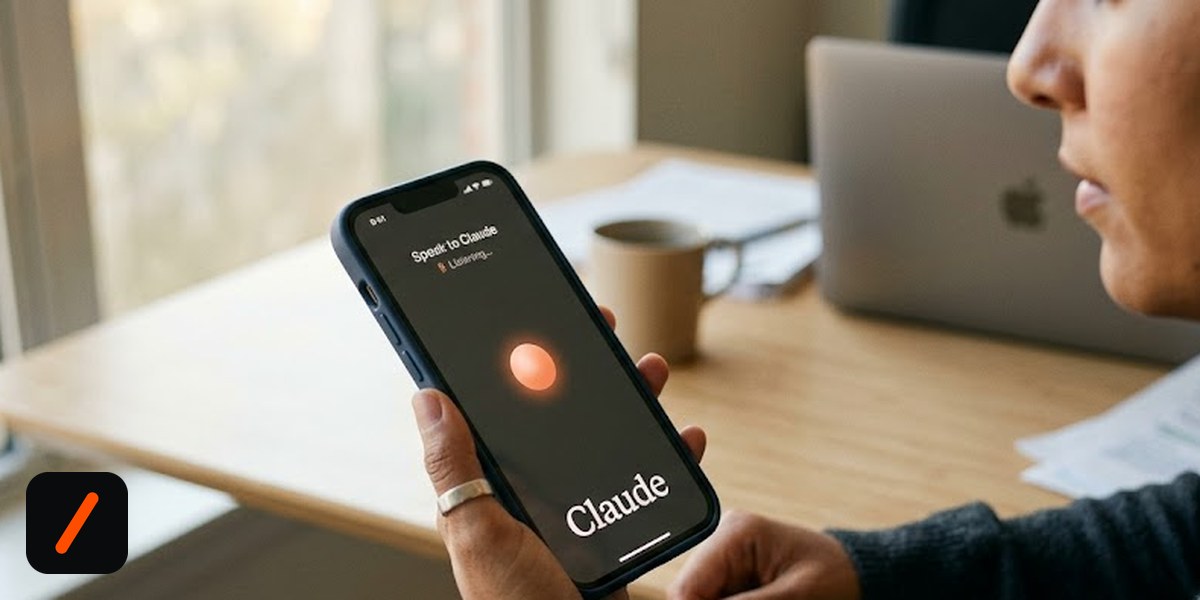
Anthropic has rebuilt Claude's voice mode so that spoken conversations can now run on its most capable models, Opus and Sonnet, instead of being locked to the lightweight Haiku model. The update, announced hours ago on July 23, also plugs voice mode into external apps like Gmail, Google Calendar, Slack, Canva, and Notion, turning a talk-to-your-assistant feature into something that can actually reschedule a meeting or draft a document by voice. The catch: the full experience is a paid perk, while free users stay on Haiku with a single connected app.
- What changed: voice mode now offers three model tiers, Opus, Sonnet, and Haiku, where every voice session previously ran on Haiku no matter what the on-screen selector showed.
- New reach: voice can now trigger actions in Gmail, Google Calendar, Slack, Canva, and Notion, so you can reschedule a meeting or draft an email hands-free.
- The tiering: free accounts are capped at Haiku plus one connected app; paid accounts get all three models and multiple integrations.
- What did not change: Anthropic did not upgrade the underlying speech model itself, so there is no new interruption handling or lower latency, only smarter models behind the same voice.
What exactly did Anthropic change?
Until this update, Claude's voice mode ran on one model: Haiku 4.5, the fast, cheap tier built for snappy conversational replies. A model selector already existed inside the voice interface, but the choice was effectively cosmetic. Whether you picked Opus, Sonnet, or Haiku, the session still ran on Haiku underneath. As of July 23, that selector does what it says. Voice mode now genuinely routes conversations through Opus or Sonnet when you choose them, and by default it uses the fastest version of whatever text model you last used. On top of the model change, Anthropic connected voice mode to a set of external apps, Gmail, Google Calendar, Slack, Canva, and Notion, so a spoken instruction can now reschedule a meeting, draft an email, or spin up a Notion doc rather than just talk back to you.
RelatedClaude Suffers Multi-Model Errors Across API and Claude.ai
Why does routing to Opus and Sonnet actually matter?
The difference between Haiku and Opus is not cosmetic in practice. Haiku is tuned for latency and cost, which makes it excellent at quick back-and-forth but weak at multi-step reasoning, nuance, and longer tasks. Opus is Anthropic's flagship reasoning model. Locking voice mode to Haiku meant the feature was fine for setting a timer or answering a trivia question but frustrating the moment you asked it to reason through something real. By letting the heavier models answer, Anthropic turns voice from a novelty into a plausible interface for actual work: talking through a plan, drafting substantive text, or reasoning about a problem while your hands are busy. The trade-off is speed, since bigger models respond slower, which is exactly why the selector, not a forced default, is the right design.
How do the voice tiers compare now?
| Capability | After this update | Before |
|---|---|---|
| Models in voice | Haiku, Sonnet, Opus | Haiku only |
| Selector behavior | Actually routes to chosen model | Cosmetic, fell back to Haiku |
| Connected apps | Gmail, Calendar, Slack, Canva, Notion | None in voice |
| Free tier | Haiku plus one app | Haiku, no apps |
| Paid tier | All models, multiple apps | Haiku only |
| Underlying voice model | Unchanged | Same base voice |
What is the free versus paid split?
The upgrade is deliberately gated. Free Claude users keep voice mode, but they stay on the Haiku model and are limited to one connected app. Paid subscribers get the full menu: all three models and multiple app integrations at once. That split tells you how Anthropic sees voice, not as a broad consumer hook but as a productivity feature for the users already paying for Claude. It also fits the wider pattern in the assistant market, where the genuinely useful, action-taking capabilities increasingly sit behind subscriptions while the free tier stays a capable but capped demo. Voice mode remains in beta across all platforms, so both tiers should expect rough edges.
How does this stack up against OpenAI and Google?
Voice is one of the most visibly contested surfaces in the assistant race. OpenAI's Advanced Voice Mode has leaned hard into natural, low-latency conversation with real-time interruption, and Google has pushed Gemini Live in a similar direction. Anthropic is taking a different angle. It is not, in this update, competing on how humanlike the voice sounds or how smoothly it handles interruptions, since it explicitly did not touch the underlying speech model. Instead it is competing on what the voice can think and do: heavier models for reasoning, and hooks into the apps where work actually happens. That is a coherent bet for a company whose brand is capability and safety rather than consumer polish, but it also means Claude's voice can still feel less conversationally fluid than rivals even as it becomes more useful.
RelatedAnthropic watermarks every Claude output, worldwide
What it means for the market
Anthropic is privately held, so there is no ticker to trade on this directly, but the signal for investors watching the AI platform race is about strategy, not a single feature. The read is that Anthropic is monetizing depth over reach: it is putting its most expensive models and its app-integration surface behind the paid tier rather than chasing free-user scale the way a consumer-first rival might. The most exposed public names are the incumbents whose assistants Claude is nudging against. Alphabet, ticker GOOGL, with Gemini Live, and Microsoft, ticker MSFT, which distributes OpenAI's models through Copilot, both compete for the same "assistant that acts inside your apps" territory that Claude just stepped further into. The thing to watch is whether voice-plus-app-actions becomes a genuine switching reason for paying users or stays a checkbox feature. This is analysis, not investment advice.
Our take
The most telling detail here is the admission baked into the fix. For a stretch, Claude's voice selector let you pick Opus or Sonnet and quietly served Haiku anyway, which is the kind of gap between interface and reality that erodes trust in an assistant. Closing it is the right move, and pairing it with real app actions is what turns voice from a demo into a tool. But the update also draws the honest boundary of Anthropic's approach: it improved the brain, not the voice. Until the underlying speech experience gets the same attention, Claude will be the assistant you reach for when you need it to think, not the one that feels most natural to talk to. That is a defensible position, and arguably the right one for Anthropic, but it leaves the conversational-fluency crown with its rivals for now.
- Speech-model upgrade. Whether Anthropic follows this with lower latency and real interruption handling, the piece it deliberately left untouched.
- App list growth. Which integrations arrive next, and whether the free tier's one-app cap loosens.
- Voice out of beta. When the feature graduates from beta across platforms, a signal Anthropic trusts the routing at scale.
- Reasoning in voice. Whether users actually adopt Opus-in-voice for real work or default back to Haiku for speed.
- ReportTechCrunch: Anthropic updates Claude voice mode with more capable models the model tiers, app integrations, and free-versus-paid split
- OfficialAnthropic news and release notes primary source for Claude feature announcements
- ReferenceGenZTech: AI coding model leaderboard how Opus and Sonnet rank on independent benchmarks
Original analysis by GenZTech. Primary reporting via TechCrunch.