
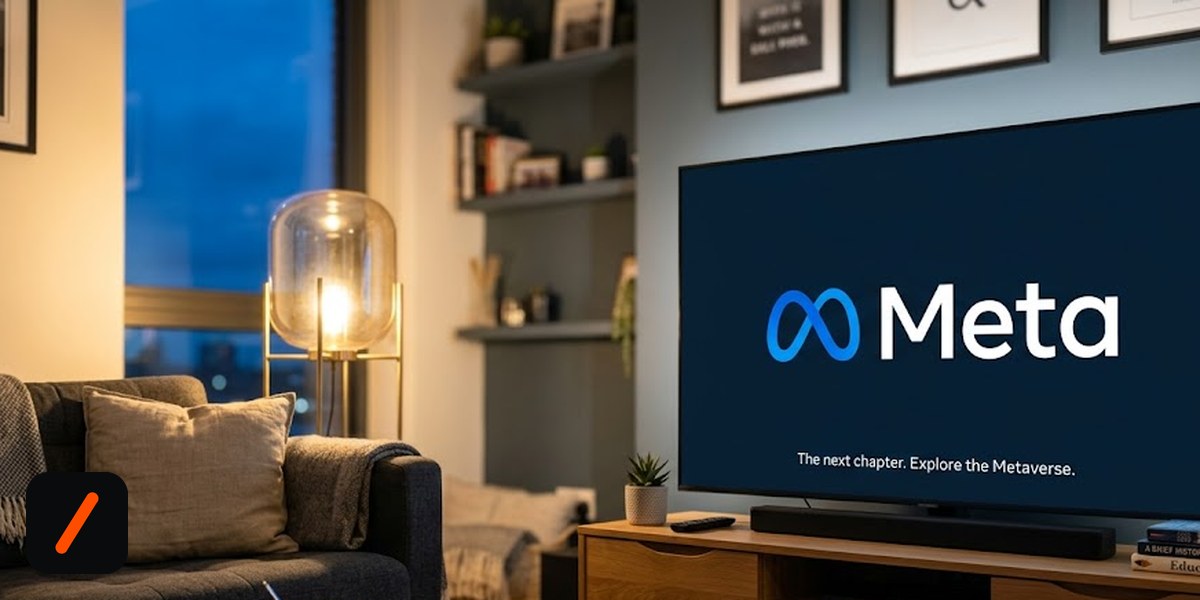
Meta launched a paid and earned media campaign on Thursday, July 23, 2026, built around an aggressively optimistic vision of AI, and set the flagship spot to David Bowie's "Five Years," a song whose entire premise is that the Earth is dying and humanity has five years left. The ad opens in black and white on panicked AI headlines, cuts to color for couples dancing on rooftops and children playing, and a voiceover answers the fear with "We couldn't disagree more." The soundtrack answers back, and it is not on message.
- Meta went on the offensive today. Mark Zuckerberg posted a manifesto framing AI as a continuation of Meta's connect-the-world mission, explicitly countering rivals who lead with job displacement and security risk.
- The song is the problem. "Five Years" opens Bowie's 1972 album The Rise and Fall of Ziggy Stardust and the Spiders from Mars. Its narrator hears a newsreader announce the planet has five years to live. It is an extinction ballad, not an anthem.
- This is a defense of a $125 billion to $145 billion bet. Meta's 2026 capital expenditure guidance sits in that range. Brand campaigns of this size do not run because sentiment is fine.
- The campaign is narrative infrastructure, not product marketing. No feature is being sold. Meta is buying permission to keep spending.
What exactly did Meta launch?
The campaign is a combined paid and earned media push, meaning bought placements plus a coordinated founder post engineered to be quoted. Zuckerberg's text does the ideological work: "Meta has always believed in giving people the power to share, connect and shape your world in the ways you want," followed by "As we enter this next wave with AI, we continue to believe the future is for everyone." He reaches back to Facebook's origin story, noting the company bet on people when it connected them to those they had lost touch with.
RelatedSpaceX will run xAI's unpermitted turbines until July 2027
The strategic target is not a competitor's product. It is a competitor's mood. Meta is positioning against the industry's prevailing public register, in which lab leaders warn about labor disruption and catastrophic misuse while shipping the systems that cause it. Meta's counter-position is that AI should be cheap, ad-supported, broadly distributed, and not something you need to be afraid of. That is a real strategic differentiator, and it maps cleanly onto Meta's actual business model, which has always been access-for-attention rather than subscription.
Why does the song choice matter this much?
Because music supervision is not an accident. A campaign at this budget clears a master recording and a publishing license, which means multiple people at Meta and at least one agency read the title, listened to the track, and signed a check for it. "Five Years" is the opening song of a concept album about the last days before the end of the world. The narrator is describing a broadcast telling everyone the planet is finished. Picking it to score a message of AI optimism is a failure of literacy, not a failure of taste.
The deeper issue is that the mistake is thematically perfect. Meta's argument is that fear of AI is overblown, and the argument arrives wearing a soundtrack about a species being told it has five years. Every critic who wanted a shorthand for "these companies do not understand the culture they are automating" now has a free one. That is the actual cost here, and it is not small: the campaign was built to shift sentiment, and its most shareable artifact is now the gaffe.
How does this compare to how other labs talk?
| Positioning | Meta | OpenAI | Anthropic | |
|---|---|---|---|---|
| Public register | Optimism, mission continuity | Inevitability with acknowledged disruption | Safety-forward, risk named first | Utility and integration |
| Consumer hook | Free, ad-supported, for everyone | Subscription assistant | Enterprise and developer trust | Already inside your apps |
| Who it addresses | The general public | Prosumers and developers | Buyers and regulators | Existing users |
| What it defends | Capex and the ad model | Compute commitments | Premium pricing | Distribution advantage |
Read that table and Meta's choice looks less strange. It is the only major lab whose product is free at the point of use, so it is the only one that gains by making AI a populist good rather than a professional tool. The optimism is genuinely load-bearing for the business model. The execution is what broke.
How did Meta get here?
- Jul 2, 2026Zuckerberg tells a company town hall that AI agent development "hasn't really accelerated in the way that we expected" over the previous four months internal expectations reset
- Jul 7 to 9, 2026Meta ships Muse Image and Muse Spark 1.1, undercutting rival API pricing by roughly 25% volume strategy, not margin
- Jul 10, 2026Meta stock rises 6% in a day and 15% on the week, its strongest week since early 2024 investors bought the pivot
- Jul 23, 2026The AI optimism campaign launches with the Zuckerberg manifesto post today
- Q3 2026Capex guidance of $125B to $145B meets the next earnings call the real test
What does it mean for the market?
The signal for investors is that Meta believes public sentiment is now a material risk to its spending plan. A company guiding to $125 billion to $145 billion of 2026 capital expenditure does not buy a brand campaign about feelings unless it expects to be asked to justify that number by regulators, advertisers, or its own shareholders. Zuckerberg told staff on July 2 that agent progress had not accelerated as expected while projecting meaningful returns in three to six months. That gap, slower technical progress paired with an accelerating narrative push, is the thing to watch on META rather than the ad itself.
RelatedCognition's SWE-2 Nearly Matches GPT-6 Astra for a Quarter the Price
The counterweight is that the market has already rewarded the strategy once: the stock's 6% single-day move on July 10 and its best week since early 2024 came off product shipping and aggressive API pricing, not messaging. If the next earnings call pairs the capex range with concrete Muse revenue, the campaign will read as confidence. If it pairs the capex range with another "three to six months," it will read as pre-emptive defense. This is analysis, not investment advice.
- Whether the cue survives the week. The cheapest fix is a re-score. If the spot quietly gets new music, Meta has conceded the point without saying so.
- Whether the Bowie estate comments. Licensed use is legal use, but estates have opinions about context, and a public objection would extend the story by days.
- Whether rivals answer. Meta named the industry's fear framing as the opponent. A counter-campaign from a subscription-funded lab is now cheap to make and easy to aim.
- The Q3 capex language. If the $125B to $145B range moves, the optimism campaign was the leading indicator.
Our take
The gaffe is funny, and the strategy underneath it is serious. Meta is the only company at this scale whose AI business genuinely improves if AI becomes ordinary, free, and unremarkable, and it is correct that no one else is making that argument in public. Running the argument as brand advertising rather than product marketing is the right call, because the thing Meta needs is not more Muse signups this quarter, it is permission to keep spending nine figures a week without a political backlash forming around it.
What the Bowie choice exposes is that the campaign was built by people optimizing for tone rather than meaning. The visuals were researched. The words were lawyered. The song was picked because it sounds hopeful in the first thirty seconds, and nobody asked what it was about. That is a small error, and it is also a precise miniature of the criticism Meta is trying to answer: a machine that matches surfaces without understanding them, shipped at enormous scale, by a company confident it has read the room.
- OfficialMeta Newsroom company announcements and campaign materials
- ReportTechCrunch, on the ad and its soundtrack first to flag the song choice
- ReportAxios, on the campaign launch confirms date and framing
- Reference"Five Years" (1972) release, album and subject matter
Original analysis by GenZTech. Reporting on the ad first surfaced via TechCrunch.