
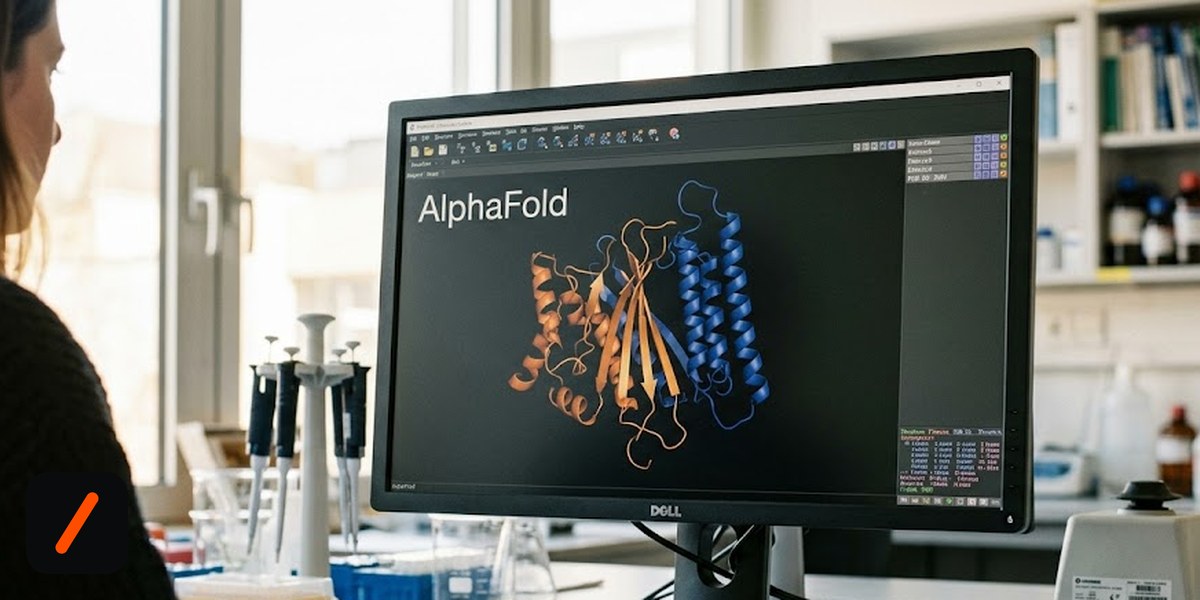
Google DeepMind has broken up the team that built AlphaFold, the protein-structure system that won its leads a share of the 2024 Nobel Prize in Chemistry. The Financial Times reported the reorganisation this morning: most authors of the original AlphaFold papers have been reassigned over the past year, and close to a quarter of the remaining core full-time authors have left Google altogether. What has not happened, despite a wave of "Google shuts down AlphaFold" headlines, is AlphaFold going away.
We checked that ourselves before writing this. As of today the AlphaFold Protein Structure Database hosted at EMBL-EBI responds normally and still serves version-6 predictions. Neither DeepMind AlphaFold repository is archived. And AlphaFold 3 shipped a tagged release, v3.0.4, on 28 July 2026, one day before the dispersal story broke, carrying a commit that adds Apple Silicon GPU support. A team can be dissolved while its software keeps shipping. That is the situation here, and the distinction matters for anyone whose lab depends on this stuff.
RelatedGemini 3.8 Flash Model Card Leaks Ahead of Google Launch
What actually happened inside DeepMind?
The change is organisational, and it is bigger than one team. Research VP Pushmeet Kohli, himself a co-author on the AlphaFold 3 paper, confirmed to the FT that the strategy has evolved away from the approach DeepMind ran for roughly nine years: pick one enormous scientific problem, point a dedicated team at it, and stay until it breaks. Kohli described the new direction as building Gemini-powered systems that assist scientists and ultimately automate parts of the research process itself.
Staff went in several directions at once, which is why the story reads differently depending on which outlet you catch it from. Researchers who stayed were folded into Gemini-based assistant work or pointed at newer targets including enzyme design, nuclear fusion, and genomics. Another group moved to Isomorphic Labs, the Alphabet drug-discovery subsidiary. Some simply left.
The departures are the part that stings. John Jumper, who shared the 2024 chemistry Nobel with Demis Hassabis for AlphaFold and with David Baker for protein design, joined Anthropic last month after nearly nine years at DeepMind. AlphaFold contributors Jonas Adler and Alexander Pritzel went with him. Earlier this year Jumper had already been moved onto a team working on code, which in hindsight looks like the first visible sign of the reshuffle.
Is AlphaFold itself being shut down?
No, and the checks that establish this take about a minute to run. Here is what we found on 29 July 2026:
- The database is live. alphafold.ebi.ac.uk returns HTTP 200, and its prediction API still serves models at latest version 6 for the UniProt entries we sampled.
- Both code repositories are open and unarchived. google-deepmind/alphafold last saw a push on 22 April 2026; google-deepmind/alphafold3 has commits through 28 July 2026.
- AlphaFold 3 is still on a release cadence. v3.0.2 landed 20 April, v3.0.3 on 9 June, v3.0.4 on 28 July 2026.
- The database is not Google's to switch off alone. EMBL-EBI hosts and operates it under a partnership, a very different dependency from a Google-run product page.
That last point is the one most coverage skips, and it is the structural reason a DeepMind reorg does not produce an outage. The database launched in July 2021 with roughly 360,000 predictions and grew past 200 million structures spanning over a million organisms. It lives at EMBL-EBI, the European public bioinformatics infrastructure, and has served more than three million researchers across 190-plus countries. Infrastructure of that shape does not evaporate because a corporate research group was reassigned.
| AlphaFold asset | Before this week | Verified 29 Jul 2026 |
|---|---|---|
| Core research team | Dedicated unit at DeepMind | Dispersed, some departed |
| AlphaFold 2 code | Apache 2.0, public | Public, not archived |
| AlphaFold 3 code | Apache 2.0, gated weights | v3.0.4 shipped 28 Jul |
| Structure database | EMBL-EBI hosted, free | Live, serving v6 models |
| Grand-challenge strategy | One problem, one team | Replaced by Gemini agents |
Why break up a Nobel-winning team?
Because the bet that produced AlphaFold and the bet DeepMind is making now are different bets, and the second one does not need the first one's org chart. AlphaFold came out of a nine-year commitment to a single hard target, staffed by specialists who understood protein biology as well as machine learning. The Gemini-agent thesis says the leverage has moved: instead of a standing team of domain experts per problem, build a general system that helps scientists across many problems.
If you believe that, a permanent protein-structure department looks like a cost rather than an asset, and those specialists are worth more spread across enzyme design, fusion, and genomics than concentrated on a problem the field largely considers solved. Isomorphic Labs is also the Alphabet entity meant to turn structure prediction into drugs, so moving that work there puts it where the revenue is supposed to come from.
What does this mean for labs and builders?
Short term, nothing breaks. Keep using the database, keep citing the papers, keep running the code. If your pipeline hits alphafold.ebi.ac.uk, your dependency is on EMBL-EBI, not on a DeepMind team roster.
RelatedQwen3.8-27B ships open weights, scoreboard attached
Longer term, watch maintenance rather than announcements. The realistic failure mode is not a shutdown notice, it is drift: a repository that stops getting commits, dependencies that rot, a model that never gets a successor. One caveat worth knowing: AlphaFold 3's code is Apache 2.0, but its weights are not freely redistributable and must be obtained from Google under separate terms. A community fork can carry the code forward. It cannot legally carry those parameters, which is the real single point of dependency if AlphaFold 3 is load-bearing for you.
- 2018AlphaFold project begins at DeepMind First CASP showing
- 2020CASP14 result treated as solving the problem
- Jul 2021Nature papers plus database launch ~360k predictions, with EMBL-EBI
- 2024Nobel Prize in Chemistry to Hassabis, Jumper, Baker
- Jun 2026Jumper, Adler and Pritzel leave for Anthropic
- 28 Jul 2026AlphaFold 3 v3.0.4 released Apple Silicon GPU support
- 29 Jul 2026FT reports the team has been dismantled
- NextWhether v3.0.5 ships, and who signs the commits
What it means for the market
For Alphabet the signal is consolidation, not retreat: science headcount is routing toward Gemini and toward Isomorphic Labs, where structure prediction has a path to drug revenue rather than citations. Anyone watching GOOGL should read this as the capital-allocation logic already visible in Google's products now reaching its research arm, with Isomorphic's pipeline milestones as the place that spend is meant to surface. For Anthropic, hiring a chemistry Nobel laureate plus two AlphaFold 3 co-authors is a credible move into scientific reasoning, a segment where it has not been a serious player. This is analysis rather than investment advice, and the number to track is whether Isomorphic ships clinical progress fast enough to justify absorbing the team.
- Commit velocity on both repos. Releases through v3.0.4 prove the code is alive today. A quiet quarter after this reorg would say more than any statement.
- Who maintains AlphaFold 3. With Adler and Pritzel at Anthropic, watch whether commits carry a named owner or trail into unattributed housekeeping.
- The EMBL-EBI partnership. The database is the community's real dependency. Any change to that agreement matters more than the org chart.
- Isomorphic Labs milestones. Alphabet has placed its commercial protein bet here, so clinical progress is the payoff test.
Our take
The reorganisation is real and significant, and the framing going around today is wrong in a way that matters. "Google shuts down AlphaFold" tells a researcher their database might disappear. What actually happened is that Google stopped funding a standing team for a problem it considers finished, while the artifacts stay up, open, and in the case of AlphaFold 3, shipping releases as recently as yesterday.
The genuinely worrying detail is not the reorg. It is that the model DeepMind is moving away from, small teams on hard problems for years, is the one that produced its most celebrated result. Betting that a general agent gets you the next AlphaFold is unproven, and the people who did it the old way are now split between an Alphabet subsidiary and a rival lab. In two years we will know whether this was portfolio management or the moment DeepMind traded a proven method for a fashionable one.
- ReportingFinancial Times: DeepMind dismantles AlphaFold team , the original scoop, includes the Kohli comments
- ReferenceAlphaFold Protein Structure Database (EMBL-EBI) , verified live 29 Jul 2026, serving v6 models
- Codegoogle-deepmind/alphafold3 releases , v3.0.4 tagged 28 Jul 2026
- OfficialGoogle DeepMind: AlphaFold , project page and model history
- ReferenceEMBL on the 2024 Nobel Prize in Chemistry , Hassabis, Jumper and Baker
Original analysis by GenZTech. Database status, repository state and release dates independently verified on 29 July 2026. Reorganisation details as reported by the Financial Times.